The Torque Tool That's No Longer Typed In
The torque-controlled tool that tightens safety fastening points has an API but is isolated from the MES: the operator manually selects the torque program for each variant. With iLEAN, the correct program is selected automatically based on the active VIN, and the OK/NOK result is traced with no manual typing.
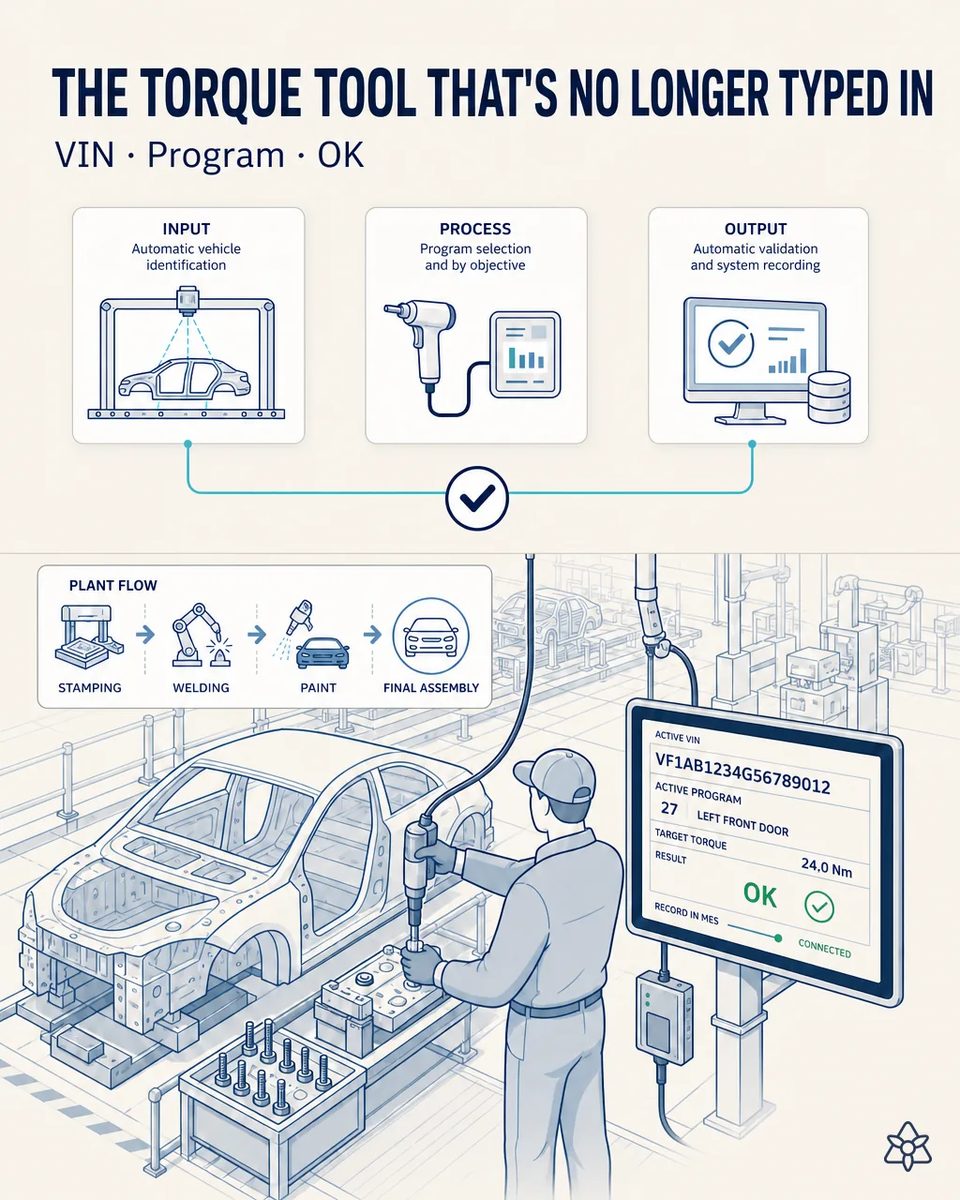
The last barrier before the customer depends on a manual selection.
Safety fastening points are the last barrier before the customer. Any manually-selected torque program error becomes a safety risk. Manual selection remains the standard method because integrating the torque tool with the MES 'takes engineering time' that never gets prioritized.
- Safety fastening points — suspension, brake lines, steering column, subframe — are the last barrier before the vehicle reaches a customer.
- The torque tool has an API, but it is not connected to the MES. The operator picks the torque program for each variant by hand, at takt, on every unit.
- On a mixed-model line that is one more decision per station and per VIN, and a wrong program on a safety joint is a safety risk, not a cosmetic defect.
- The integration that would solve it keeps losing to other engineering priorities, so manual selection remains the standard method.
Connect stitches the torque tool to the MES — driven by the VIN at the station.
Connect stitches the torque tool and the MES via API: when the MES flags which VIN enters the station, it automatically publishes the correct torque program; the OK/NOK result returns to the MES tied to that VIN, with no manual typing.
When the MES says which VIN enters the station, Connect publishes the right program to the tool. When the tool finishes, the OK/NOK result and the tightening go back to the MES under that VIN. The operator stops choosing and keeps tightening. On a mixed-model line, that removes one decision per unit at every connected station, and with it the most dangerous kind of error the station can make.
Torque programs picked by hand versus picked by the active VIN
| Aspect | Today | With iLEAN Connect |
|---|---|---|
| Torque program per variant | Selected by the operator | Loaded from the active VIN |
| Wrong program on a safety joint | Possible on every unit | Removed as a manual step |
| OK/NOK result | Lives in the tool's controller | Written to the MES under the VIN |
| NOK on a safety point | Handled at the station by the operator | Raised through andon with the VIN |
| Evidence for a field investigation | Searched across controllers | One query per VIN |
| Engineering effort | A project that never gets prioritized | API to API, no tool replacement |
Manual program selection with human-error risk → automatic selection with no manual typing, complete per-VIN torque traceability.
Impact estimate — to be validated with your numbers.
The block below is an estimate to be validated against your plant's actual data. We put it forward so the committee has an order of magnitude; we refine it during the assessment.
- Fast payback, estimated at 3-6 months.
- A drastic reduction in the risk of a safety non-conformance caused by a wrong program on a critical joint.
- Complete per-VIN torque traceability, without a single value typed by hand.
- And when a field question comes in about a specific vehicle, the answer is a query, not a search across tool controllers.
Fast payback, 3-6 months, drastic reduction in safety non-conformance risk. *Figure to be validated*. (Payback 3-6 months · reduces safety-recall risk)
And the fair question from the production manager
“What if the MES publishes the wrong VIN and the tool loads the wrong program?” — matching a VIN to its variant's torque program is an anchored lookup against your own bill of process, where even the best models drop below 1.5% error [1], and here it is mostly deterministic. The second net is the tool itself: it confirms which program is loaded before the first rundown, and a mismatch between VIN and program stops the station instead of tightening, with the reason shown to the operator.
[1] OpenAI paper "Why Language Models Hallucinate", 2025 — on the reliability of AI in anchored tasks.
What people ask about connecting the torque tool to the MES by VIN
Do we need to replace the DC torque tools?
No. If the tool's controller has an API, Connect talks to it as it is. The tools, the controllers and the MES all stay, and the station keeps its current tightening strategy.
Which fastening points should be connected first?
The safety-critical ones: suspension, braking, steering and subframe joints. That is where a manual program error stops being a quality issue and becomes a safety one. Other joints can follow once the pattern is proven on the first stations.
What reaches the MES after each rundown?
The OK/NOK result, the final torque and angle and the program used, all under the VIN that was at the station. Retries are kept too, because three attempts on the same joint tell a story that a final OK hides.
What happens on a NOK result at a safety joint?
The NOK is written to the MES against the VIN and raised through andon, so the unit cannot leave the zone with an open safety joint unnoticed.
Can one station handle several variants in the same shift?
Yes, that is the point. The program changes with each VIN in the sequence, without the operator touching the selector. A new variant only needs its program mapped once in the bill of process.
More cases from this series
- The Color Change Won't Start Without ProofA paint color change requires a certified nozzle purge; leftover pigment contaminates the first units of…
- The Line Leader Dictates Hands-FreeThe line leader walks the entire shift between stations with hands full. Key observations that die at…
- The IATF Dossier That Builds ItselfOn IATF 16949 audit day, or during a corporate process audit, someone today spends weeks reconstructing…
- The JIT Delivery Note Enters ERP AloneA JIT supplier's truck arrives at the dock on a minute-tight delivery window. With iLEAN Connect, the…
- The Vintage Press Panel That Starts TalkingMany stamping shops live with at least one older-generation press, critical for a specific body part,…
- The Paint Defect That Never Reaches the OvenAt paint-line cadence, the human eye tires and misses subtle finish defects. iLEAN Edge places a camera…
Tell us how many safety fastening points on your line still depend on a program picked by hand.
We work on your plant's real data, not ours. Assessment with no commitment.
Request estimated ROI within 48h ‹ See all cases of vehicle assembly See automotive