Weeks of audit prep, reduced to one click
When the IATF 16949 auditor arrives, or an OEM requests the PPAP package for a program, someone today spends weeks reconstructing traceability. With iLEAN Edge + Agents, every critical change automatically builds an auditable dossier: before/after photos, a decision log, timestamped signatures, organized by standard and by OEM.
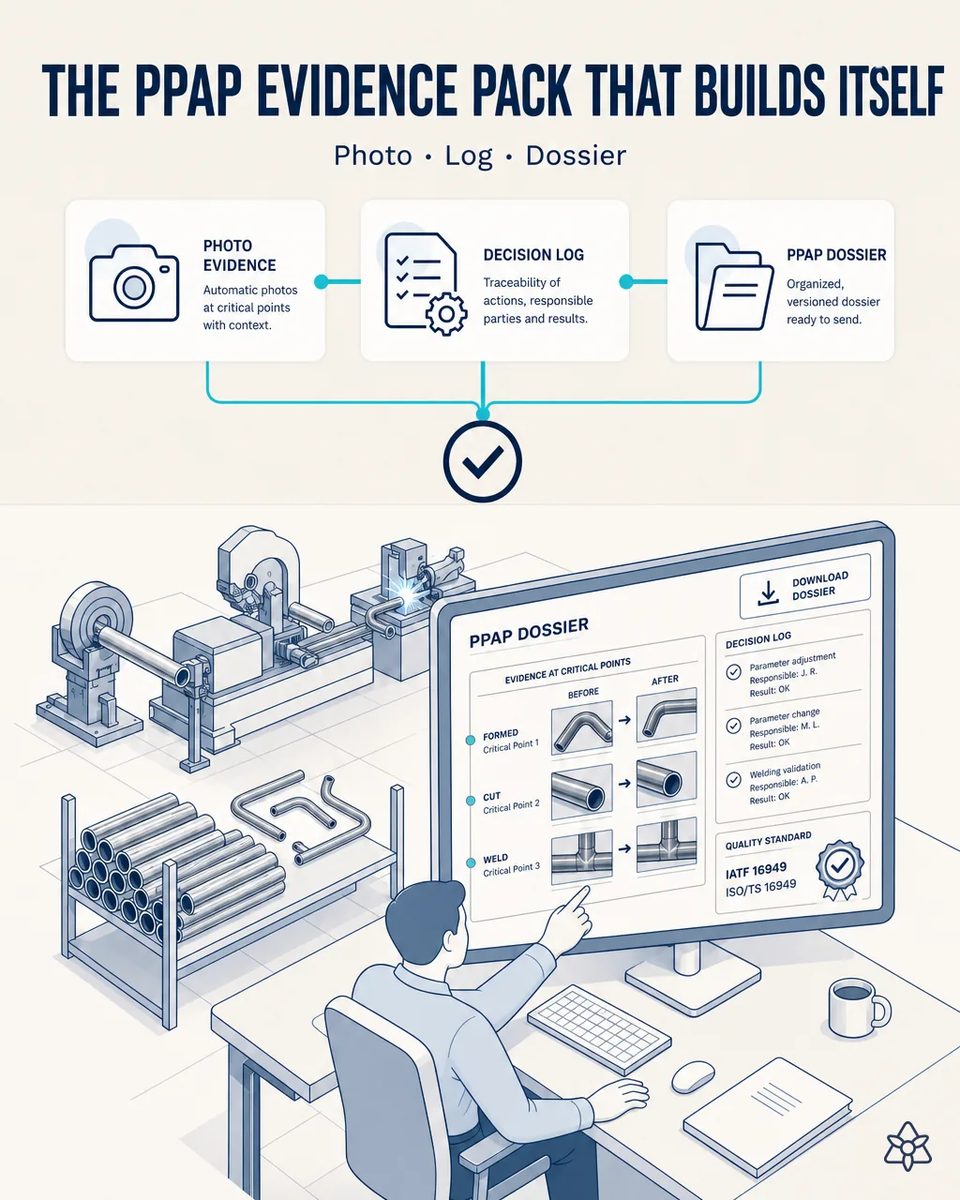
Weeks go into rebuilding evidence of things that already happened.
IATF 16949 audits and the PPAP packages each OEM requires per program need evidence that today gets rebuilt manually, risking documentation-driven nonconformances.
- When the IATF 16949 auditor arrives, or an OEM requests the PPAP package for a program, someone spends weeks reconstructing traceability, pulling people out of production and quality work to do it.
- The evidence exists, but scattered: travel cards, weld parameters, gauge changeover sign-offs, metrology spreadsheets, emails with the OEM. Four or five places, none of them organized for an auditor.
- Each OEM wants it organized its own way, so the same work is repeated per customer and per program. A Tier 1/2 with several OEMs multiplies that effort by every customer with audit or PPAP rights.
- Whatever was not written down at the time becomes a gap, and documentation gaps are among the easiest nonconformances an auditor can write.
Edge captures at every change; Agents files it by standard and by OEM.
Edge captures photos and data per change; Agents organizes it by standard and by OEM, generating a dossier structured by program/period.
The dossier is assembled at the moment of the change, not the week before the audit, by the same Edge cameras that already watch the critical points. Agents only reorders what already exists, by IATF clause or by PPAP element, for whoever is asking. Anything rebuilt afterward inherits the gaps of whatever nobody wrote down, and that is where nonconformances appear.
PPAP and audit prep today versus the dossier that builds itself
| Aspect | Today | With iLEAN Edge + Agents |
|---|---|---|
| Preparing a PPAP package | Weeks of rebuilding | Generated from what is on record |
| Before/after photos of a change | Rarely taken | Captured automatically |
| Decision log and signatures | Scattered across emails | Timestamped per change |
| Same evidence for several OEMs | Rebuilt per customer | One dossier, one view per OEM |
| New-program qualification | Documents chased at the end | Accumulated through APQP |
| Documentation-driven nonconformance | Risked at every audit | Eliminated |
weeks rebuilding for an audit or PPAP → zero. Risk of documentation-driven nonconformance → eliminated.
Estimated impact — to validate with your own numbers.
The block below is an estimate to be validated against your plant's actual data. We put it forward so the committee has an order of magnitude; we refine it during the assessment.
- Estimated payback 6-12 months, depending on audit frequency and how often you qualify new programs.
- Weeks of rebuilding for an audit or a PPAP go to zero, and the people who did it go back to production and quality work.
- The risk of a documentation-driven nonconformance is eliminated, because a missing piece of evidence is detected when it should have been created, not on the auditor's day.
- And continuous protection of OEM accounts, which is what the next program award depends on. A clean audit history is part of how an OEM rates a supplier.
continuous protection of OEM accounts, estimated payback 6-12 months depending on audit frequency and new-program qualification cadence. *Estimate to validate*.
And the fair question from the production manager
“Isn't this a document management system with a new label?” — no: a document manager stores what someone uploads afterward, gaps included; here the evidence is captured at the change itself. Classifying each item against a PPAP element or an IATF clause is an anchored task, where the best models drop below 1.5% error [1], and quality reviews the dossier before it goes to an OEM. Nothing is sent without a person approving it.
[1] OpenAI paper "Why Language Models Hallucinate", 2025 — on the reliability of AI in anchored tasks.
What people ask about the PPAP evidence pack
Does it follow each OEM's own PPAP requirements?
Yes. The evidence is the same; the view is organized per OEM, following the submission level and the customer-specific requirements each one sets. Nobody rebuilds the same evidence twice.
Does it cover the APQP phases of a new program, not only the final PPAP?
Yes. Evidence accumulates from the first trial runs, so by the time the PPAP is due, most of the package is already on record. The run-at-rate and capability evidence is collected as it happens.
What evidence does a gauge changeover leave?
Before and after images of each critical point, the OK from each camera, the sign-off and its time. That is exactly what an auditor asks for on a process change. It is created without anyone stopping to take a photo.
What happens when a program changes after its PPAP?
The change is captured with its own evidence and linked to the original package, so the resubmission starts from a complete trail instead of a blank page. The OEM sees the before, the after and who approved it.
Does it help with a customer 8D as well?
Yes: the same dossier that serves an audit shows what happened on the lot in question — parameters, changes, sign-offs — which shortens the first days of an 8D. Containment can then be bounded to the lots that are really affected.
More cases from this series
- The travel card no longer gets lost on paperiLEAN Connect photographs the travel card at batch startup and makes the tube lot traceable in the…
- Talk to the AI without stopping your walkWith a headset, the line lead dictates issues hands-free; iLEAN structures and saves them within seconds.
- Zero hand-typed weld parametersiLEAN stitches the laser weld cell to the ERP: the correct parameter arrives on its own, with no manual…
- Two worlds that finally talk: spreadsheet and ERPiLEAN absorbs the dimensional-measurement spreadsheet in real time and uploads it to the ERP after…
- The truck no longer waits on your receiving dockOne photo of the delivery note and heat-lot labels is enough for iLEAN to push the data to the ERP after…
- No critical alert gets read too late againiLEAN catches steel delays and OEM specification changes at zero latency and suggests the specific…
Tell us how many PPAP packages you submitted last year and how long each one took.
We work on your plant's real data, not ours. Assessment with no commitment.
Request estimated ROI within 48h ‹ See all cases of precision automotive tubing See automotive