Talk to the AI without stopping your walk
The forming and welding line lead spends the whole shift walking between stations, hands busy. What they know — a steel lot showing more rejects, a welder in training needing support, a roller starting to wear — dies at the end of the shift. With iLEAN Connect's headset mode, they dictate it while walking, and the AI structures it, saves it, and returns support within seconds.
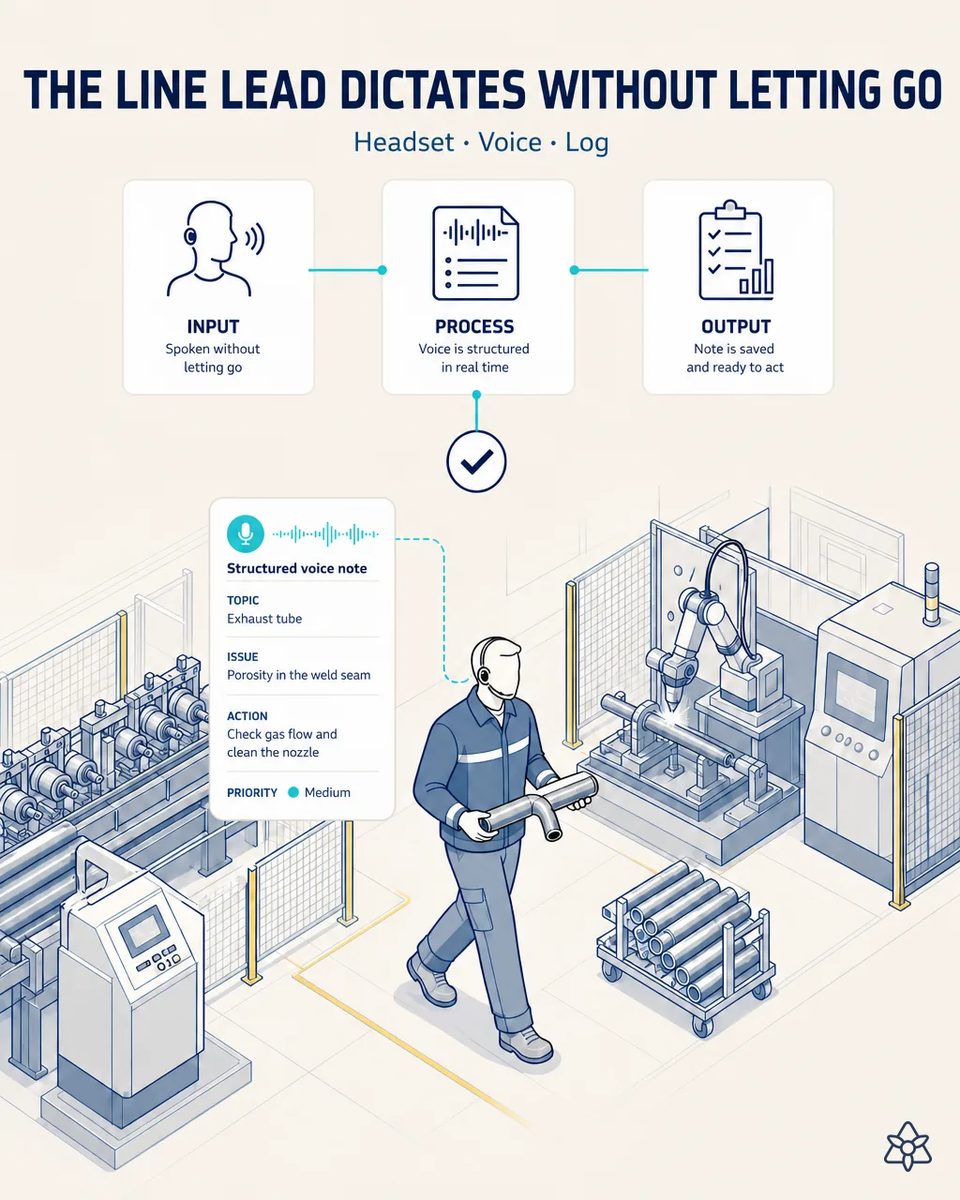
The person who knows the line best never has a free hand to record it.
critical operational knowledge lives in the line lead's head and never enters the system while it's still useful.
- The forming and welding line lead walks between stations the whole shift, hands busy: adjusting a stand, checking a seam, supporting a welder in training.
- They notice what no system records: a steel lot throwing more rejects than usual, a forming roll starting to wear, a seam showing porosity on one program.
- Recording it means walking back to a terminal, so it gets told at the shift handover — or not at all.
- When that knowledge dies at shift end, the next lead meets the same roll wear or the same steel lot from scratch, and quality hears about it only when a reject appears. The same problem gets solved again, by a different person, with no memory of the last attempt.
Connect in voice mode — the lead speaks, iLEAN structures, nobody types.
Connect voice mode with a custom wake phrase. An LLM structures the dictation as an issue linked to the active lot/line/shift, and returns confirmation by voice or push.
A wake phrase, a sentence spoken while walking, and a confirmation back by voice or push. What the lead knows reaches quality while it can still change a decision, tied to the lot and the line it concerns. The shift handover stops depending on the memory of whoever is leaving.
The shift in the lead's head versus the shift on record
| Aspect | Today | With iLEAN Connect |
|---|---|---|
| A steel lot giving more rejects | Mentioned at handover, maybe | An issue tied to the heat and the line |
| Forming roll starting to wear | Noticed, then forgotten | Recorded with date and stand |
| A welder in training needing support | Depends on who is nearby | Logged and routed to the right person |
| Reaching quality | Next day, if at all | In real time |
| The lead's hands | Busy — so nothing is written | Still busy — the voice does it |
| Continuous improvement input | Anecdotes | Issues crossed with program and steel-lot data |
knowledge that dies at shift end → enters the system in real time and gets cross-referenced with live program and steel-lot data.
Estimated impact — to validate with your own numbers.
The block below is an estimate to be validated against your plant's actual data. We put it forward so the committee has an order of magnitude; we refine it during the assessment.
- No standalone payback: this is an enabling piece. It is hard to monetize upfront, and we would rather say so than put a number on it.
- Its value is that every continuous-improvement effort on the floor depends on this information existing and reaching quality in time.
- Knowledge that died at shift end enters the system in real time, crossed with live program and steel-lot data.
- We estimate it together with the area lead, looking at the issues that reached quality too late last year.
hard to monetize upfront, but every continuous-improvement effort on the floor depends on this information existing and reaching quality in time. *Estimate to validate with the area lead*.
And the fair question from the production manager
“Is this for keeping track of what my people say?” — no. iLEAN listens to the line lead, and only after the wake phrase; there is no continuous listening and no location tracking. Turning a dictated sentence into an issue with line, lot and symptom is an anchored task with a closed trade vocabulary, where the best models drop below 1.5% error [1], and the lead hears the confirmation before it is saved.
[1] OpenAI paper "Why Language Models Hallucinate", 2025 — on the reliability of AI in anchored tasks.
What people ask about the line lead's headset
Does it work next to a running tube mill and a welding station?
Recognition is prepared for industrial noise and for trade words like stand, seam, heat or scarfing. The headset is compatible with hearing protection. It is tested on the floor during commissioning, not in an office.
What is the wake phrase for?
It makes sure nothing is recorded until the lead decides to speak to the system. Everything said before or after it is ignored. Ordinary conversation on the floor never enters the system.
How does a dictated issue find its lot and line?
The lead's line and shift are known, and the ERP says which program and steel lot are running there at that moment, so the issue is attached without naming them. The lead only has to say what they saw.
What does a dictated issue look like once it is saved?
A short record: line, stand or station, symptom, priority and the steel lot running at the time, plus the original audio in case someone needs to hear it. Quality can filter by line, stand or steel lot.
Does it answer back, or only record?
It answers: a confirmation that the issue was saved and, where there is one, the relevant history — for example that the same stand showed wear two weeks ago. That is what turns a shift anecdote into a pattern with a date.
More cases from this series
- The travel card no longer gets lost on paperiLEAN Connect photographs the travel card at batch startup and makes the tube lot traceable in the…
- Zero hand-typed weld parametersiLEAN stitches the laser weld cell to the ERP: the correct parameter arrives on its own, with no manual…
- Two worlds that finally talk: spreadsheet and ERPiLEAN absorbs the dimensional-measurement spreadsheet in real time and uploads it to the ERP after…
- The truck no longer waits on your receiving dockOne photo of the delivery note and heat-lot labels is enough for iLEAN to push the data to the ERP after…
- No critical alert gets read too late againiLEAN catches steel delays and OEM specification changes at zero latency and suggests the specific…
- Your most expensive asset, connected without touching itAn external camera digitizes the tube mill panel's parameters without touching the machine or stopping…
Tell us what your line lead knew last month that reached quality too late.
We work on your plant's real data, not ours. Assessment with no commitment.
Request estimated ROI within 48h ‹ See all cases of precision automotive tubing See automotive