No critical alert gets read too late again
Mid-morning, an email arrives from the steel supplier warning of a 48-hour delay — or an OEM sends an Engineering Change Notice (ECN) changing a tolerance. The email lands in an inbox reviewed hours later, when a line is already scheduled against the old spec. With iLEAN Connect, the system reads the alert at zero latency, cross-references active ERP programs, and alerts the right person with the specific action to take.
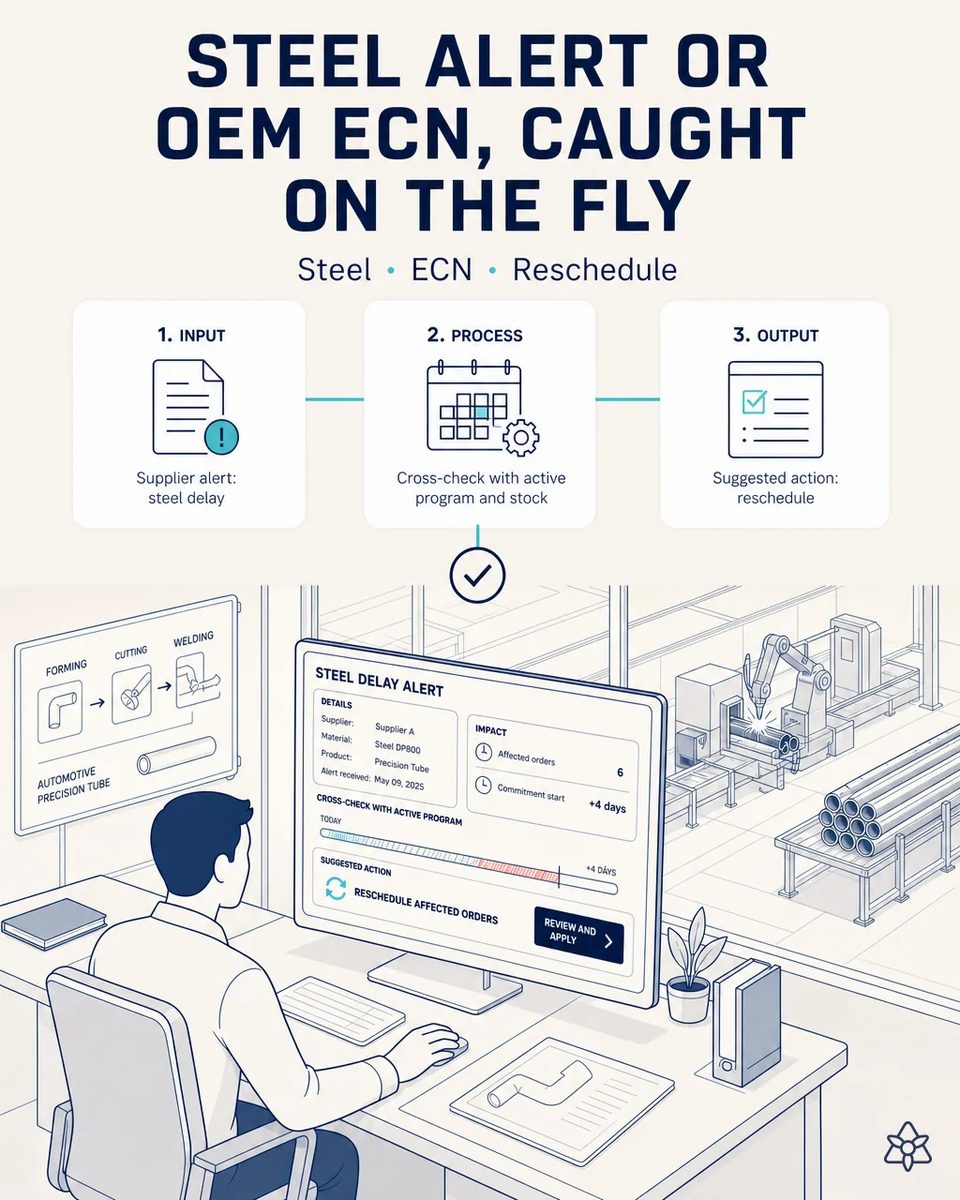
The email that changes the line schedule is read hours after it lands.
critical alerts — from a steel supplier or OEM engineering — reach specific people who don't monitor their inbox in real time. By the time they're read, line decisions have already been made that now need undoing.
- Two kinds of email reshape a tube plant's day: the steel supplier warning that a coil shipment slips 48 hours, and the OEM sending an Engineering Change Notice that moves a tolerance on a program.
- Both land in a personal inbox, in free text, among a hundred other messages, addressed to people who do not watch their email in real time.
- Human latency is typically 2-4 hours. By then a line may already be scheduled — or running — against the old spec or against steel that will not arrive.
- An ECN read late means tubes cut to a tolerance the OEM no longer accepts; a steel delay read late means a tube mill set up for a coil that is not on the dock.
Connect in chaotic-sources mode — a mailbox in silent copy, around the clock.
Connect's chaotic-sources mode — a mailbox in 24/7 silent copy. An LLM extracts intent and key entities (supplier/OEM, affected program, dates, tolerance) and cross-references the ERP, returning a specific action to the right role.
Reading the email sooner is only half of it. What matters is that it comes back crossed with the ERP: which programs use that steel grade or that drawing, which line is scheduled against it, and who has to decide. The alert arrives already translated into an action for the role that owns it.
The alert in an inbox versus the alert crossed with the ERP
| Aspect | Today | With iLEAN Connect |
|---|---|---|
| Human latency | 2-4 hours | Seconds |
| An ECN changing a tolerance | Applied when someone reads it | Flagged against every affected program |
| Coil slipping 48 hours | Tube mill set up for missing steel | Sequence rescheduled on the real date |
| Tubes already cut to the old spec | Found at the OEM | Held before shipment |
| Who is told | Whoever was in the To: field | Planning, quality or engineering, by content |
| Final decision | The recipient, late | The responsible manager, with the action proposed |
2-4 hours of human latency → seconds. Rescheduling based on the real alert, not on something read too late.
Estimated impact — to validate with your own numbers.
The block below is an estimate to be validated against your plant's actual data. We put it forward so the committee has an order of magnitude; we refine it during the assessment.
- Estimated payback 3-7 months, depending on how often critical alerts reach you.
- Unplanned stoppages avoided: a tube mill set up and waiting on steel that is not coming, with the crew standing by.
- Production against an obsolete specification avoided, before it ends up as scrap or a customer complaint.
- From 2-4 hours of human latency to seconds, with rescheduling based on the real alert, not on one read too late. The line is set up for the steel that will actually be there.
avoided unplanned stoppages and producing against an obsolete spec, estimated payback 3-7 months depending on alert frequency. *Estimate to validate*.
And the fair question from the production manager
“Is iLEAN going to read our engineers' mail?” — no. It sits in silent copy on one operational mailbox agreed with you, the one suppliers and OEM engineering already write to. Classifying the intent of an alert and pulling the program, date and tolerance is an anchored task, where the best models drop below 1.5% error [1] — and the action is proposed, never executed on its own.
[1] OpenAI paper "Why Language Models Hallucinate", 2025 — on the reliability of AI in anchored tasks.
What people ask about catching steel and ECN alerts
Does it understand an ECN that arrives with a drawing attached?
It reads the notice and the attached change description, extracts the affected part number and the tolerance that moves, and crosses both with the programs in the ERP. Engineering gets the list of affected programs, not just the email.
How does it tell a real steel delay from a routine shipping confirmation?
By intent: a new date, a quantity cut or a grade substitution is an alert; a confirmation that matches the order is logged and interrupts nobody. Only what changes the plan reaches a person.
Does it know which tube mill is scheduled against that coil?
When crossed with the ERP schedule, yes. The alert arrives with the line, the program and the start date it affects. Planning sees at once whether another program can move forward to fill the gap.
What if the supplier proposes a substitute steel grade?
It goes to quality and engineering, not to planning alone, because a material change on a PPAP-approved part needs the OEM's approval before it runs. Catching that before the tube mill is set up avoids an unapproved lot.
Does it replace our formal engineering change process?
No. The ECN still goes through your change process and your APQP documents. What changes is that the process starts the minute the notice arrives, not hours later. The record of when it arrived and who acted is kept for the audit trail.
More cases from this series
- The travel card no longer gets lost on paperiLEAN Connect photographs the travel card at batch startup and makes the tube lot traceable in the…
- Talk to the AI without stopping your walkWith a headset, the line lead dictates issues hands-free; iLEAN structures and saves them within seconds.
- Zero hand-typed weld parametersiLEAN stitches the laser weld cell to the ERP: the correct parameter arrives on its own, with no manual…
- Two worlds that finally talk: spreadsheet and ERPiLEAN absorbs the dimensional-measurement spreadsheet in real time and uploads it to the ERP after…
- The truck no longer waits on your receiving dockOne photo of the delivery note and heat-lot labels is enough for iLEAN to push the data to the ERP after…
- Your most expensive asset, connected without touching itAn external camera digitizes the tube mill panel's parameters without touching the machine or stopping…
Tell us how long the last OEM change notice took to reach the line.
We work on your plant's real data, not ours. Assessment with no commitment.
Request estimated ROI within 48h ‹ See all cases of precision automotive tubing See automotive