Two worlds that finally talk: spreadsheet and ERP
The metrology lead fills in a spreadsheet every batch with the dimensional and weld measurements the control plan requires. That spreadsheet lives in a shared folder the ERP never sees. iLEAN Connect detects the spreadsheet being filled in, absorbs each cell in real time and, after validation, automatically inserts it into the ERP.
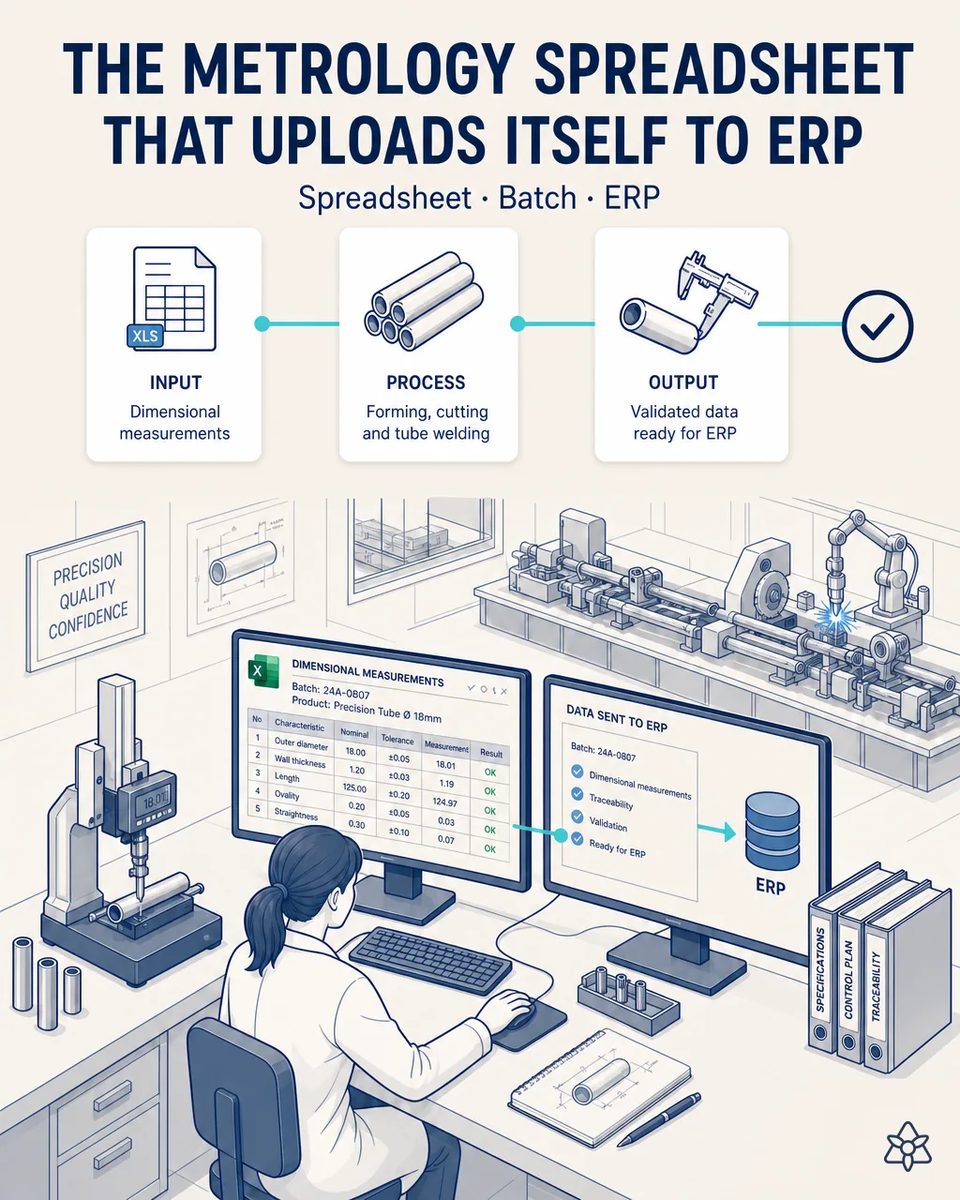
The control plan lives in a spreadsheet the ERP has never seen.
two parallel worlds — the real spreadsheet (live data required by IATF 16949) and the official ERP (data transcribed weeks late by someone spending half a day a month copy-pasting).
- Every batch, the metrology lead records what the control plan demands: outside diameter, wall thickness, length, ovality, straightness, plus weld checks such as flattening or expansion tests.
- That spreadsheet sits in a shared folder. It is the live record, the one the metrology lead trusts and the one IATF 16949 cares about. Several people have edited it for years, and it has grown tabs and notes along the way.
- The ERP holds a transcribed version that arrives weeks late, typed by someone who spends half a day a month copying and pasting.
- When an OEM asks for capability on a characteristic, or a PPAP needs dimensional results, the two worlds have to be reconciled by hand, against the clock, and every transcription error surfaces at exactly that moment.
Connect listening inward — it reads the shared folder, not the person.
Connect's "listen inward" mode watches the shared folder, not the person, absorbing the data in real time with a grounded LLM; after validation, it flows to the ERP via API.
The metrology lead keeps the spreadsheet they trust. iLEAN absorbs each cell as it is saved and, after validation, it flows to the ERP via API — so the official record and the real one stop being two different things. The capability an OEM asks for at each review is then a query, not an afternoon's work. And the data your control plan demands is where the auditor expects to find it.
Two parallel records versus one record that flows
| Aspect | Today | With iLEAN Connect |
|---|---|---|
| Lag between measurement and ERP | Weeks | Zero latency |
| Monthly copy-paste | Half a day | Zero |
| Flattening and expansion test results | In a tab nobody else opens | Tied to the batch in the ERP |
| Capability on outside diameter | Recomputed for each request | Current on the day it is asked |
| A mistyped wall thickness | Surfaces at a PPAP | Never typed |
| Seats in the quality/lab module | One per person who types | Reduced by 50-80% |
weeks of lag → zero latency. Half a day a month transcribing → zero.
Estimated impact — to validate against your actual license invoice.
The block below is an estimate to be validated against your plant's actual data. We put it forward so the committee has an order of magnitude; we refine it during the assessment.
- 💰 CFO angle: the ERP bills per named user. Everyone who logs into the quality or lab module purely to type results is a seat: a typical 50-80% reduction, recurring every year.
- Estimated payback 4-9 months, before counting the license saving.
- From weeks of lag to zero latency, and half a day a month of transcription down to zero.
- Dimensional results ready for a PPAP or an OEM review without reconciling two records, which is where most of the time goes today.
typical 50-80% reduction in quality/lab-module licenses, estimated payback 4-9 months. *Estimate to validate*.
And the fair question from the production manager
“Our metrology sheet has a tab per program and notes in every margin — will it cope?” — yes, because parsing does not rely on fixed cell positions: it reads headers, units and tabs as they are. Mapping a spreadsheet with a stable structure is an anchored task, where the best models drop below 1.5% error [1], and the metrology lead validates the batch before anything is pushed. Nobody is asked to standardize the sheet first.
[1] OpenAI paper "Why Language Models Hallucinate", 2025 — on the reliability of AI in anchored tasks.
What people ask about the metrology spreadsheet and the ERP
Does the metrology lead have to change how they work?
No. They keep filling the same spreadsheet in the same folder. iLEAN reads it on save; nobody is asked to open a new screen. The folder stays where it is and so do the permissions.
Does it handle results that arrive later, like destructive weld tests?
Yes. A flattening or expansion test result is absorbed when it is saved and attached to the batch it belongs to, even if it lands a day after the dimensional checks. The batch record completes itself as results come in.
How many seats can we really drop?
Typically 50-80% of quality and lab seats, depending on how many people log in only to type. We check it against your actual license contract before promising anything. The saving recurs every year the contract renews.
Does it flag a measurement out of tolerance?
It carries the tolerance from the control plan, so an out-of-tolerance value is highlighted on the validation summary before it is pushed. Quality sees the deviation the moment it is saved, not weeks later.
Does it read exports from our measuring equipment too?
If the equipment exports to a file in the same folder, yes: it is read the same way as the spreadsheet, without anyone retyping it. Coordinate measuring and laser diameter gauges are the usual cases.
More cases from this series
- The travel card no longer gets lost on paperiLEAN Connect photographs the travel card at batch startup and makes the tube lot traceable in the…
- Talk to the AI without stopping your walkWith a headset, the line lead dictates issues hands-free; iLEAN structures and saves them within seconds.
- Zero hand-typed weld parametersiLEAN stitches the laser weld cell to the ERP: the correct parameter arrives on its own, with no manual…
- The truck no longer waits on your receiving dockOne photo of the delivery note and heat-lot labels is enough for iLEAN to push the data to the ERP after…
- No critical alert gets read too late againiLEAN catches steel delays and OEM specification changes at zero latency and suggests the specific…
- Your most expensive asset, connected without touching itAn external camera digitizes the tube mill panel's parameters without touching the machine or stopping…
Tell us how many weeks your ERP runs behind your metrology spreadsheet.
We work on your plant's real data, not ours. Assessment with no commitment.
Request estimated ROI within 48h ‹ See all cases of precision automotive tubing See automotive