Zero hand-typed weld parameters
The laser weld cell that closes the tube before final forming is relatively modern and has an API. But it sits isolated from the ERP: every program change means manually typing the parameter. With iLEAN, the cell gets stitched bidirectionally to the ERP: the correct parameter travels automatically from the active program.
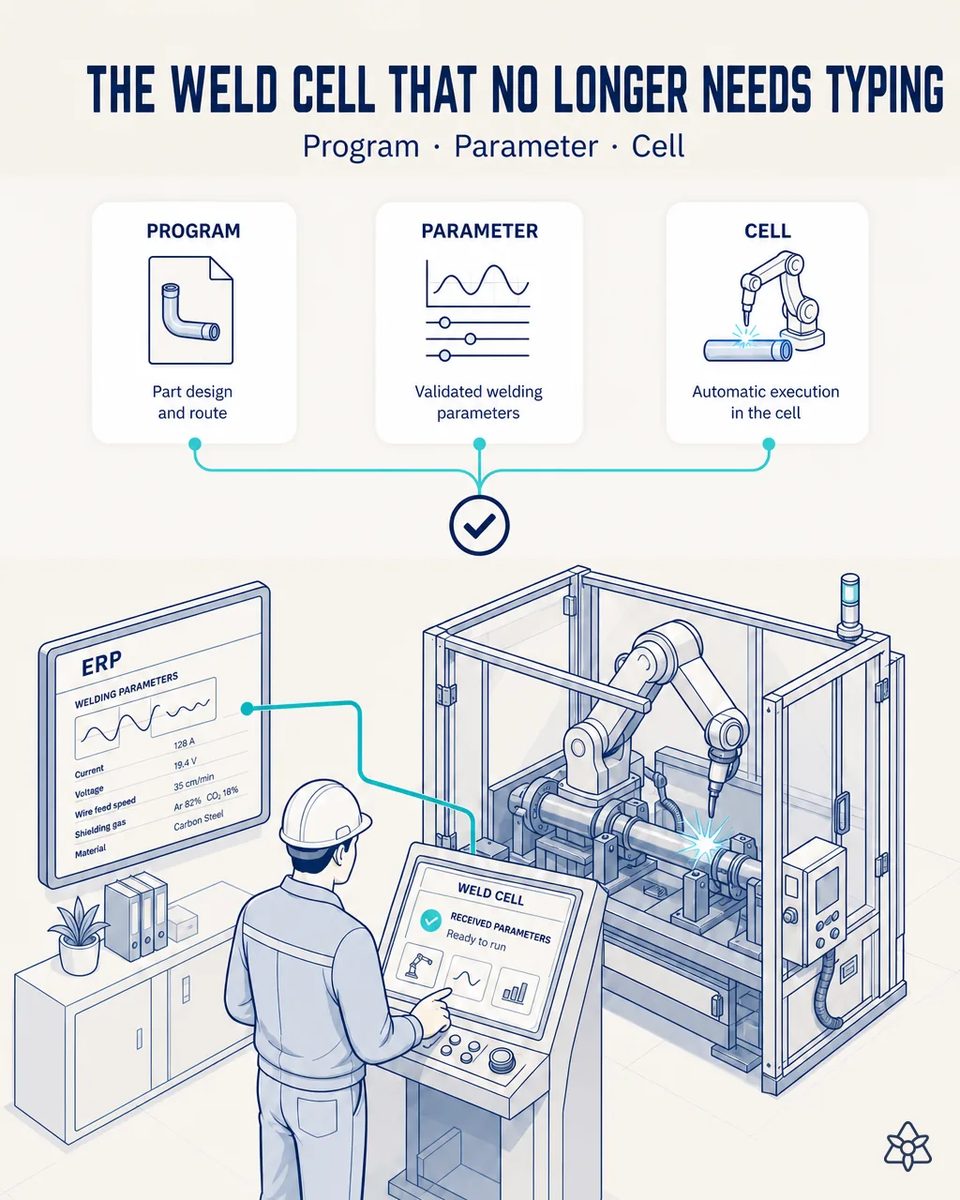
The most critical process in the flow still depends on someone's fingers.
the weld cell is the most critical process in the flow — any parameter error there turns into a rejected part or, worse, one that isn't caught until it reaches the customer.
- The laser weld cell that closes the tube's longitudinal seam before final forming is relatively modern and has an API — but it sits isolated from the ERP.
- Every program change means typing the weld parameter by hand at the cell panel, with the same data already sitting in the ERP. The same number is typed twice, by two people, in two places.
- It is the most critical step in the flow: a parameter error there becomes a rejected tube or, worse, one that is not caught until it reaches the customer.
- Plants log typing errors here every month, and some of them are already tied to rejects or nonconformances. With a high mix of programs, the exposure never goes away.
Connect stitches ERP and weld cell together through their APIs.
Connect stitches two modern systems together via API. When the ERP marks a program start, it automatically publishes the qualified weld parameter to the cell.
When the ERP marks a program start, it publishes the qualified weld parameter to the cell, and the cell reports back what it loaded. The parameter nobody types is the parameter nobody can mistype. And no integration project is needed: neither system is replaced and no shutdown window is required. It does not wait in the IT project queue behind everything else.
The isolated weld cell versus the stitched weld cell
| Aspect | Today | With iLEAN Connect |
|---|---|---|
| Source of the weld parameter | Keyed at the cell panel | Published from the active ERP program |
| Qualified parameter set | In a binder next to the cell | Travels with the program |
| Human-origin parameter errors | Every month | Zero |
| What the cell loaded | Assumed | Confirmed back to the ERP |
| Out-of-spec nonconformance risk | Permanent | Drastically reduced |
| The cell and the ERP | — | Both stay; neither is replaced |
monthly parameter-typing errors (some tied to rejects or nonconformances) → zero human-origin error.
Estimated impact — to validate with your own numbers.
The block below is an estimate to be validated against your plant's actual data. We put it forward so the committee has an order of magnitude; we refine it during the assessment.
- Estimated payback 3-6 months, fast because there is no equipment to buy and no machine to stop.
- Monthly parameter-typing errors, some tied to rejects or nonconformances, go to zero human-origin error.
- The risk of an out-of-spec nonconformance reaching the OEM drops drastically.
- And every weld parameter used has a traceable origin: the approved program, not someone's memory. That is what an auditor asks to see after any weld-related complaint.
fast payback of 3-6 months, drastically reduced risk of an out-of-spec nonconformance. *Estimate to validate*.
And the fair question from the production manager
“What if the ERP sends the wrong parameter?” — then the error sits in the master data, where it is found and fixed once, instead of being repeated by hand at every changeover. The published set is checked against the qualified set for that program and against the cell's read-back; where iLEAN has to interpret a free-text program note, that is an anchored task, where the best models drop below 1.5% error [1]. Any mismatch blocks the start.
[1] OpenAI paper "Why Language Models Hallucinate", 2025 — on the reliability of AI in anchored tasks.
What people ask about stitching the laser weld cell
Which weld parameters travel from the ERP?
Those your process qualification fixes for the program: laser power, welding speed, focal position and shielding gas flow, or the equivalent set on your cell. The list is agreed with your welding engineer. Nothing outside the qualified window can be published.
What if a program runs on a high-frequency welder instead of the laser?
The pattern is the same wherever the welder exposes an interface. High-frequency welders with a controller API are stitched the same way; older ones fall under the panel-camera case. Both routes end in the same ERP record.
Can the operator still adjust a parameter at the cell?
Within the window your procedure allows, yes, and the adjustment is reported back to the ERP with its author. Outside that window the change needs a quality sign-off. The adjustment never disappears into the cell's local memory.
How do we know the cell actually ran what was published?
The cell reports back the parameter it loaded, and that read-back is stored with the lot. If it differs from what was published, the start is blocked. That read-back becomes evidence on the lot.
Does it help with PPAP when a parameter is requalified?
Yes: the requalified set becomes the one the ERP publishes, and the date it took effect is on record for the change history the OEM asks for. There is no gap between the approval and the floor.
More cases from this series
- The travel card no longer gets lost on paperiLEAN Connect photographs the travel card at batch startup and makes the tube lot traceable in the…
- Talk to the AI without stopping your walkWith a headset, the line lead dictates issues hands-free; iLEAN structures and saves them within seconds.
- Two worlds that finally talk: spreadsheet and ERPiLEAN absorbs the dimensional-measurement spreadsheet in real time and uploads it to the ERP after…
- The truck no longer waits on your receiving dockOne photo of the delivery note and heat-lot labels is enough for iLEAN to push the data to the ERP after…
- No critical alert gets read too late againiLEAN catches steel delays and OEM specification changes at zero latency and suggests the specific…
- Your most expensive asset, connected without touching itAn external camera digitizes the tube mill panel's parameters without touching the machine or stopping…
Tell us how many weld parameter changes your cell runs in a week.
We work on your plant's real data, not ours. Assessment with no commitment.
Request estimated ROI within 48h ‹ See all cases of precision automotive tubing See automotive