The travel card no longer gets lost on paper
Every tube batch starts with a paper travel card that defines the program, gauge, and destination OEM. Today it lives on paper until someone transcribes it at the end of the shift. With iLEAN Connect, the operator photographs the card at startup and the batch exists in the central system at zero latency, with no habit change.
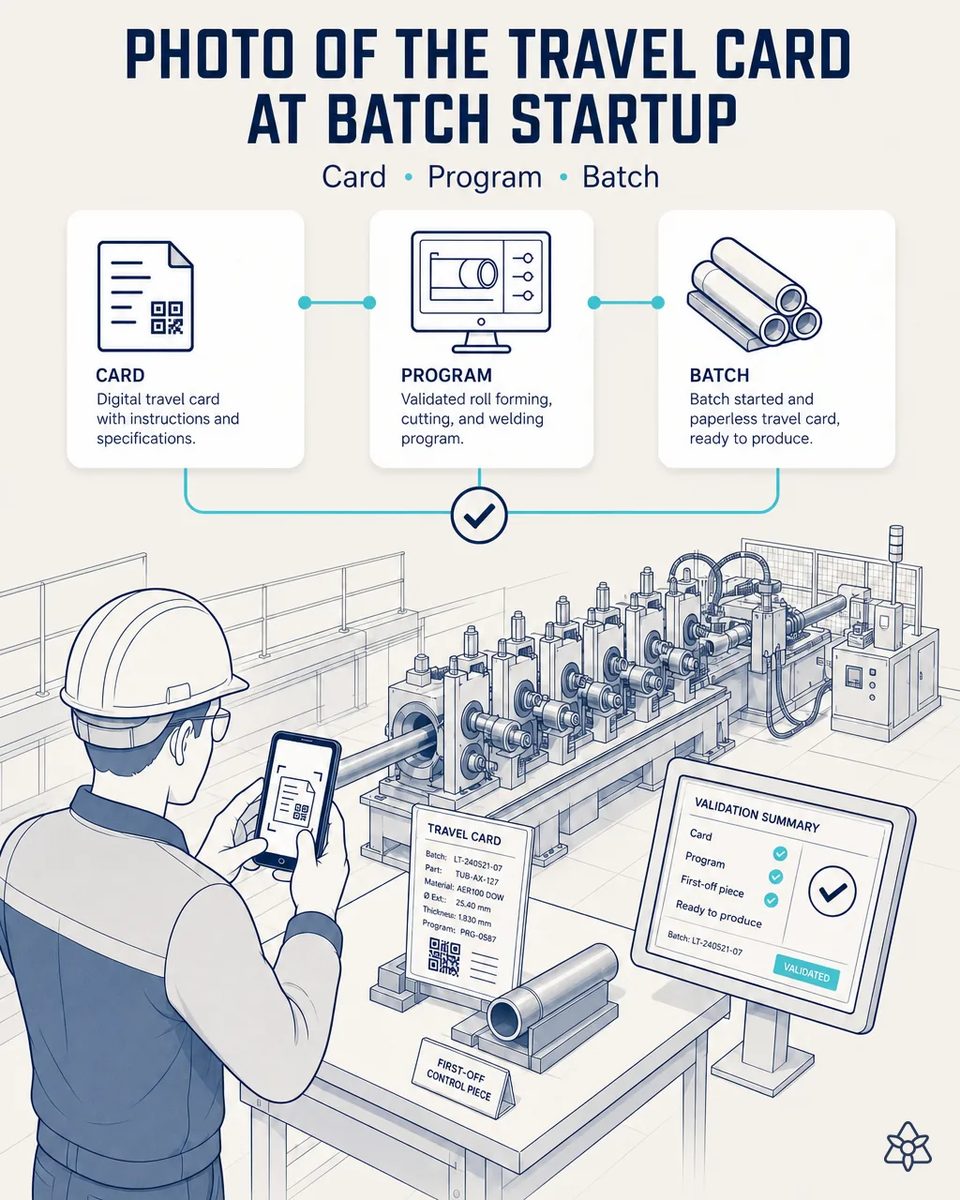
The card that ties the lot to its program travels by hand.
The travel card and the first-off control piece are filled by hand and travel physically through 3-4 stations. If it gets lost or filled in badly, the lot-to-program traceability IATF 16949 requires is lost until someone reconstructs it.
- Every batch opens with a travel card: program, gauge, cut length, destination OEM, shift and operator. It is filled in at the tube mill and then travels physically through 3-4 stations — forming, welding, sizing, cut-to-length.
- The first-off control piece is recorded the same way: outside diameter, wall thickness and the weld check, written on paper next to the line.
- Until someone transcribes it at the end of the shift, the lot exists on the floor but in no system that quality or the OEM can query.
- If the card gets lost, soaked in coolant or filled in wrong, the lot-to-program traceability IATF 16949 requires is broken until someone reconstructs it from memory and rack tags.
Connect in photo mode — the card stays on paper, the lot goes digital.
Connect photo mode. The operator captures the card with a phone or industrial tablet. A grounded LLM extracts structured fields (program, gauge, length, destination OEM, shift, operator) and saves them to iLEAN's central memory. Zero habit change for the operator.
It is the simplest of the twelve to deploy and usually the first one approved, because nothing on the floor changes except one photo. The card keeps traveling with the bundle, as it always has; what changes is that the lot it describes already exists in the central system when the first tube leaves the cut-off saw.
The travel card on paper versus the travel card captured
| Aspect | Today, on paper | With iLEAN Connect |
|---|---|---|
| When the lot becomes queryable | At shift end, if someone transcribes it | At startup, zero latency |
| Lot tied to program and gauge | Only on the physical card | Structured fields in central memory |
| A card lost between stations | Traceability rebuilt by hand | The photo already exists |
| First-off control piece | Handwritten, filed by the line | Stored with the lot it released |
| Destination OEM of a bundle | Read off the tag on the rack | One query by lot number |
| Operator's routine | — | Same card, plus one photo |
traceability that depends on the physical card not getting lost → a digitally queryable lot from zero latency.
Estimated impact — to validate with your own numbers.
The block below is an estimate to be validated against your plant's actual data. We put it forward so the committee has an order of magnitude; we refine it during the assessment.
- Estimated payback 4-9 months, depending on how many lots the plant starts per day.
- The saving comes from the production lead's transcription time, which today goes into copying cards at shift end.
- Traceability stops depending on a physical card not getting lost: the lot is digitally queryable from zero latency.
- And a lost or damaged card stops being a traceability gap that has to be explained to an auditor.
estimated payback 4-9 months depending on daily lot volume, recovering the production lead's transcription time. *Estimate to validate*.
And the fair question from the production manager
“What if it misreads the gauge or the program number on a handwritten card?” — reading fields from a card with a known layout is an anchored task, where the best models drop below 1.5% error [1]. And there is a second net: every field is checked against the programs active in the ERP, and the operator confirms the summary on the line tablet before the lot is recorded.
[1] OpenAI paper "Why Language Models Hallucinate", 2025 — on the reliability of AI in anchored tasks.
What people ask about photographing the travel card
Does the travel card have to be redesigned?
No. Vision reads the card you already use, printed or handwritten. Changing it would mean changing a document your control plan references, and that is not needed. The operator fills it in exactly as before.
Which fields does it pull from the card?
Program, gauge, cut length, destination OEM, shift and operator, plus any handwritten deviation. Those are the fields that tie the lot to its program under IATF 16949. A field the model reads with low confidence is flagged for the operator instead of guessed.
Does the card still travel with the bundle?
Yes. The physical card keeps doing its job on the floor; the photo only makes sure the lot also exists in the system from minute one. If a card is lost at the sizing station, nothing is lost with it.
What about a program split across two tube mills or two shifts?
Each startup is photographed on its own line and shift, and both captures are tied to the same program, so the split is visible instead of lost. That is the case that most often breaks traceability on paper.
Does it help when an OEM asks which lot went into a shipment?
That is the question it answers fastest: the lot, its program, its gauge and its first-off piece come out of one query instead of a search through binders. During a containment, those hours are the difference between a bounded lot and a sorted month.
More cases from this series
- Talk to the AI without stopping your walkWith a headset, the line lead dictates issues hands-free; iLEAN structures and saves them within seconds.
- Zero hand-typed weld parametersiLEAN stitches the laser weld cell to the ERP: the correct parameter arrives on its own, with no manual…
- Two worlds that finally talk: spreadsheet and ERPiLEAN absorbs the dimensional-measurement spreadsheet in real time and uploads it to the ERP after…
- The truck no longer waits on your receiving dockOne photo of the delivery note and heat-lot labels is enough for iLEAN to push the data to the ERP after…
- No critical alert gets read too late againiLEAN catches steel delays and OEM specification changes at zero latency and suggests the specific…
- Your most expensive asset, connected without touching itAn external camera digitizes the tube mill panel's parameters without touching the machine or stopping…
Tell us how many lots your tube mills start in a day and when their cards reach the system.
We work on your plant's real data, not ours. Assessment with no commitment.
Request estimated ROI within 48h ‹ See all cases of precision automotive tubing See automotive