The crimp lab spreadsheet reaches the ERP on its own
In the lab's shared folder lives the spreadsheet that holds up crimp quality for the whole plant. Every shift the technician measures height and width, runs the pull test, cuts the micrograph and writes it down. This is live data, measured with calibrated instruments, with evidential value in an audit. And yet the corporate system requires someone to key it in again, so the official number runs weeks behind the real one.
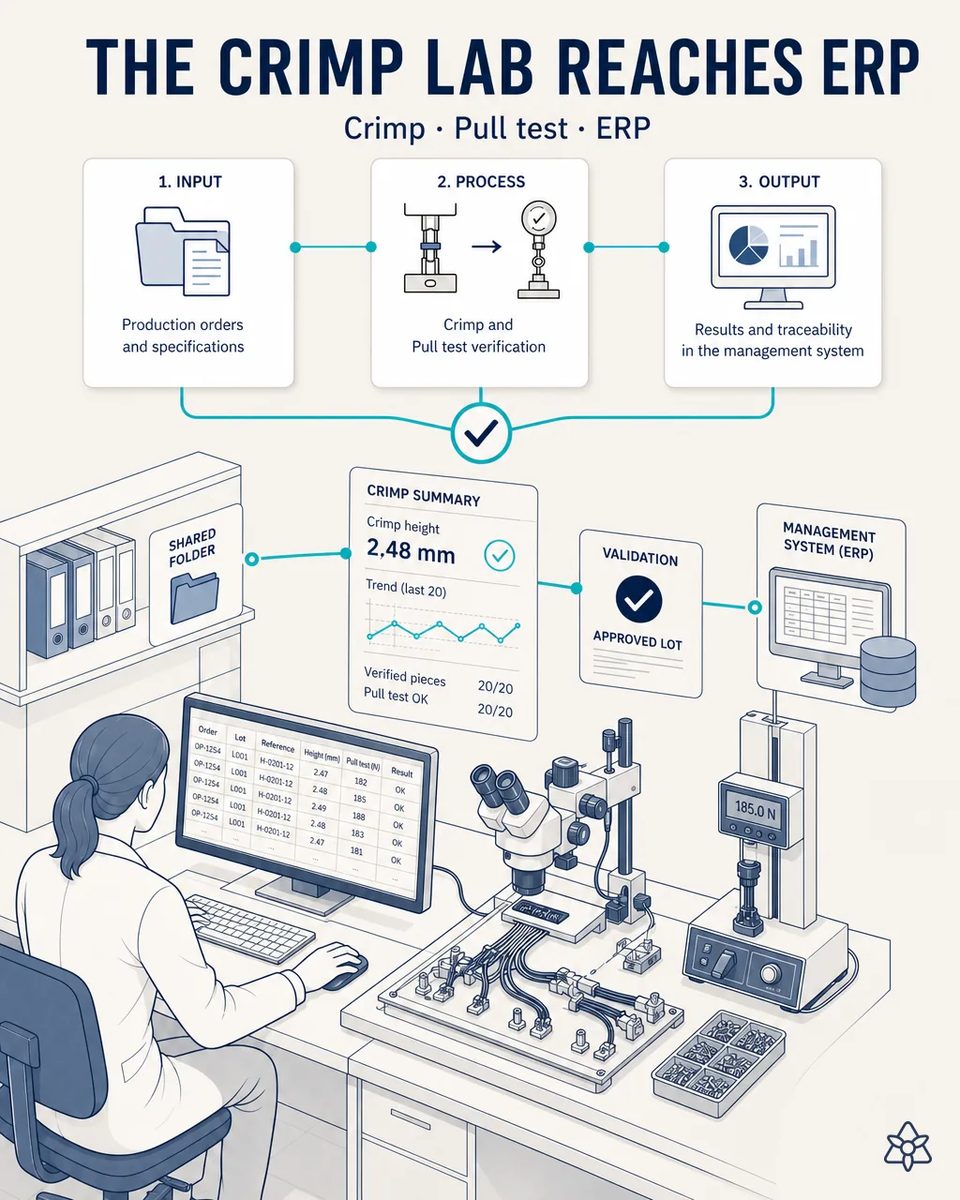
There are two truths about the crimp: the lab's, which is today's, and the system's, which is weeks old.
This is live data, measured with calibrated instruments, with evidential value in an audit. And yet the corporate system requires someone to key it in again, so the official number runs weeks behind the real one. There are two truths about crimping: the lab's, which is from today, and the system's, which is from weeks ago. When the customer asks for process capability evidence, it gets rebuilt by hand from the spreadsheet. When you have to prove the applicator was in window the day of the suspect harness, you go looking in the spreadsheet.
- The lab measures crimp height, pull-out force and cross-section with calibrated instruments. That is live data, with evidentiary value in an audit.
- And yet the corporate system requires that somebody key it in again, so the official figure runs weeks behind the real one.
- When the customer asks for process capability evidence, it is rebuilt by hand from the spreadsheet.
- When you have to prove the applicator was in window on the day of the suspect harness, the archaeology starts.
Connect in inward listening mode: it reads the file when it is saved.
With Connect in inward listening mode, iLEAN observes the shared folder and reads the file when it is saved. It extracts every structured row with its instrument, its technician and its timestamp, computes trend and capability per applicator, and publishes the summary on the quality manager's tablet for validation. Only then does it push into the system through its interface. And here is the argument a chief financial officer signs. Today the lab and quality team log into the system mainly to enter data, and each of those users consumes a named licence of the quality module. With Connect, only the manager who validates needs to log in. The typical pattern is going from six licences to one, a recurring cut of fifty to eighty per cent.
Today the lab and quality team mostly enter the system to type data in, and each of those users consumes a named licence of the quality module. With Connect only the owner who validates goes in.
The lab figure, before and after
| Aspect | Today | With iLEAN Connect |
|---|---|---|
| Lag between measurement and system | Weeks | The moment the file is saved |
| Who keys it in | Every technician, every shift | Nobody |
| Quality module licences | One per person entering data | One, the owner who validates |
| Process capability per applicator | Rebuilt by hand | Computed and published on its own |
| Audit evidence | Spreadsheet plus system, not matching | One series, with instrument and technician |
| The lab spreadsheet | Everyone tries to kill it and fails | It stays: it is the tool that works |
see the impact section; the attached pool details the before and after for this case.
Impact estimate — to validate against your numbers.
The block below is an estimate to be validated against your plant's actual data. We put it forward so the committee has an order of magnitude; we refine it during the assessment.
- Estimated payback 3-6 months — the fastest of the whole set.
- From 6 to 1 quality module licence: between −50% and −80% recurring.
- The licence saving is immediate and depends on no improvement hypothesis: it is a cost line that goes down.
- And the official figure stops running weeks behind the real one, which is what you pay for when the audit arrives.
Estimated payback 3-6 months · from 6 to 1 quality-module licence, a recurring 50% to 80% cut This is the fastest payback of the whole set, three to six months, because the licence saving is immediate, recurring, and does not depend on any improvement hypothesis: it depends on the system invoice. The range has to be calibrated against your vendor's actual pricing.
And the fair question from the production manager
"What if the sheet changes format?" — listening mode does not depend on a frozen template: it extracts structured rows with their instrument, technician and timestamp, which is an anchored task over a document that already has that structure [1]. If a new column shows up one day, it is flagged for review rather than silently accepted.
[1] OpenAI paper "Why Language Models Hallucinate", 2025 — on the reliability of AI in anchored tasks.
What people ask about integrating the crimp lab
Do we have to stop using the spreadsheet?
No. The spreadsheet stays, because it is the tool that lab has been measuring well with for years. What disappears is the second keying, not the sheet.
Do ERP licences really come back?
It is the easiest part to check: count how many users enter the quality module only to type data in. That number is the saving, and it does not rest on any process-improvement estimate.
Who validates before it posts to the system?
The quality owner, over an already computed summary on their tablet. It is still a human signature; what is removed is the transcription.
Does it cover pull testing as well as crimp height?
Yes. Any measurement recorded on that sheet comes through the same path, including pull-out force, which is the one most often requested as evidence.
How does it post to the ERP: interface or screen automation?
Interface. Automating the screen looks quicker to build and breaks at the next ERP update; the interface is what survives in production.
More cases from this series
- The audit evidence pack assembles itselfEvery critical event leaves evidence indexed by clause and by customer requirement. The audit stops…
- Zero customer line stop: four coordinated ringsFour cross-checked verification rings from reel to sequenced shipment, holding harness quality steady…
- The legacy crimp press panel starts talkingAn external camera digitises crimp height, counters and alarms from a legacy cut-and-crimp panel without…
- The supervisor who walks the floor and talks to the systemEarpiece and voice so the harness supervisor records and queries without stopping between boards. Weak…
- Nothing enters the system without a human signing itNothing the AI captures enters the system until a human signs it with two taps at the board. Humans in…
- The alert that today gets read too lateOEM and supplier emails read on arrival, cross-checked against the live schedule and turned into a…
Tell us how many people enter the quality module today only to type data in.
We work on your plant's real data, not ours. Assessment with no commitment.
Request estimated ROI within 48h ‹ See all cases of automotive wire harnesses See automotive