The legacy crimp press panel starts talking
In the cut-and-crimp area, new connected machines live alongside machines that are ten to twenty-five years old and still perfectly capable. Nobody is going to replace them, and they are right not to. Their panels show exactly what the plant would need to know continuously: piece counter, measured crimp height, crimping force, end-of-reel warning, applicator alarm. That data is born and dies on the screen.
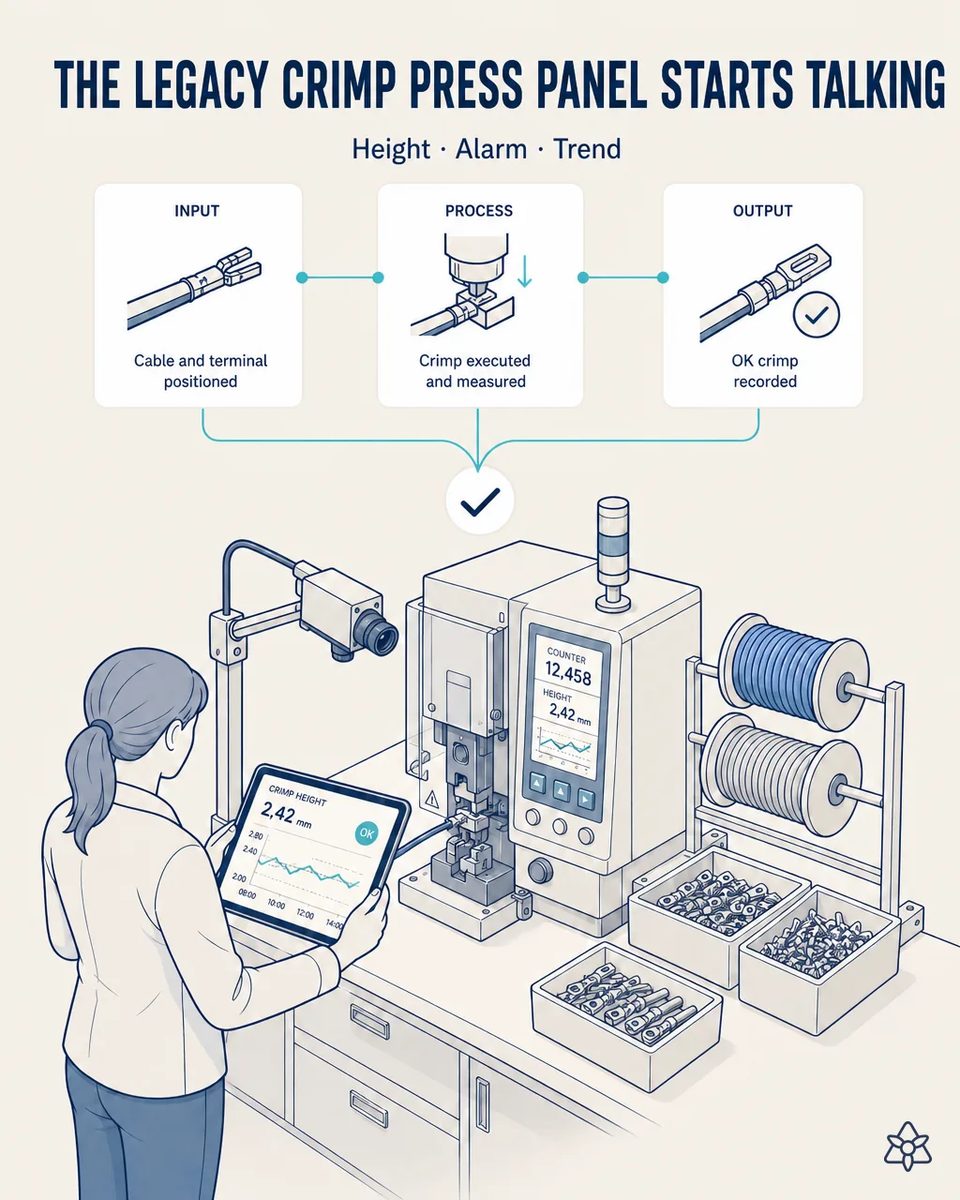
The data that decides harness quality is born and dies on a screen.
Their panels show exactly what the plant would need to know continuously: piece counter, measured crimp height, crimping force, end-of-reel warning, applicator alarm. That data is born and dies on the screen. And crimping is the critical failure point of a harness. A worn applicator slowly drifts crimp height until parts start coming out of specification. Today that gets caught in the lab sampling, hours later, with thousands of terminals already crimped.
- Crimp press panels show exactly what the plant would need continuously: piece counter, measured crimp height, press force, end of reel, applicator alarm.
- That data is born and dies on the screen. It does not leave the machine, it is not historised, it is never cross-checked against the active order.
- And the crimp is the harness's critical failure point: a worn applicator drifts the height gradually until parts come out of specification.
- Today that is caught at lab sampling, hours later, with thousands of terminals already pressed.
A camera looking at the panel. No electrical contact, no recertification, no downtime.
With Connect, an external camera pointed at the panel is enough. No electrical contact, no machine recertification, no downtime. A grounded model reads every frame optically, structures the time series per machine and per order, and cross-checks it against the active order in the system. When the drift trends towards leaving the window, iLEAN warns before it leaves. You move from changing the applicator by calendar or after it already failed, to changing it when the curve asks for it. The machine is still the same machine, but now the plant has its curve digitised.
The machine stays the machine: nothing is wired to it, no firmware changes and its certification is untouched. The only new thing is that the plant now has its curve digitised.
Crimp control, before and after
| Aspect | Today | With iLEAN Connect |
|---|---|---|
| Crimp height | Lab sampling, hours later | Continuous series, read off the panel |
| Applicator drift | Seen once it has already drifted out | Flagged before it leaves the window |
| Applicator change | By calendar, or after it failed | When the curve asks for it |
| Integration with the machine | Would mean touching and recertifying it | None: external camera |
| Cross-check with the active order | Manual, if at all | Automatic, by machine and order |
| A mixed fleet of makers | One project per maker | The same method for all |
see the impact section; the attached pool details the before and after for this case.
Impact estimate — to validate against your numbers.
The block below is an estimate to be validated against your plant's actual data. We put it forward so the committee has an order of magnitude; we refine it during the assessment.
- Estimated payback 5-10 months.
- Copper and terminal scrap from crimp drift down by at least 30%.
- Machine CAPEX avoided: no need to replace crimp presses that work perfectly just to be able to measure them.
- Full applicator life used, instead of changing it by calendar.
Estimated payback 5-10 months · crimp drift scrap down 30% and machine CAPEX avoided Estimated payback runs between five and ten months, with at least a thirty per cent reduction in copper and terminal scrap from crimp drift, and indefinite avoidance of the CAPEX of replacing machines that work. An estimate to validate.
And the fair question from the production manager
"What if the camera misreads a digit of the crimp height?" — reading a seven-segment display or a fixed-layout panel is about as anchored a task as there is [1]. And nothing is decided on a single reading: what triggers the alert is the trend of the series, which one bad reading does not move. The alert is then handled by a person, who looks at the machine before touching anything.
[1] OpenAI paper "Why Language Models Hallucinate", 2025 — on the reliability of AI in anchored tasks.
What people ask about digitising legacy crimp presses
Does the machine have to stop for installation?
No. The camera and its mount go up during a changeover or between shifts, and nothing is wired to the machine. That is why this case gets through in plants where touching a certified crimp press is off the table.
We have presses from three makers and none of them speak alike. Does it still work?
It does, and that is where it shows most. The method does not depend on the machine's protocol but on what its panel displays, so a mixed fleet is handled exactly like a uniform one.
Does it replace the crimp lab and the pull test?
No, and it should not. The lab remains the calibrated measurement with evidentiary value. What this adds is continuity between one sample and the next, which is where there is nothing today.
What if somebody nudges the camera?
The system detects that the framing changed and flags it, instead of carrying on reading wrong. It is a cheap check and it prevents the silent failure, which is the dangerous one.
Can we start with a single machine?
That is the recommendation: one machine — the one generating the most scrap today — for a few weeks. That curve alone shows whether drift is the problem you suspect or the problem is somewhere else.
More cases from this series
- The audit evidence pack assembles itselfEvery critical event leaves evidence indexed by clause and by customer requirement. The audit stops…
- Zero customer line stop: four coordinated ringsFour cross-checked verification rings from reel to sequenced shipment, holding harness quality steady…
- The crimp lab spreadsheet reaches the ERP on its ownCrimp height, pull test and micrograph data reach the ERP with no transcription, and the quality module…
- The supervisor who walks the floor and talks to the systemEarpiece and voice so the harness supervisor records and queries without stopping between boards. Weak…
- Nothing enters the system without a human signing itNothing the AI captures enters the system until a human signs it with two taps at the board. Humans in…
- The alert that today gets read too lateOEM and supplier emails read on arrival, cross-checked against the live schedule and turned into a…
Tell us how many crimp presses you run and how many give any data to the system today.
We work on your plant's real data, not ours. Assessment with no commitment.
Request estimated ROI within 48h ‹ See all cases of automotive wire harnesses See automotive