Zero customer line stop: four coordinated rings
The core pain of a harness supplier is not scrap and it is not productivity. It is the customer line stop. A wrong harness or a late shipment goes straight into an assembly plant that has no buffer, and every minute of downtime gets invoiced, charged back and remembered. A containment event combines direct cost per minute of downtime, customer charge-backs, your own people flown out to sort at the customer plant, a special audit, and damage to your supplier scorecard, which is what decides the award of the next programme. The impact of a single event is measured in hundreds of thousands of dollars; the reputational impact, in years of revenue.
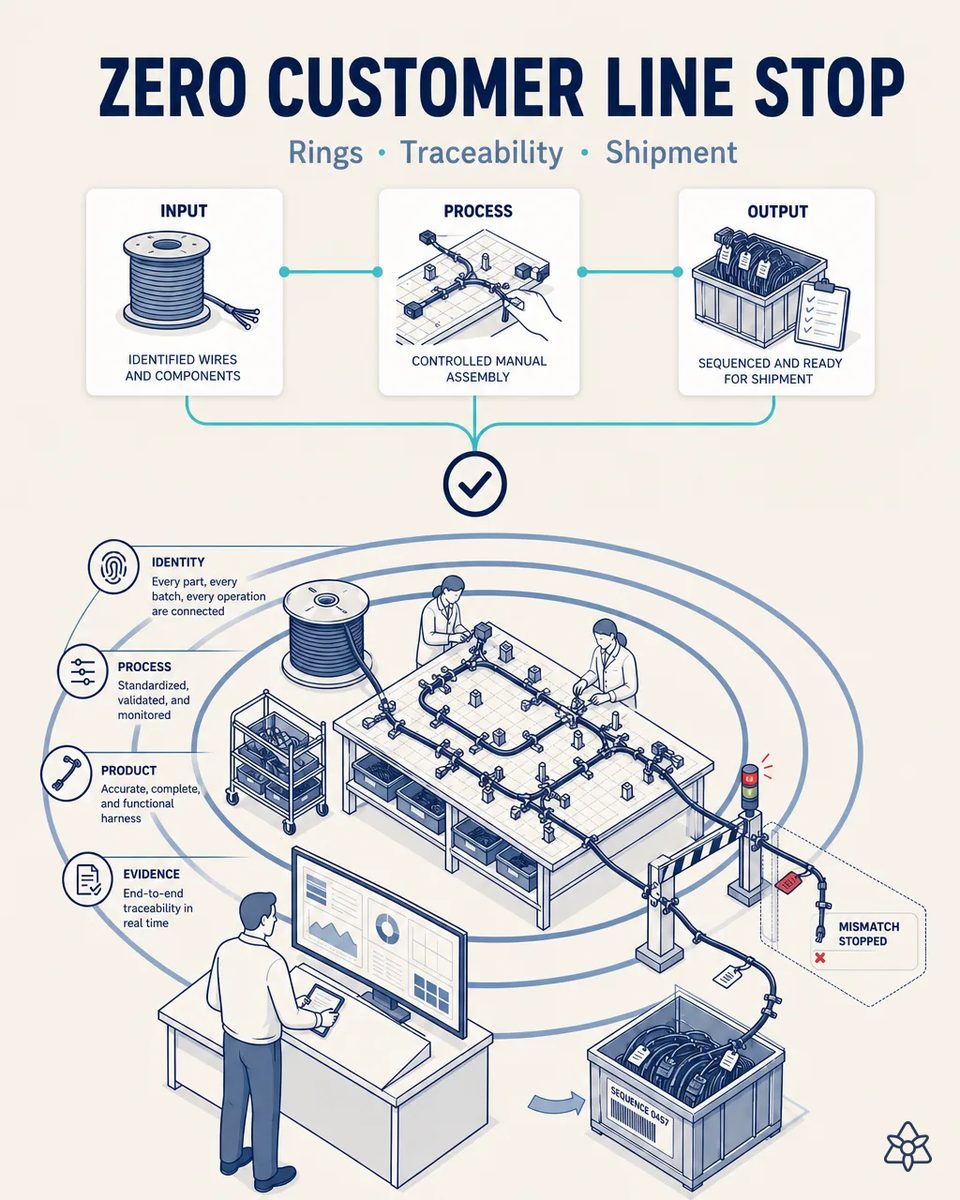
A single event is measured in hundreds of thousands. The reputational damage, in years of business.
A containment event combines direct cost per minute of downtime, customer charge-backs, your own people flown out to sort at the customer plant, a special audit, and damage to your supplier scorecard, which is what decides the award of the next programme. The impact of a single event is measured in hundreds of thousands of dollars; the reputational impact, in years of revenue. And the root cause is almost never exotic: a mixed component during a changeover, a missing clip the test cannot see, a badly traced terminal lot, a wrong shipping sequence. We have already walked through every one of them.
- A containment event combines cost per minute of downtime, customer chargeback, your own people sorting at their plant, a special audit and damage to your supplier score.
- And that score is what decides the award of the next programme.
- Its root cause is almost never exotic: a crossed component at a changeover, a missing clip the test cannot see, a badly traced terminal lot.
- What fails is not a particular barrier: it is that the barriers do not talk to each other.
Four rings: identity and material, process, product, and evidence.
The first ring is identity and material: which part number and revision are being built, with which reel and which terminal lot, validated by a human at second zero. The second ring is process: crimping is in window because the panel says so continuously and the lab confirms it without lag, and the changeover is verified point by point before start-up. JIDOKA with artificial intelligence does not allow production out of condition. The third ring is product: every harness passes the visual check on clips, retainers and taping that the electrical test cannot see, and the bench result enters the system tied to its harness. Two independent, complementary verifications, not redundant ones. The fourth ring is delivery and evidence: the live schedule and external alerts are cross-checked against what is actually built, and every harness travels with its dossier already composed. And SMED with artificial intelligence organises the changeovers so that all this verification is not paid for in productivity. And here is what is specific to this sub-sector. The four rings turn tacit knowledge into explicit verification, which is exactly what you need when turnover is structural. Quality stops depending on how many months the operator has been in the role, and the time to certify a person on a station gets shorter because the system walks with them. It replaces nobody: it makes someone who just arrived produce like someone with a year on the job.
You go from bounding containments by safety margin to bounding them by real traceability, which cuts the scope by an order of magnitude.
The four rings, one by one
| Ring | What it secures | With what |
|---|---|---|
| 1 · Identity and material | Which part number and revision, with which reel and lot | Connect + human validation at second zero |
| 2 · Process | The crimp in window and the changeover verified | Panel read continuously, lab with no lag, JIDOKA with AI |
| 3 · Product | Clips, retainers and taping the test cannot see | Edge at the final station + test bench integrated |
| 4 · Evidence | That all of the above can be demonstrated | Agents indexing by clause and by customer |
| Coordination | That the barriers talk to each other | One central memory shared by all four |
| Final decision | Authorise the shipment or stop | Signed by a person |
see the impact section; the attached pool details the before and after for this case.
Impact estimate — to validate against your numbers.
The block below is an estimate to be validated against your plant's actual data. We put it forward so the committee has an order of magnitude; we refine it during the assessment.
- Estimated payback 6-12 months, measured against the first containment event avoided.
- Containment scope cut by an order of magnitude, by bounding on real traceability.
- Less exposure on the supplier score, which is what decides the next award.
- And the eleven cases before this one stop being eleven separate projects and become one chain.
Estimated payback 6-12 months against the first containment event avoided You move from bounding containments by safety range to bounding them by real traceability, which cuts the scope by an order of magnitude. Estimated payback is six to twelve months against the first containment event avoided, and it protects the supplier scorecard and the award of future programmes, whose multi-year value is orders of magnitude larger. An estimate to validate against your own history.
And the fair question from the production manager
"Do we have to implement all twelve cases for this to work?" — no, and trying would be a bad idea. The rings are built in order: identity and material first, because it holds up the other three. Each ring pays on its own; what multiplies is that they share one central memory instead of living in four systems that do not talk.
[1] OpenAI paper "Why Language Models Hallucinate", 2025 — on the reliability of AI in anchored tasks.
What people ask about coordinating the four rings
Where do you start?
With the first ring, identity and material, because without knowing for certain what was built and with which component, the other three measure on sand. It also tends to have the shortest payback.
How long until the full chain is running?
It depends on the number of bays and references, but it is not framed as a single project: each ring goes into production on its own and pays from that moment.
Does this replace our quality system?
No. It leans on it and gives it what does not reach it today. Replacing the quality system of a certified automotive plant is not an AI project, it is something else.
What happens if one ring fails?
The others carry on, and that is by design. What is avoided is the current situation, where one barrier failing is not seen by any of the others.
How do you measure whether it is working?
By the average scope of containments and by the response time to a claim. Both can be measured today, before starting, and both are what the customer decides on.
More cases from this series
- The audit evidence pack assembles itselfEvery critical event leaves evidence indexed by clause and by customer requirement. The audit stops…
- The crimp lab spreadsheet reaches the ERP on its ownCrimp height, pull test and micrograph data reach the ERP with no transcription, and the quality module…
- The legacy crimp press panel starts talkingAn external camera digitises crimp height, counters and alarms from a legacy cut-and-crimp panel without…
- The supervisor who walks the floor and talks to the systemEarpiece and voice so the harness supervisor records and queries without stopping between boards. Weak…
- Nothing enters the system without a human signing itNothing the AI captures enters the system until a human signs it with two taps at the board. Humans in…
- The alert that today gets read too lateOEM and supplier emails read on arrival, cross-checked against the live schedule and turned into a…
Tell us what your last containment event at a customer plant cost you.
We work on your plant's real data, not ours. Assessment with no commitment.
Request estimated ROI within 48h ‹ See all cases of automotive wire harnesses See automotive