The audit evidence pack assembles itself
On audit day, whether certification, customer, or the special audit that follows an incident, someone spends one or two weeks rebuilding evidence: crimp records, calibrations, changeover checklists, test results, rework, operator training. The auditor asks for a specific traceability chain, the plant shows paper, and where there is a gap there is a finding. The evidence exists, but it is spread across six systems and four folders, and none of it is organised by the index the auditor actually uses.
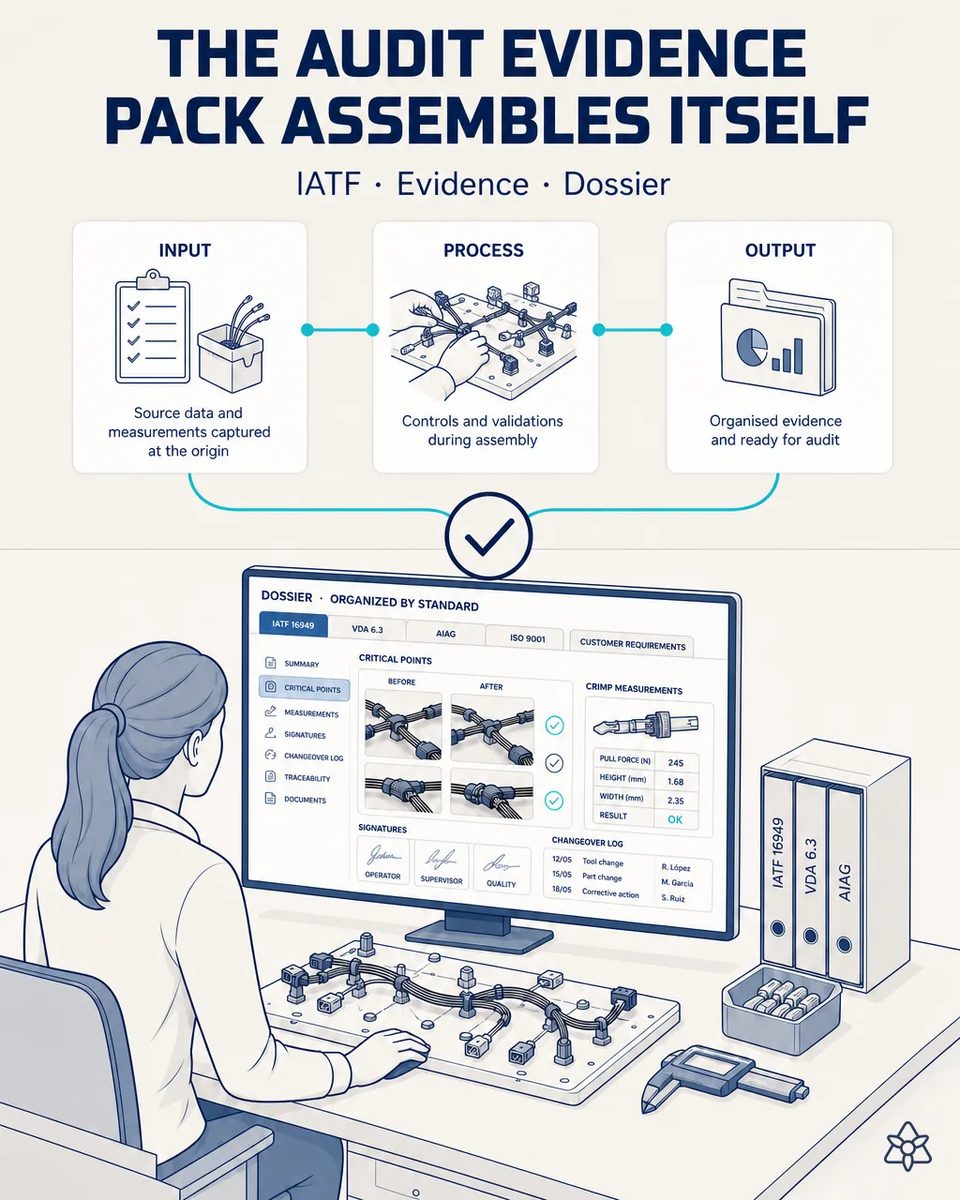
The evidence exists. It is spread across six systems and none of it is filed by the auditor's index.
The auditor asks for a specific traceability chain, the plant shows paper, and where there is a gap there is a finding. The evidence exists, but it is spread across six systems and four folders, and none of it is organised by the index the auditor actually uses. Worse still is the special audit after a customer incident. There the clock is running, the customer is watching, and the quality of the response decides whether the matter closes with an eight-discipline report or escalates to a new business hold.
- The auditor asks for a specific traceability, the plant produces paper, and where there is a gap there is a non-conformity.
- The evidence exists, but it lives spread across six systems and four folders.
- Worse is the special audit after an incident at the customer: there the clock runs and the customer is watching.
- The quality of the answer decides whether it closes with an eight-discipline report or escalates to new-business hold.
The agents as an organising layer over the central memory.
With the agents as an organising layer over central memory, every critical event leaves its record with its visual evidence: board start-up, changeover, test result, rework, applicator change. The agents index it against the automotive standard's clause map and against each customer's requirement format, and compose the dossier for a period or for a single harness on demand. The control plan stops being a document and becomes something you can prove was executed, event by event.
The control plan stops being a document and becomes something you can demonstrate was executed, event by event.
Audit preparation, before and after
| Aspect | Today | With iLEAN's agents |
|---|---|---|
| Preparing an audit | 1-2 weeks of the quality team | Minutes of generation |
| Where the evidence is | Six systems and four folders | One indexed central memory |
| Order of the pack | The plant's | The auditor's clause map |
| Each customer's format | Rebuilt by hand | Assembled on demand |
| Special audit after an incident | Against the clock | The harness's pack, already built |
| The control plan | A document | Something demonstrable event by event |
see the impact section; the attached pool details the before and after for this case.
Impact estimate — to validate against your numbers.
The block below is an estimate to be validated against your plant's actual data. We put it forward so the committee has an order of magnitude; we refine it during the assessment.
- Estimated payback 5-10 months, from recovering the quality team's time.
- From 1-2 weeks of preparation to minutes of generation.
- Fewer evidence gaps, which are the ones that turn into non-conformities.
- And in the special audit, an answer measured in hours rather than days — which is what decides whether it escalates.
Estimated payback 5-10 months · from 1-2 weeks of audit preparation to minutes From one or two weeks of preparation to minutes of generation. Estimated payback five to ten months through recovered quality and engineering time and, what really matters, through reduced risk of a major finding and of customer escalation. An estimate to validate.
And the fair question from the production manager
"Is the AI going to draft our answers to the auditor?" — no. The agents organise and index evidence that already exists and that the plant generated: board start-up, changeover, test result, rework, applicator change. Retrieving and ordering existing documents is an anchored task [1]. What gets said to the auditor is still said by the quality manager.
[1] OpenAI paper "Why Language Models Hallucinate", 2025 — on the reliability of AI in anchored tasks.
What people ask about the self-assembling audit pack
Does it work for the automotive standard and for each customer's format?
For both, and that is the point: the same evidence is indexed against the standard's clause map and against each OEM's particular requirements, which almost never line up.
What about the years before this was implemented?
They stay as they are. The automatic pack starts assembling from the first recorded event; the earlier history keeps living where it lives today.
Does it include visual evidence?
Yes, and it is what carries most weight in the special audit: the photo of the board start-up or of the point Edge marked is worth more than a tabular record.
Does it depend on having implemented the other eleven cases?
No, but it feeds on them. With Connect and Edge running the pack is rich; without them, the agents organise whatever exists, which is already more than six loose folders.
Who signs the pack?
The quality manager, as today. What changes is that they reach that signature with the pack assembled instead of with two weeks of collation behind them.
More cases from this series
- Zero customer line stop: four coordinated ringsFour cross-checked verification rings from reel to sequenced shipment, holding harness quality steady…
- The crimp lab spreadsheet reaches the ERP on its ownCrimp height, pull test and micrograph data reach the ERP with no transcription, and the quality module…
- The legacy crimp press panel starts talkingAn external camera digitises crimp height, counters and alarms from a legacy cut-and-crimp panel without…
- The supervisor who walks the floor and talks to the systemEarpiece and voice so the harness supervisor records and queries without stopping between boards. Weak…
- Nothing enters the system without a human signing itNothing the AI captures enters the system until a human signs it with two taps at the board. Humans in…
- The alert that today gets read too lateOEM and supplier emails read on arrival, cross-checked against the live schedule and turned into a…
Tell us how many days it costs you today to prepare a customer audit.
We work on your plant's real data, not ours. Assessment with no commitment.
Request estimated ROI within 48h ‹ See all cases of automotive wire harnesses See automotive