The alert that today gets read too late
Electronic data interchange brings the official schedule. But the things that break a shift arrive outside of it: an email from the customer's planner pulling a part forward in the sequence, a warning that the connector truck will arrive a day late, an authorised material deviation, a drawing revision change. All of that lands in one specific person's inbox, and they read it when they can. In a supplier shipping sequenced to several assembly plants, the window to react is measured in hours.
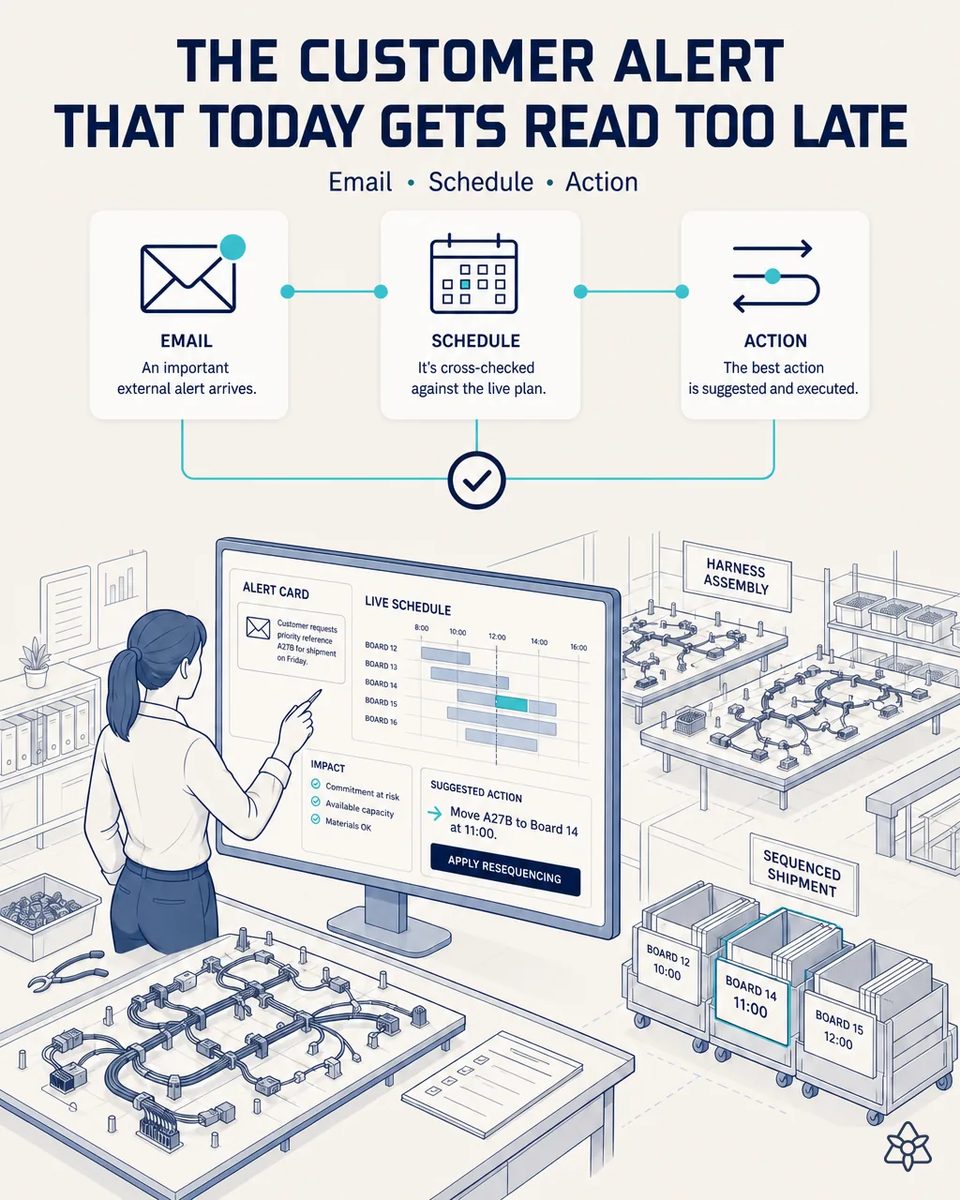
The window to react is measured in hours. The email gets read when there is time.
All of that lands in one specific person's inbox, and they read it when they can. In a supplier shipping sequenced to several assembly plants, the window to react is measured in hours. If the customer's message is read late in the afternoon, the night shift has already built the wrong mix. If the connector delay is discovered when the operator opens an empty box at the board, the line stops with its full crew standing inside it.
- Schedule changes, sequence pull-aheads, a delayed connector, a supplier quality alert: it all lands in one person's inbox, read when they can.
- For a supplier shipping sequenced to several assembly plants, the window to react is measured in hours.
- If the alert is read late in the afternoon, the night shift has already built the wrong mix.
- If a connector delay surfaces when the operator opens an empty box at the board, the line stops with its full manning inside.
Connect on silent copy over a dedicated inbox, twenty-four hours a day.
With Connect in chaotic-sources mode, iLEAN sits silently copied on a dedicated mailbox around the clock. The moment a message arrives, it extracts intent and entities: which part, what quantity, which destination, which window. It cross-checks against the live schedule and the critical component inventory, and alerts the right role with a concrete suggested action: resequence a board, pull a sub-assembly forward, trigger an expedited shipment, or simply confirm there is no impact. The person signs the decision; the AI prepares it.
The person signs the decision; the AI prepares it. What changes is not who decides, but that by the time they decide they already have the part, the quantity, the destination and the impact on the live schedule in front of them.
The external alert, before and after
| Aspect | Today | With iLEAN Connect |
|---|---|---|
| Who sees it | One person, when they open the mail | The right role, as it lands |
| Latency to reaction | Hours | Minutes |
| Cross-check with the live schedule | In someone's head, if there is time | Automatic |
| Cross-check with critical component stock | Looked up separately | Comes in the same alert |
| Weekends and night shift | Nobody reads it | Read all the same |
| What reaches the owner | The whole email | Extracted entities and a suggested action |
see the impact section; the attached pool details the before and after for this case.
Impact estimate — to validate against your numbers.
The block below is an estimate to be validated against your plant's actual data. We put it forward so the committee has an order of magnitude; we refine it during the assessment.
- Estimated payback 3-8 months.
- From hours of latency between the external alert and the plant's reaction, to minutes.
- Fewer board stoppages for a missing component — the stoppage that takes the whole manning with it.
- Fewer premium freight shipments, which are direct and unbudgeted cost.
Estimated payback 3-8 months · fewer board stoppages for missing parts and fewer premium freights From hours of latency between the external alert and the shop floor reaction, down to minutes. Estimated payback runs three to eight months through fewer board stoppages for missing components and fewer emergency freights. An estimate to validate.
And the fair question from the production manager
"Is the AI going to reply to our customer?" — no. It does not write, does not answer and confirms nothing outwards. Extracting intent and entities from a message that is already in front of it is an anchored task [1]; what it does with that is prepare the decision and put it in front of the right role. Whoever answers the OEM today still answers tomorrow.
[1] OpenAI paper "Why Language Models Hallucinate", 2025 — on the reliability of AI in anchored tasks.
What people ask about reading customer alerts
Do you need access to our corporate mail?
No. It works on a dedicated inbox that relevant traffic is forwarded to, or a silent copy of the scheduling and quality addresses. Nobody's personal mailbox is involved.
Our alerts come in three formats and some as a PDF attachment. Does that matter?
That is the normal case, which is why the mode is called chaotic sources. Email, PDF, customer portal and attached sheet are treated the same: what matters is the extracted entity, not the wrapper.
What does it do when an alert has no impact?
It says so, and that counts too. A good share of today's cost is that somebody has to read thirty messages to find the two that matter. Having the other twenty-eight marked no-impact gives that reading time back.
What if it gets the urgency wrong?
It comes with the suggested action and the original message one click away, so the person sees the reasoning. If it under-classifies, the message still shows up in the inbox as it does today; nothing is lost relative to the current situation.
Can it connect to the schedule in our planning system?
Yes, and that is what gives it value: without cross-checking against the live schedule, an alert is just a structured email. The specific interface is defined in the AI Discovery, and it is usually the one the execution system already uses.
More cases from this series
- The audit evidence pack assembles itselfEvery critical event leaves evidence indexed by clause and by customer requirement. The audit stops…
- Zero customer line stop: four coordinated ringsFour cross-checked verification rings from reel to sequenced shipment, holding harness quality steady…
- The crimp lab spreadsheet reaches the ERP on its ownCrimp height, pull test and micrograph data reach the ERP with no transcription, and the quality module…
- The legacy crimp press panel starts talkingAn external camera digitises crimp height, counters and alarms from a legacy cut-and-crimp panel without…
- The supervisor who walks the floor and talks to the systemEarpiece and voice so the harness supervisor records and queries without stopping between boards. Weak…
- Nothing enters the system without a human signing itNothing the AI captures enters the system until a human signs it with two taps at the board. Humans in…
Tell us how many hours pass today between a customer alert landing and the plant reacting.
We work on your plant's real data, not ours. Assessment with no commitment.
Request estimated ROI within 48h ‹ See all cases of automotive wire harnesses See automotive