Photographing the work order at every lot startup
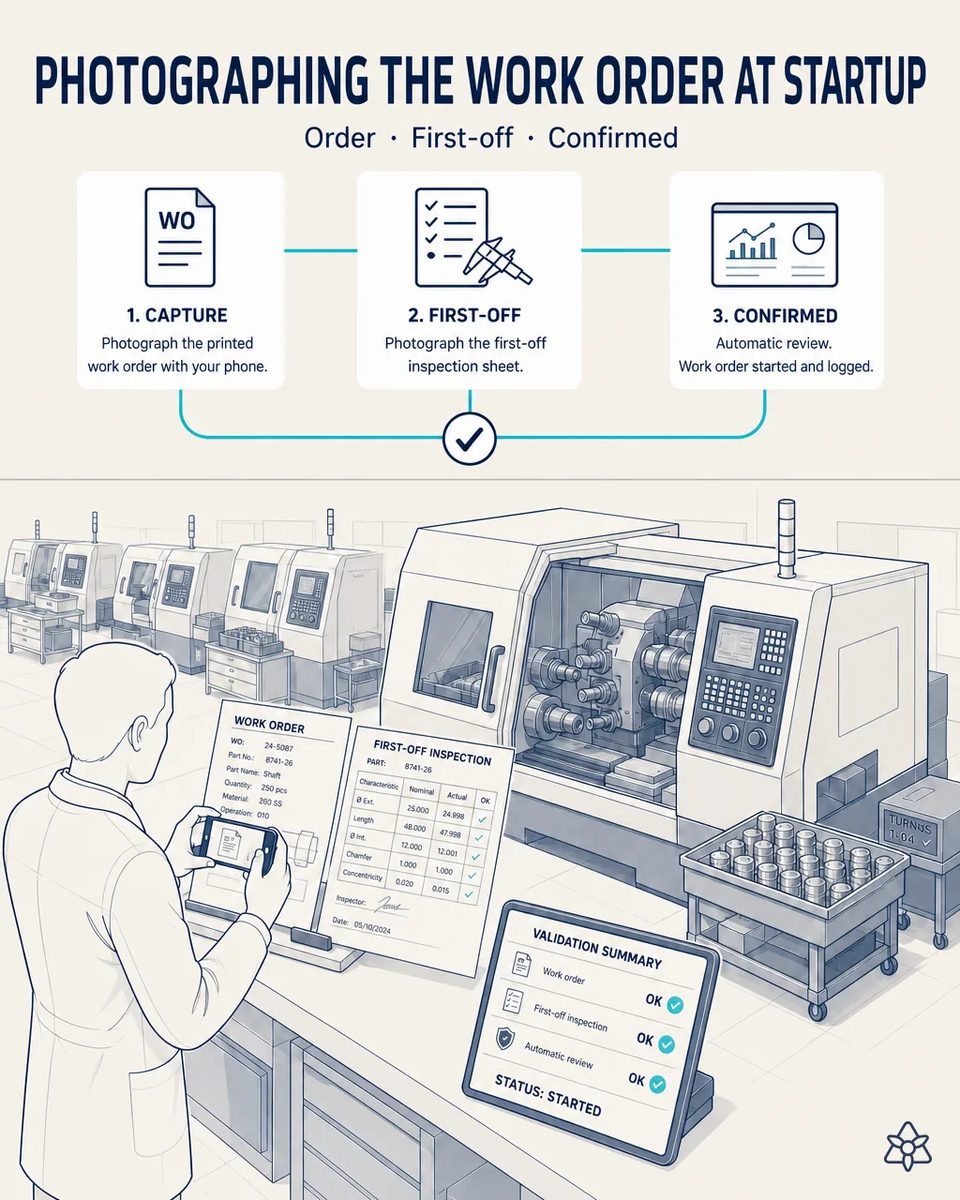
In a precision machining plant, the operator starts each shift with a printed work order and a hand-filled first-off inspection sheet. Those two documents define the lot, but today they disappear into a folder until someone collects them at day's end. With iLEAN Connect, the operator snaps two photos at startup and the lot exists in the central system instantly.
The lot is defined on paper that nobody reads until evening.
the work order prints from ERP data and any change (bar-stock lot, tool used, quality note) gets handwritten. The first-off sheet is handwritten by IATF requirement. Both can sit 4-8 hours undigitized, and if a complaint arrives that same afternoon, someone has to manually reconstruct which lathe and which tool produced the part.
- The work order prints from the ERP, but the moment reality deviates it gets corrected in pen: a different bar-stock lot, a swapped insert grade, a quality note on a thread or a chamfer.
- The first-off sheet is handwritten because IATF 16949 asks for it: critical dimensions, concentricity, chamfers, thread gauge result and the inspector's signature.
- Both documents can sit 4 to 8 hours in a folder next to the lathe before anyone in the technical office types them into the ERP.
- If a complaint lands that same afternoon, someone has to walk the floor asking which lathe and which tool produced that shaft or that brake piston, and the answer depends on who remembers.
Connect in photo mode — the paper stays, the lot goes live.
Connect photo mode. A grounded model extracts structured fields (part number, bar-stock lot, lathe, first-off dimensions, sign-off) from the two photos into central memory. Zero habit change for the operator; early human verification (in-line tablet) confirms before the data crosses into the ERP.
Nothing is redesigned and nobody types more: the operator adds two photos to a routine that already exists. In a plant where every lathe starts several lots per shift, that is the cheapest traceability gain on the table, and usually the first case a plant manager approves because it asks nothing of the floor.
Lot startup on a clipboard versus lot startup in memory
| Aspect | Today, on paper | With iLEAN Connect |
|---|---|---|
| When the lot appears in the system | 4-8 h later | At the moment of startup |
| Pen corrections on the work order | Lost unless retyped | Extracted and tied to the lot |
| First-off critical dimensions | In a binder by the lathe | Queryable by part number |
| Which lathe and which insert | Asked around the floor | One web lookup by lot |
| Technical-office transcription | Every order, every day | Recovered |
| What the operator does differently in bar turning | — | Same paper, plus two photos |
4-8h of startup-digitization latency → instant. Manual reconstruction of which lathe/tool produced a lot → instant web lookup by lot.
Impact estimate — to be validated with your numbers.
The block below is an estimate to be validated against your plant's actual data. We put it forward so the committee has an order of magnitude; we refine it during the assessment.
- Estimated payback 4-9 months, depending on how many work orders start per day across the lathe fleet.
- The saving comes from transcription time in the technical office, which today goes into copying work orders and first-off sheets lot after lot.
- Startup digitization goes from 4-8 hours to instant, so the lot is queryable while it is still running.
- And the question of which lathe and which tool produced a lot becomes a web lookup instead of a floor walk.
estimated payback 4-9 months depending on daily order volume, recovered technical-office transcription time. *Estimate to be validated*.
And the fair question from the production manager
“What if it misreads a diameter on the first-off sheet?” — reading fields from a sheet with a known layout is an anchored task, where the best models drop below 1.5% error [1]. And there is a second net: the summary goes to the tablet at the lathe, any value outside the drawing tolerance is highlighted, and the operator confirms or corrects it before anything crosses into the ERP.
[1] OpenAI paper "Why Language Models Hallucinate", 2025 — on the reliability of AI in anchored tasks.
What people ask about photographing the work order
Do we have to change our first-off inspection sheet?
No. It stays handwritten, as your control plan requires, and the model reads the layout you already use, including the nominal, actual and OK columns. Changing a document the control plan references would be extra work nobody needs.
Does it catch the bar-stock lot written in pen on the order?
Yes, and that is the field that matters most, because it is the link between the heat and the turned part. It is extracted and tied to the lot like any printed field, and a value read with low confidence is flagged instead of guessed.
What happens with a lathe that runs three short lots in one shift?
Each startup is two photos and becomes its own lot record with its own first-off. On sliding-head lathes with frequent part-number changes, that is where the paper gap is widest and where it closes fastest.
Do we need ERP integration on day one in bar turning?
No. It works from the first startup against iLEAN's central memory, which already answers the lot lookup. The push into the ERP is connected later, once the value is visible to production and quality.
Can the operator use their own phone?
A plant phone or a tablet at the lathe works best, so photos stay inside the plant's systems. What matters is that the photo is taken at startup, not at the end of the shift when the folder is collected.
More cases from this series
- From delivery note and heat certificate to ERP, by photoPhotograph the delivery note and heat certificate; after one validation tap, it's all in the ERP. Less…
- Early human verification: two taps before it hits the ERPEvery iLEAN capture goes through an in-line tablet: the operator confirms with two taps before data…
- The shift lead's knowledge, captured hands-freeWearing an earpiece, the shift lead dictates issues while walking the floor; iLEAN structures them and…
- The laser marker, stitched to the ERP with no manual typingLot and part number travel automatically from ERP to the laser marker, eliminating the typing error that…
- The vintage multi-spindle lathe that now "talks"An external camera reads RPM, feed rate and wear off the vintage panel; the machine stays itself, but…
- From the metrology spreadsheet to the ERP, no retypingiLEAN detects the metrology spreadsheet on save and, after validation, pushes it to the ERP. Up to -80%…
Tell us how many hours a lot startup takes to reach your ERP today.
We work on your plant's real data, not ours. Assessment with no commitment.
Request estimated ROI within 48h ‹ See all cases of precision machining See automotive