From the metrology spreadsheet to the ERP, no retyping
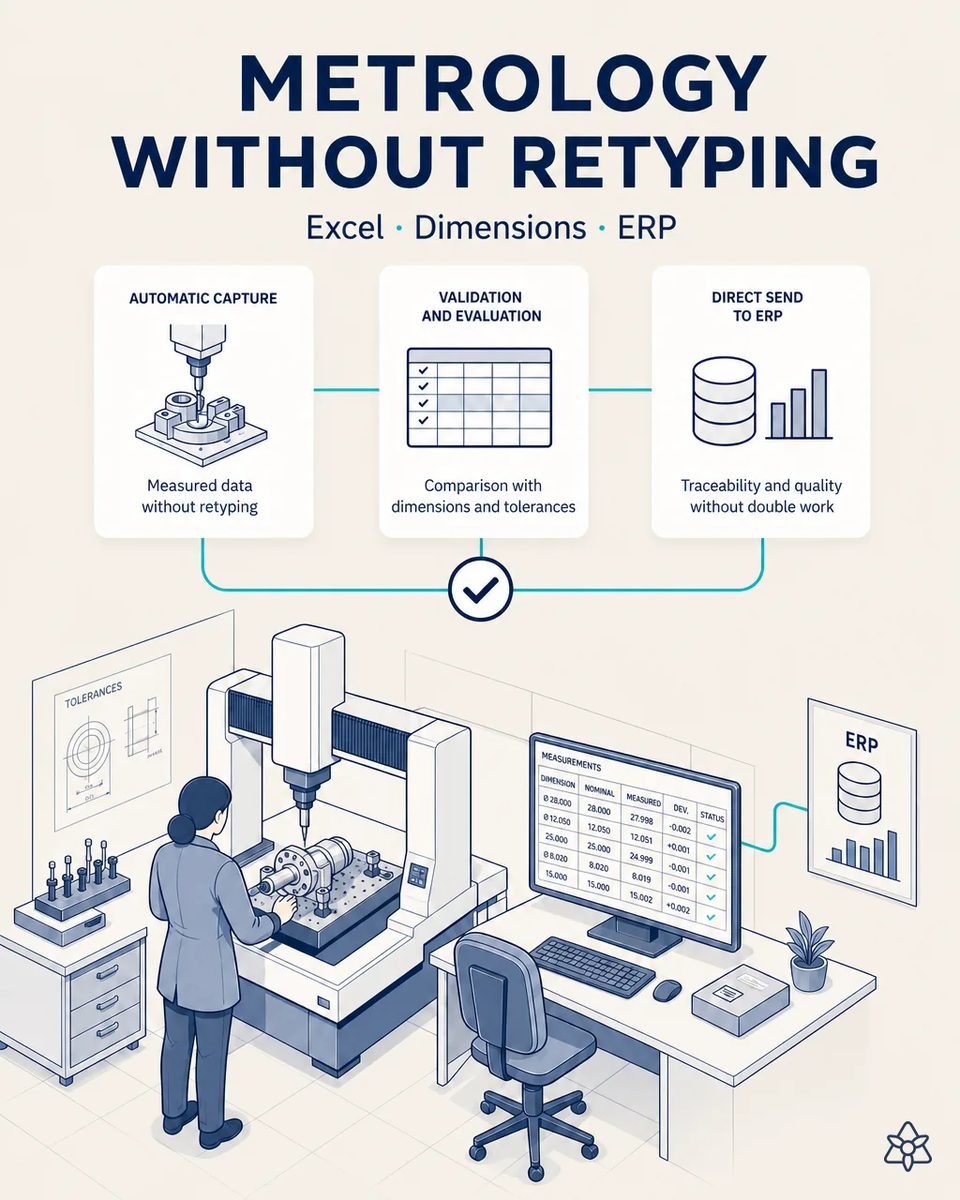
The quality lead fills out a spreadsheet every lot with CMM-measured dimensions, roughness and hardness. That spreadsheet lives in a folder the ERP never sees. iLEAN Connect detects it, absorbs it on save and, after validation, pushes it to the ERP.
The real measurements and the official ones live in different worlds.
two parallel worlds — the real spreadsheet (live dimensions) and the official ERP (data retyped days later by someone who spends recurring time copy-pasting and makes errors on critical dimensions).
- Every lot, the quality lead fills a spreadsheet with CMM dimensions, surface roughness, hardness and the Cpk of the critical dimensions agreed in the PPAP. That is the number the OEM reviews in the PPAP and at every capability review.
- That spreadsheet sits in a shared folder the ERP never sees, so the official record lags reality by days. By the time the ERP shows a problem, the lot has already shipped.
- Days later someone copies it into the quality module, and the errors land exactly on the critical dimensions where a decimal decides whether a lot is in or out. Those errors are found, if at all, when a customer asks for the data.
- Meanwhile the plant pays for several quality-module seats whose main job is retyping what already exists in a file. Few people question that cost because it has always been there.
Connect listening inward — it watches the metrology folder, not the person.
Connect's "listen inward" mode — it watches the shared folder, not the person: reads the delta the moment the file saves, parses it with a grounded model, validates on screen, and pushes to the ERP via API.
The quality lead keeps their spreadsheet and their method. What disappears is the copy-paste afterwards, and with it most of the reason for paying several seats in the quality module. The CFO sees the license line drop; quality sees SPC that is finally current. Nobody in quality has to learn a new tool to make it happen.
The CMM spreadsheet today versus the spreadsheet that flows
| Aspect | Today | With iLEAN Connect |
|---|---|---|
| Lag from measurement to ERP | Days | Instant, after validation |
| Recurring retyping | Every lot | Zero |
| Errors on critical dimensions | Typos in the decimal | Read from the source file |
| SPC and Cpk in the ERP | Out of date | Fed lot by lot |
| Quality-module seats | Several | The single validator |
| The quality lead's workflow | — | Same spreadsheet, same folder |
days of lag between real measurement and ERP data → instant. Recurring transcription time → zero.
Impact estimate — to be validated against your license invoice.
The block below is an estimate to be validated against your plant's actual data. We put it forward so the committee has an order of magnitude; we refine it during the assessment.
- Estimated payback 4-9 months, mostly from the license line.
- Typically a 50-80% reduction in quality/metrology module licenses, from several seats down to the one validator.
- Lag between real measurement and ERP data goes from days to instant, so a drifting Cpk is visible while the lot is still on the lathe.
- And recurring transcription time drops to zero, along with the typing errors on critical dimensions.
CFO angle — typically a 50-80% reduction in quality/metrology module licenses (from several seats down to the one validator), estimated payback 4-9 months. *Estimate to be validated*.
And the fair question from the production manager
“What if it picks up the wrong column of a messy spreadsheet?” — parsing a sheet whose structure repeats every lot is an anchored task, where the best models drop below 1.5% error [1]. And nothing reaches the ERP until the validator sees the parsed values on screen, next to the drawing tolerance, and approves them.
[1] OpenAI paper "Why Language Models Hallucinate", 2025 — on the reliability of AI in anchored tasks.
What people ask about pushing CMM data to the ERP
Does the quality lead have to change their template?
No. It reads the template already in use, including extra tabs for roughness, hardness or thread gauge results. If the template changes later, the parser is adjusted, not the person. Formulas, merged cells and color codes used by quality are respected.
What if the file is saved several times during the day?
It reads the delta on each save, so only new or changed rows are proposed for validation. Nothing is pushed twice and nothing already approved is overwritten silently. If two people edit the file at the same time, the last saved version is the one proposed, and the previous one is kept in the history.
Does it flag a dimension out of tolerance?
Yes. A value outside the drawing tolerance is highlighted on the validation screen before anything is pushed, so the validator sees it before the ERP does. Values close to the limit can also be marked, which is useful for critical dimensions with a tight Cpk target.
Can it feed SPC charts in the ERP?
That is one of the main gains: with data arriving lot by lot, Cpk on critical dimensions stops being calculated at month end and becomes a live signal. Trends per critical dimension and per lathe become visible without anyone building a chart by hand.
Where does the license saving come from?
The seats used mainly for retyping are no longer needed. Only the person who validates keeps access, which is where the 50-80% range comes from. The exact figure depends on how many seats you have today and what each one is used for, which we review with you.
More cases from this series
- From delivery note and heat certificate to ERP, by photoPhotograph the delivery note and heat certificate; after one validation tap, it's all in the ERP. Less…
- Early human verification: two taps before it hits the ERPEvery iLEAN capture goes through an in-line tablet: the operator confirms with two taps before data…
- The shift lead's knowledge, captured hands-freeWearing an earpiece, the shift lead dictates issues while walking the floor; iLEAN structures them and…
- The laser marker, stitched to the ERP with no manual typingLot and part number travel automatically from ERP to the laser marker, eliminating the typing error that…
- The vintage multi-spindle lathe that now "talks"An external camera reads RPM, feed rate and wear off the vintage panel; the machine stays itself, but…
- Raw-material delay alerts, rescheduled in timeiLEAN reads the heat-delay alert instantly and suggests which lathes to reschedule before they run out…
Tell us how many quality-module seats you pay for and who uses them.
We work on your plant's real data, not ours. Assessment with no commitment.
Request estimated ROI within 48h ‹ See all cases of precision machining See automotive