From delivery note and heat certificate to ERP, by photo
The truck arrives with steel, brass or aluminum bar stock. The receiving lead photographs the delivery note and the 3.1 heat certificate instead of typing line by line into the ERP; iLEAN digitizes both documents in seconds.
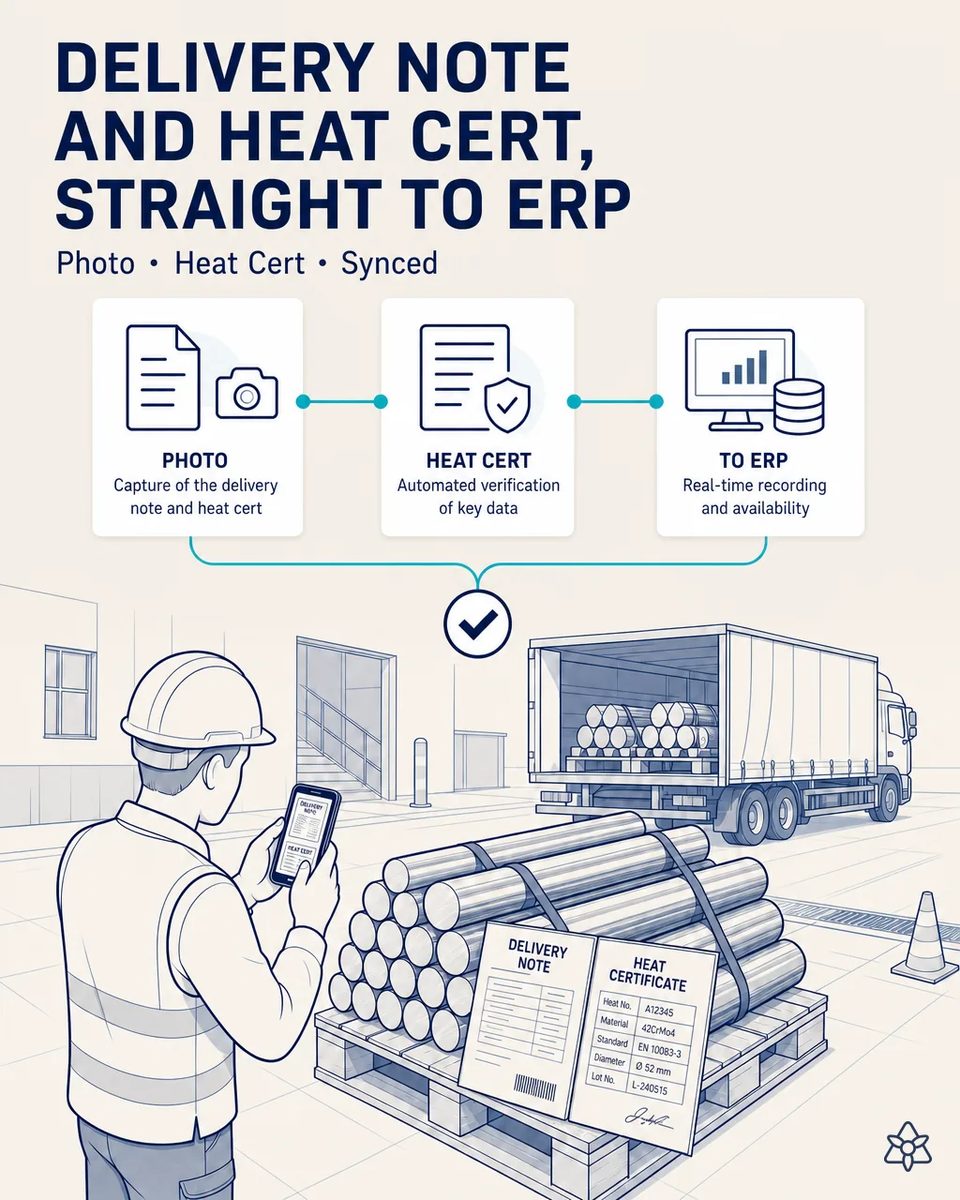
Heat-to-part traceability starts with someone typing next to a waiting truck.
the carrier waits racking up demurrage while the receiving lead types every delivery-note line; if rushed, heat numbers get mistyped and surface weeks later in an untraceable nonconformity.
- The truck arrives with steel, brass or aluminum bar and the carrier waits while the receiving lead types every delivery-note line into the ERP, bundle by bundle. With several mills, each one uses its own format.
- Demurrage keeps running, so the job gets rushed, and the 3.1 certificate is filed on paper to be dealt with later. Finding it later means searching through binders sorted by date, not by heat.
- In a hurry, a heat number gets one digit wrong, and it only surfaces weeks later as a nonconformity nobody can trace back to the bar it came from. By then the bar has been cut, turned and possibly shipped.
- On a safety part, a heat that cannot be traced to its 3.1 certificate is a finding waiting for the next IATF audit or the next OEM request. And that request usually comes with a deadline measured in hours.
Connect photo-to-analog — the supplier's documents, exactly as they come.
Connect's photo-to-analog mode. Vision AI recognizes the delivery note and heat certificate format without asking the supplier to change theirs; one-tap validation on an industrial tablet.
Suppliers are not asked to change a single format. The receiving lead photographs what arrives, confirms with one tap, and the heat is linked to the bar from the first minute instead of whenever someone finds time to type — which, on a busy day, can be never. The bar goes to the rack with its heat already in the system.
Receiving by keyboard versus receiving by camera
| Aspect | Today | With iLEAN Connect |
|---|---|---|
| Carrier at receiving | Waiting, with demurrage | Released in minutes |
| Heat number entry | Typed under pressure | Read from the certificate |
| Chemical analysis and grade | Filed on paper | Extracted and linked to the heat |
| Supplier formats | One more to learn each time | Recognized as they are |
| Receiving-module seats | Several | Reduced to validation |
| Heat to turned part | Rebuilt when asked | Complete from receiving |
slow receiving with carrier demurrage → minutes. Mistraced heats → complete heat-to-part traceability by photo.
Impact estimate — to be validated against what receiving costs you.
The block below is an estimate to be validated against your plant's actual data. We put it forward so the committee has an order of magnitude; we refine it during the assessment.
- Estimated payback 3-8 months, from licenses and demurrage together.
- Typically a 50-70% reduction in receiving/warehouse module licenses, because typing seats become one validator.
- Carrier demurrage eliminated: receiving drops from slow to minutes. The carrier leaves as soon as the photos are confirmed, not when the typing ends.
- And mistraced heats give way to complete heat-to-part traceability by photo, from the bar rack to the laser mark.
CFO angle — typically a 50-70% reduction in receiving/warehouse module licenses plus eliminated carrier demurrage, estimated payback 3-8 months. *Estimate to be validated*.
And the fair question from the production manager
“A wrong heat number on a brake part is serious — can we trust a photo?” — reading fields from a heat certificate with a recognizable layout is an anchored task, where the best models drop below 1.5% error [1]. And the heat number is cross-checked against the delivery note and the purchase order before the receiving lead confirms it, so a mismatch stops receiving instead of entering the ERP.
[1] OpenAI paper "Why Language Models Hallucinate", 2025 — on the reliability of AI in anchored tasks.
What people ask about receiving bar stock by photo
Do our mills need to send a standard certificate?
No. Vision recognizes each supplier's delivery note and 3.1 certificate as they are, including scanned, stamped or multi-page copies. Asking suppliers to change format is exactly what this case avoids. New suppliers are added without a project, because the model reads the document, not a template.
What if one delivery covers several heats?
Each heat is extracted separately and linked to its bundles, so the split is kept from receiving onward and each lathe lot inherits the right heat. Partial bundles and remnants returned from the lathes keep their heat as well.
Does it read the chemical analysis and mechanical properties?
Yes. Grade, analysis and properties are extracted with the heat, which is what quality checks against the drawing and material specification. If a value falls outside the specification, it is flagged before the bar reaches a lathe.
What if the diameter on the certificate differs from the order?
It is flagged on the validation screen. Receiving does not close until a person decides whether to accept, quarantine or return the bar. The decision and who made it are stored with the heat, which is the evidence an auditor asks for.
Does capture need special hardware at receiving?
No. A plant phone is enough for the photos, and the validation tap can happen on the same phone or on a tablet at the receiving desk. Photos can also be taken of bundle tags, which helps when a bar is split across several lots.
More cases from this series
- Early human verification: two taps before it hits the ERPEvery iLEAN capture goes through an in-line tablet: the operator confirms with two taps before data…
- The shift lead's knowledge, captured hands-freeWearing an earpiece, the shift lead dictates issues while walking the floor; iLEAN structures them and…
- The laser marker, stitched to the ERP with no manual typingLot and part number travel automatically from ERP to the laser marker, eliminating the typing error that…
- The vintage multi-spindle lathe that now "talks"An external camera reads RPM, feed rate and wear off the vintage panel; the machine stays itself, but…
- From the metrology spreadsheet to the ERP, no retypingiLEAN detects the metrology spreadsheet on save and, after validation, pushes it to the ERP. Up to -80%…
- Raw-material delay alerts, rescheduled in timeiLEAN reads the heat-delay alert instantly and suggests which lathes to reschedule before they run out…
Tell us how long a bar delivery takes to be received in your ERP.
We work on your plant's real data, not ours. Assessment with no commitment.
Request estimated ROI within 48h ‹ See all cases of precision machining See automotive