The vintage multi-spindle lathe that now "talks"
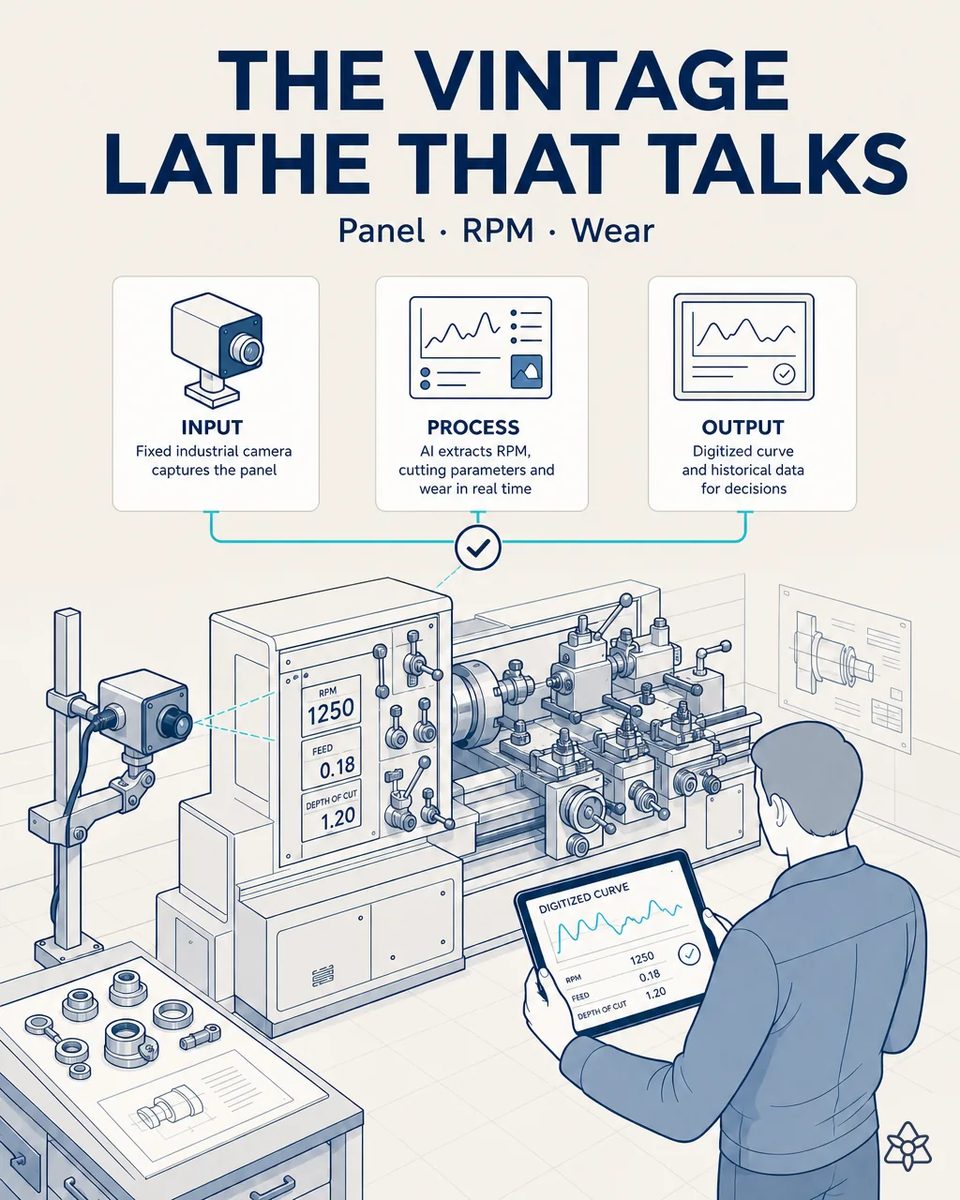
A decolletage plant's lathe fleet often includes 10-20 year old machines with networkless proprietary panels showing RPM, feed, power draw and estimated tool wear. Replacing one costs hundreds of thousands of euros and weeks of downtime. With iLEAN Connect, an external camera aimed at the panel is enough: the machine stays itself, but those parameters are now logged in central memory, lot by lot.
The most expensive lathe in the plant forgets everything every cycle.
the multi-spindle lathe is the most expensive asset and the line's bottleneck. Its panel shows everything a machining supervisor would need to correlate cutting parameters with wear and out-of-spec parts — but that data dies on screen every cycle.
- A bar turning fleet often runs multi-spindle lathes that are 10 to 20 years old, with proprietary panels and no network port, because they still turn good parts and nobody wants to touch them.
- That panel shows RPM, feed rate, spindle load and estimated insert wear — exactly what a supervisor needs to explain an out-of-spec thread or a diameter drifting toward its limit.
- The data dies on screen at the end of every cycle, so nobody can correlate a cutting parameter with the parts that failed, and every root-cause discussion starts from opinions.
- Replacing one of those lathes costs hundreds of thousands of euros and weeks of downtime on the machine that is already the line's bottleneck.
Connect in photo mode on the panel — the lathe stays itself, but now it talks.
Connect photo mode on the panel. A fixed industrial camera plus LLM-grounded OCR reads every value and structures a time series per lot/spindle, cross-referenced with the ERP.
Nothing is wired into the control and no software is touched. The camera reads what the operator already sees, and that is what turns fleet renewal from an urgency into a decision you can schedule — with data per spindle instead of a hunch about which machine is worn out.
The silent multi-spindle versus the lathe on record
| Aspect | Today | With iLEAN Connect |
|---|---|---|
| RPM, feed and spindle load | Visible, never stored | Time series per lot and spindle |
| Insert wear trend | The operator's feel | A curve you can query |
| Out-of-spec thread or diameter | Cause unknown | Root cause per lot in minutes |
| The lathe's control | — | Untouched, no ports opened |
| Fleet renewal | Pressed by lack of data | Deferrable with full visibility |
| Link to the ERP lot | None | Cross-referenced automatically |
zero correlation between cutting parameter and out-of-spec part → root-cause analysis per lot in minutes. Fleet renewal becomes deferrable without losing visibility.
Impact estimate — to be validated with your numbers.
The block below is an estimate to be validated against your plant's actual data. We put it forward so the committee has an order of magnitude; we refine it during the assessment.
- Estimated payback 5-10 months, counted on avoided capex and scrap together.
- Avoided lathe-renewal capex: the machine keeps producing and stops being a blind spot in the fleet.
- Scrap reduction from correlating cutting parameters with defects, which is impossible today because the parameters are never stored.
- And root-cause analysis per lot drops from guesswork to minutes, which is what the OEM measures when a complaint arrives.
estimated payback 5-10 months, avoided lathe-renewal CAPEX, scrap reduction through parameter-to-defect correlation. *Estimate to be validated*.
And the fair question from the production manager
“Can a camera reading an old panel be precise enough?” — the task is anchored: fixed screen, fields in known positions and expected physical ranges for each spindle, where the best models drop below 1.5% error [1]. And any reading outside the physically possible range is discarded instead of stored, so the series stays clean enough to defend in front of a customer.
[1] OpenAI paper "Why Language Models Hallucinate", 2025 — on the reliability of AI in anchored tasks.
What people ask about reading the multi-spindle panel
Does the lathe's warranty or validation change?
No. Nothing is installed on the control, no cable is connected and no port is opened. The camera sits outside the guard, on its own stand, and can be removed in minutes without leaving a trace on the machine. The installation is usually done during a planned stop, not during production.
Can it separate readings by spindle?
Yes. The series is structured per lot and per spindle, which is what lets you see that one position is wearing inserts faster than the others or running a different load for the same part number. That comparison between spindles is usually the first finding, and it often explains scrap that was blamed on the bar.
What if the panel mixes analog dials and a small display?
Both are read. Dials are common on older multi-spindle machines and are handled as fields with a known scale and range, so a needle reading is stored the same way as a digit. If the panel has a backlit display that flickers, capture is synchronized so the frame is read when the value is stable.
Does it predict when to change an insert?
It gives you the wear history against the parts produced and the defects found. With that, the change interval stops being a fixed number on a sheet and becomes a decision backed by data from your own lathe. It also shows whether a premium insert grade actually lasts longer on your part number, which is a purchasing question as much as a production one.
Is it worth it on a sliding-head lathe too?
Yes, the pattern is the same and the camera setup is simpler. You usually start with the multi-spindle because it is the bottleneck and the most expensive asset to replace. Once the first lathe is read, adding more is mostly a matter of mounting cameras.
More cases from this series
- From delivery note and heat certificate to ERP, by photoPhotograph the delivery note and heat certificate; after one validation tap, it's all in the ERP. Less…
- Early human verification: two taps before it hits the ERPEvery iLEAN capture goes through an in-line tablet: the operator confirms with two taps before data…
- The shift lead's knowledge, captured hands-freeWearing an earpiece, the shift lead dictates issues while walking the floor; iLEAN structures them and…
- The laser marker, stitched to the ERP with no manual typingLot and part number travel automatically from ERP to the laser marker, eliminating the typing error that…
- From the metrology spreadsheet to the ERP, no retypingiLEAN detects the metrology spreadsheet on save and, after validation, pushes it to the ERP. Up to -80%…
- Raw-material delay alerts, rescheduled in timeiLEAN reads the heat-delay alert instantly and suggests which lathes to reschedule before they run out…
Tell us which lathe in your fleet you would most like to hear from.
We work on your plant's real data, not ours. Assessment with no commitment.
Request estimated ROI within 48h ‹ See all cases of precision machining See automotive