Raw-material delay alerts, rescheduled in time
Mid-morning, an email arrives from the steel or brass supplier warning of a delay on a bar-stock delivery scheduled for that afternoon. It lands in an inbox nobody watches in real time, while several lathes are already scheduled to run that material. With iLEAN Connect, the system reads the email instantly, cross-references active work orders and alerts with the concrete rescheduling action.
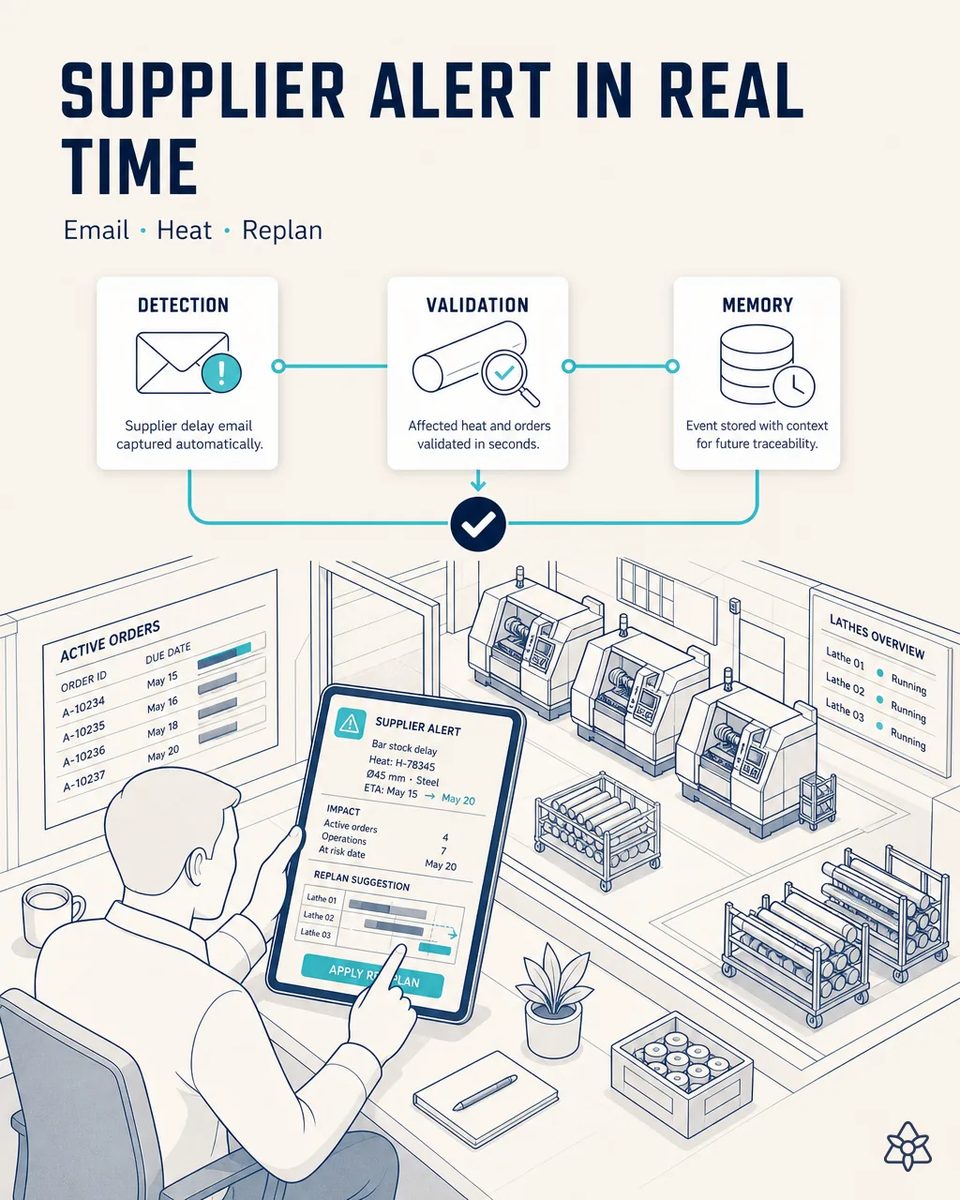
The email that decides the afternoon lands in an inbox nobody is watching.
critical supplier alerts land by email with specific people who can't watch the inbox in real time; by the time they're read, lathe scheduling is already broken.
- Mid-morning the steel or brass supplier writes: the ground bar due this afternoon slips two days, or arrives in a different diameter than ordered.
- The message goes to a buyer who is in a meeting, while several lathes are already scheduled to run that heat and that diameter as soon as the current lot finishes.
- By the time someone reads it, the lathe has been set up for a bar that is not coming, and the changeover time is already lost twice: once to set up, once to undo.
- Nobody ignored anything: the channel was simply never designed for the speed of a bar turning schedule, where a lathe can finish a lot in a couple of hours.
Connect in chaotic-sources mode — a dedicated mailbox in silent copy, 24/7 in bar turning.
Connect's chaotic-sources mode — a dedicated mailbox in silent copy 24/7. A model extracts intent (supply delay) and entities (supplier, heat number, diameter, date), cross-references the ERP, and returns the concrete action to the right role.
The supplier does not change how they write, and the buyer does not change how they work. What changes is that the notice is read and crossed with the lathe schedule in seconds, and the right person gets an action — which lathe to swap to which order — not just another email to interpret. Over a few months it also builds a record of which suppliers slip and how often.
The delay in an inbox versus the delay on the lathe plan
| Aspect | Today | With iLEAN Connect |
|---|---|---|
| Time to read the notice | Hours | Seconds |
| What gets extracted | Whatever the reader notices | Supplier, heat, diameter, new date |
| Lathes affected | Worked out by hand | Listed from active work orders |
| Changeover for missing bar | Already done, then undone | Avoided |
| Who acts | Whoever opens the email | The role that owns the reschedule |
| Record of the event | Buried in a mailbox | Stored with context for traceability |
hours of human latency → seconds. Lathe rescheduling based on real-time data instead of hours-old reading.
Impact estimate — to be validated with your numbers.
The block below is an estimate to be validated against your plant's actual data. We put it forward so the committee has an order of magnitude; we refine it during the assessment.
- Estimated payback 3-7 months, depending on how often supply alerts arrive.
- Idle lathes caused by poor information flow stop happening, and so do changeovers that have to be undone.
- Human latency goes from hours to seconds, regardless of who is in a meeting or on leave.
- And the reschedule is based on real-time data, not on an email read after lunch, with the event stored for the next supplier review.
avoided idle lathes from poor information flow, estimated payback 3-7 months depending on alert frequency. *Estimate to be validated*.
And the fair question from the production manager
“What if it misreads the heat number or the diameter?” — pulling known entities out of a supplier message is an anchored task, where the best models drop below 1.5% error [1]. And the reschedule is only a proposal: the planner sees it with the original email next to it, checks the extracted heat and diameter, and applies it or not.
[1] OpenAI paper "Why Language Models Hallucinate", 2025 — on the reliability of AI in anchored tasks.
What people ask about catching bar stock delays
Which mailbox does it read?
A dedicated one that receives a silent copy of supplier mail, configured with your IT team. Nobody's personal inbox is opened, and the buyer keeps receiving everything as before. Access is limited to that mailbox and logged.
Can it tell a delay from a routine dispatch confirmation?
Yes. It classifies intent first: a confirmation is filed, while a delay, a partial delivery or a change of diameter triggers the cross-check against the lathes that depend on that bar. Messages in other languages, or with the delay hidden in an attached PDF, are handled the same way.
Does it know which lathes are loaded with that diameter?
It crosses the heat and diameter with the active work orders in the ERP, so it returns the specific lathes and lots at risk with their due dates, not a generic warning to the whole plant. If the bar is already partially in stock, it also says how many hours each lathe can keep running.
What if the supplier offers an alternative heat or grade?
It is flagged for a human decision, because a substitute material on a safety part needs quality approval and may affect the PPAP already submitted to the OEM. The decision and the reason are stored with the heat, which helps when the PPAP is reviewed later.
Does it reschedule the lathes by itself?
No. It proposes the swap and the planner applies it with one action. Humans in command, always: the system never changes the lathe plan on its own. If the planner ignores the proposal, nothing happens on the floor; the alert simply stays open until someone closes it.
More cases from this series
- From delivery note and heat certificate to ERP, by photoPhotograph the delivery note and heat certificate; after one validation tap, it's all in the ERP. Less…
- Early human verification: two taps before it hits the ERPEvery iLEAN capture goes through an in-line tablet: the operator confirms with two taps before data…
- The shift lead's knowledge, captured hands-freeWearing an earpiece, the shift lead dictates issues while walking the floor; iLEAN structures them and…
- The laser marker, stitched to the ERP with no manual typingLot and part number travel automatically from ERP to the laser marker, eliminating the typing error that…
- The vintage multi-spindle lathe that now "talks"An external camera reads RPM, feed rate and wear off the vintage panel; the machine stays itself, but…
- From the metrology spreadsheet to the ERP, no retypingiLEAN detects the metrology spreadsheet on save and, after validation, pushes it to the ERP. Up to -80%…
Tell us how many lathe hours you lost last quarter waiting for bar stock.
We work on your plant's real data, not ours. Assessment with no commitment.
Request estimated ROI within 48h ‹ See all cases of precision machining See automotive