Early human verification: two taps before it hits the ERP
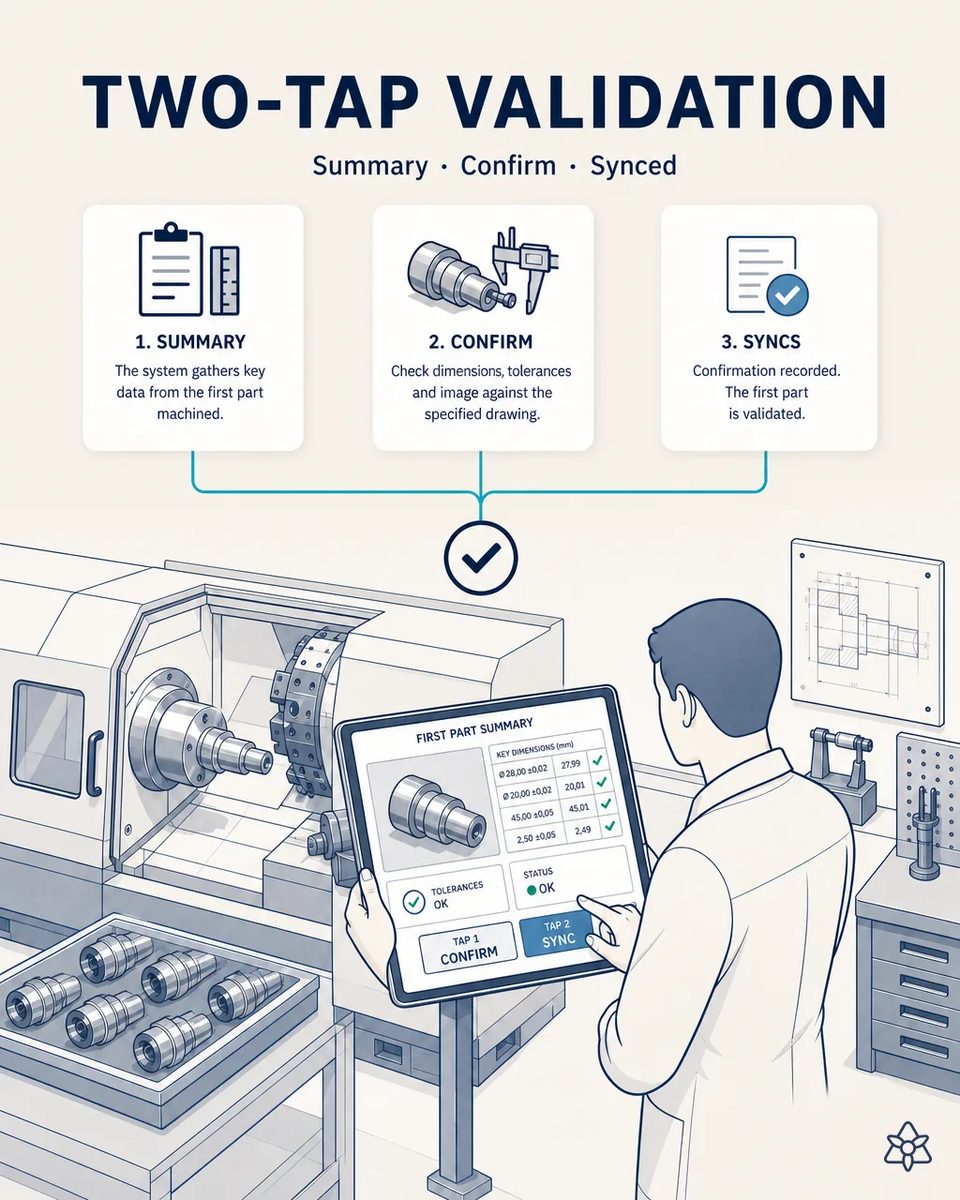
What sets iLEAN apart from an "autonomous" AI agent is this: nothing it captures reaches the central system without a human seeing it first. In machining, that's a tablet at the lathe showing a two-second visual summary to confirm with two taps.
Nobody wants an AI approving a first-off on a brake part by itself.
the main cultural brake on digitizing safety-part machining is the fear of an AI validating the first-off part on its own and letting an out-of-tolerance lot through. But operators don't want to type either.
- The biggest cultural brake on digitizing safety-part machining is fear: an AI that validates the first-off alone and lets an out-of-tolerance lot of brake pistons through.
- But operators do not want to type either, so today data reaches the ERP late and is entered by someone who never held the part or saw the gauge.
- A lot started without a real first-off confirmation is the hole a containment escapes through, and it rarely shows until the OEM finds it.
- And when the OEM asks who approved it, the answer has to be a name and the evidence they saw, not a tick in a box typed hours later.
Connect with early human verification — a visual summary and two taps at the lathe.
Connect's early human verification mode. Every capture — a work order photo, a voice-dictated issue, a supplier alert — reaches the tablet as a visual summary before crossing into the master data; UI designed for two-second validation.
This is what separates iLEAN from an autonomous agent: nothing it captures enters the system unseen. Without this piece the other eleven never get approved, because nobody signs off on AI writing into the master data of a safety part — and nobody should. The two taps are the price of trust, and operators find it a fair one.
Data entered later versus data confirmed at the lathe
| Aspect | Today | With iLEAN |
|---|---|---|
| Who validates the first-off data | Whoever types it | Whoever measured the part |
| Time to confirm | A trip to a terminal | About two seconds, two taps |
| Out-of-tolerance dimension | Seen when typed, if at all | Flagged red on the summary |
| ERP master data | Polluted by unchecked entries | Only confirmed data crosses |
| When the OEM asks who approved | A tick in a box | A name, a time and the summary shown |
| Corrections to the AI | Not recorded | Stored and used to improve extraction |
unvalidated data contaminating the ERP, or a lot started without first-off confirmation → data captured and validated within seconds, clean master data.
Strategic value — no payback of its own, and we say so.
The block below is an estimate to be validated against your plant's actual data. We put it forward so the committee has an order of magnitude; we refine it during the assessment.
- No standalone payback. It is the enabling piece of the whole matrix, and we do not dress it up with a number it cannot defend.
- Without it, none of the other cases can be trusted into production on a safety part, so its value is the value of everything it unlocks.
- Unvalidated data stops contaminating the ERP: what crosses has a person's confirmation behind it. Nothing reaches the master data on assumption.
- And a lot never starts without a first-off confirmation that can be shown to an auditor, with name, time and the exact summary that was approved.
the enabling piece of the whole iLEAN matrix — without it, the rest of the cases can't be trusted into production. *Strategic value, not directly monetizable*.
And the fair question from the production manager
“If a person confirms everything, what is the AI saving?” — the assembly, not the decision. Reading dimensions off a first-off sheet is an anchored task, where the best models drop below 1.5% error [1]; the operator only checks a summary that is already built, and every correction is stored so the system learns exactly where it fails.
[1] OpenAI paper "Why Language Models Hallucinate", 2025 — on the reliability of AI in anchored tasks.
What people ask about the confirmation tablet
Can iLEAN approve a first-off on its own?
No, and it is not a setting you can switch on. Data crosses into the master only after a person confirms it, which is an architectural rule, not a preference. Making it optional would remove the reason the rest of the cases can be approved.
How long does the operator spend on it?
Around two seconds per capture. The interface is designed to be read at a glance next to a running lathe, with tolerances shown in green or red against the drawing. If the operator disagrees with a value, one more tap opens the field to correct it.
Where does the tablet go on a lathe with coolant mist?
On a stand or arm outside the guard, at the operator's normal position. It is an industrial tablet with a sealed case, not an office device. It can also be fixed to the lathe guard frame when floor space is tight.
Does it cover more than first-off data?
Yes. Work order photos, dictated issues, metrology files and supplier alerts all pass through the same confirmation before reaching the ERP. That single gate is what keeps the master data clean, whatever the source.
What is logged when someone confirms?
Which summary was shown, who confirmed, when and what was corrected. That is the trail an IATF auditor or the OEM's supplier quality engineer asks for.
More cases from this series
- From delivery note and heat certificate to ERP, by photoPhotograph the delivery note and heat certificate; after one validation tap, it's all in the ERP. Less…
- The shift lead's knowledge, captured hands-freeWearing an earpiece, the shift lead dictates issues while walking the floor; iLEAN structures them and…
- The laser marker, stitched to the ERP with no manual typingLot and part number travel automatically from ERP to the laser marker, eliminating the typing error that…
- The vintage multi-spindle lathe that now "talks"An external camera reads RPM, feed rate and wear off the vintage panel; the machine stays itself, but…
- From the metrology spreadsheet to the ERP, no retypingiLEAN detects the metrology spreadsheet on save and, after validation, pushes it to the ERP. Up to -80%…
- Raw-material delay alerts, rescheduled in timeiLEAN reads the heat-delay alert instantly and suggests which lathes to reschedule before they run out…
Tell us who signs your first-off today and where that signature lives.
We work on your plant's real data, not ours. Assessment with no commitment.
Request estimated ROI within 48h ‹ See all cases of precision machining See automotive