First article validated
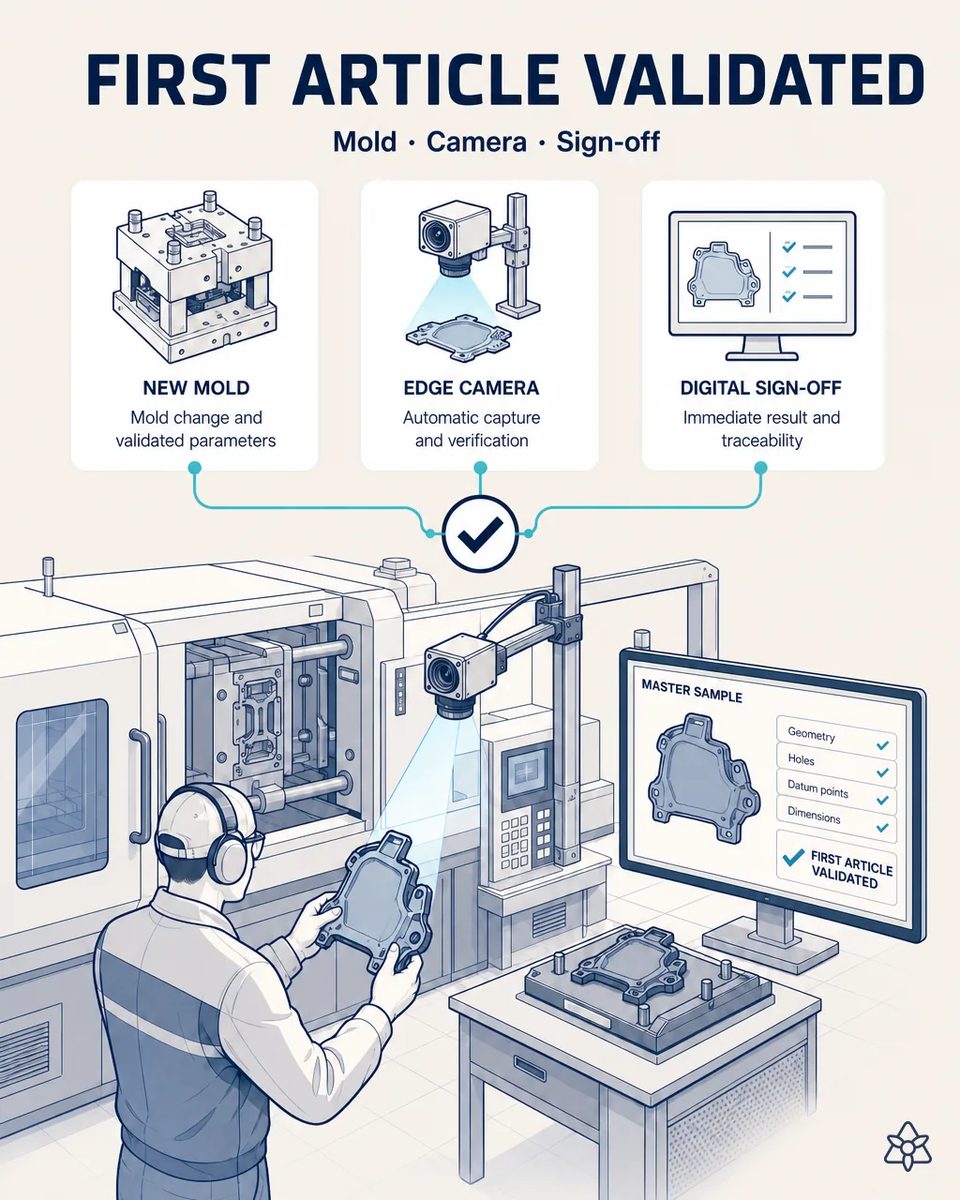
Every mold or color change requires first-article validation before the full run proceeds. Today it depends on a human eyeballing it under time pressure. With iLEAN Edge, fixed cameras compare the part against the approved reference state; JIDOKA AI won't let the run start until there's objective visual evidence and quality sign-off.
Two pressures meet at the first article, and rigor is the one that loses.
The pressure to shorten changeover time competes directly with validation rigor, and time pressure wins more often than anyone admits out loud. A badly validated first article can drag an entire lot out of spec.
- Every mold change and every color change ends the same way: somebody looks at the first part and decides whether the run can go.
- That decision happens while the press is stopped, with the changeover sitting on the shift's critical path and everybody waiting.
- Time pressure wins more often than anyone says out loud, and the record of the decision is a signature, not a measurement.
- A badly validated first article does not stay a single bad part: it drags the whole lot out of spec, and the lot is already boxed by the time anyone finds out.
Edge plus JIDOKA AI — no full run until there is evidence and a sign-off.
Edge + JIDOKA AI. Industrial cameras with CNNs trained to compare the first article against the approved master sample. Full-run start is blocked until OK + quality lead sign-off.
The camera does not decide alone. It compares the first article against the approved reference state point by point and hands the quality lead something to sign on, and the full run stays blocked until both the OK and the signature exist. What changes is not who decides, but what they decide on.
Today's first article versus the validated first article
| Aspect | Today | With iLEAN Edge |
|---|---|---|
| The first-article decision | An eyeball under time pressure | Compared against the approved master sample |
| Evidence behind the decision | A signature on a form | Images with every point checked |
| Start of the full run | Whenever the setter says go | Blocked until OK plus sign-off |
| A run started on a bad first article | The whole lot at risk | Cannot start |
| The changeover clock | Rigor traded away for minutes | Seconds added, rigor kept |
| Change on a shift with no quality technician | Signed anyway | Same criterion, remote sign-off |
eyeballed validation under time pressure → objective visual-evidence validation, with no changeover speed given up.
Impact estimate — to be validated with your numbers.
The block below is an estimate to be validated against your plant's actual data. We put it forward so the committee has an order of magnitude; we refine it during the assessment.
- Payback tied to how often you change mold or color — the brief deliberately gives no month range here, because the return is counted per changeover and not per calendar.
- What it protects is the whole lot after every change, which is the unit of loss in a molding shop.
- Changeover rigor stops competing with changeover speed, because the check costs seconds and the argument costs minutes.
- Bring your changes per week and the average lot size and the range comes out of your own numbers, not ours.
protects the entire lot after every changeover, payback depending on mold/color change frequency. Estimate to validate.
And the fair question from the production manager
"What if the camera blocks a run for no reason?" — the objection is the right one, because the changeover is on the critical path. The comparison is made against the reference state of that exact part number, and a doubt does not become a silent block: it escalates to the quality lead, who signs on the evidence. It stops on a verifiable discrepancy, not on model uncertainty — which is the line this matrix draws everywhere, including the anchored tasks where the best models drop below 1.5% error [1].
[1] OpenAI paper "Why Language Models Hallucinate", 2025 — on the reliability of AI in anchored tasks.
What people ask about validating the first article
What does it compare the first article against?
The approved master sample for that part number, plus the reference images defined at commissioning with your quality team. It is your approved state, agreed with your customer, not a generic notion of what a good molded part looks like.
Who signs when quality is not on the floor?
Whoever your procedure names, from wherever they are: the evidence is on screen, so a night-shift change no longer depends on whether the one qualified person happens to be in the building. The signature is recorded with its time and its author either way.
Does it measure dimensions or only compare appearance?
It compares appearance, geometry and the presence of features against the reference. Critical dimensions still go to metrology; what this removes is the run starting before anyone looked properly.
What happens when the master sample itself is revised?
The new reference is loaded and the change is dated. Runs validated against the old state stay recorded as such, which is what you need when a customer asks about a specific week.
Does this replace the dimensional first-article report for PPAP?
No, and it should not be sold as that. It feeds it: the images and the process parameters of every validated first article are already captured and dated, so assembling the report stops being archaeology and becomes a selection of what already exists.
More cases from this series
- Supervisor's voice, liveWith a headset and Connect voice mode, the floor supervisor logs incidents without ever stopping to type.
- The press panel that talksAn external camera reads an old, unnetworked injection press panel; its process parameters get digitized…
- Two-tap validationNothing iLEAN captures reaches the central system without a human confirming it first, in seconds, from…
- Paperless lot startupThe operator photographs the process sheet and traveler card at press startup; the lot exists in the…
- Resin delivery in secondsOne photo of the delivery note and CoA; iLEAN digitizes and traces the lot before it enters the…
- Resin drying straight to ERPiLEAN watches the resin drying control folder, validates the data, and posts it to the ERP. Up to 80%…
Tell us how many mold and color changes your presses run in a week.
We work on your plant's real data, not ours. Assessment with no commitment.
Request estimated ROI within 48h ‹ See all cases of automotive plastic injection See automotive