The traceability marker, stitched to the ERP by API
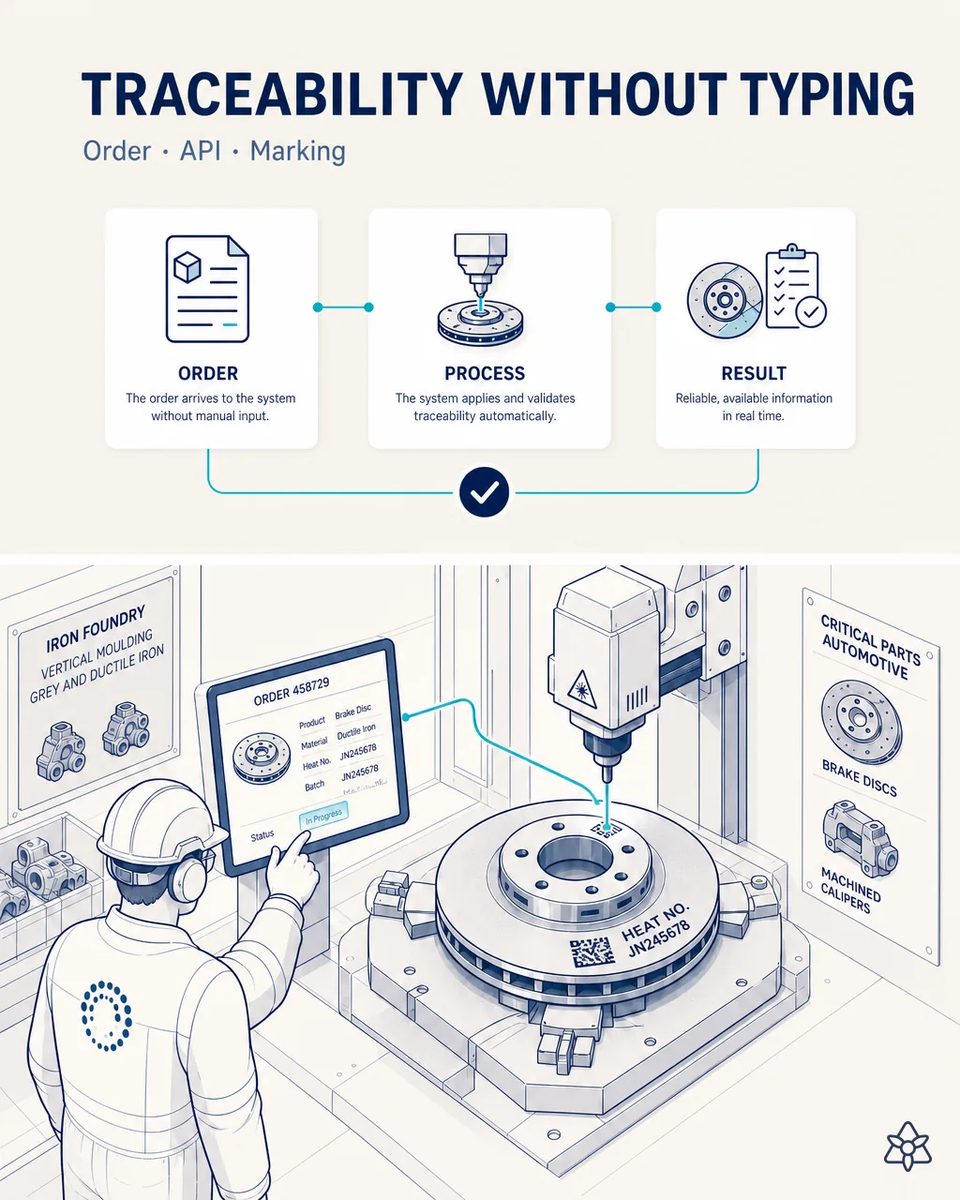
The laser or dot-peen marker that engraves traceability on every part is a modern machine, five to fifteen years old, with an API available. And yet somebody types every part-number change into its screen, copying what is already in the ERP. iLEAN Connect stitches the two systems together: what the order publishes is what the marker engraves.
The API exists. The integration never reached the top of the list.
Double entry between ERP/MES and line equipment is the classic silent error of a machining shop. It is not a technical problem — the API exists — it is a priority one: doing the integration properly never reached the top of the list. Every manual change is a chance for a mismatch between what the system says and what the part carries. And on a brake disc or a caliper, false traceability is not a clerical error: it is a containment you cannot bound and an audit non-conformity waiting to happen. It is usually the customer who finds it when scanning the DataMatrix, which is the worst possible place to discover it.
- The marker that engraves heat number and DataMatrix on every disc and caliper is five to fifteen years old and has a documented API. And somebody still types every part-number change into its screen, copying what the ERP already holds.
- Every manual change is a chance of a mismatch between what the system says and what the part carries. On a safety part, false traceability is a containment you cannot bound.
- It is usually the customer who finds it, scanning the DataMatrix at incoming inspection — the worst possible place to discover it, and the one that goes straight into the supplier scorecard.
- It is not a technical problem, it is a priority one: doing the integration properly never made it above the daily fires of the machining shop.
Connect in integration mode — two modern systems stitched, neither replaced.
Connect in integration mode, stitching two modern systems without replacing either:
The active order publishes part number, heat number and date; the marker receives them through its API at every change; and what was engraved comes back to the central system as an explicit confirmation. If the marker does not accept the change, the plant knows before production starts, not a thousand parts later. Marking stops being an assumption and becomes evidence. In a shop that already runs slower than the molding line, the minutes recovered at every part change are minutes on the critical path of the whole plant, and the mismatch that can no longer happen is the one the customer used to find first.
- The active ERP/MES order publishes part number, heat number and date.
- The marker receives them through its API at every part change, with no manual intervention.
- The marking result comes back to the central system as an explicit confirmation, not an assumption.
- If the marker does not accept the change, the system says so before production starts, not a thousand parts later.
The isolated marker versus the stitched marker
| Aspect | Today | With iLEAN Connect |
|---|---|---|
| Manual entries per part change | One, on the marker screen | Zero |
| Mismatch between order and marking | Found by the customer | Cannot happen by design |
| What was actually engraved | Assumed | Confirmed and returned to the order |
| Marker refusing a change | Discovered a thousand parts later | Flagged before production starts |
| Time at every part change | Minutes on the critical path | A tap in the ERP |
| Either system | — | Neither is replaced |
from one manual entry per part change to zero · from mismatches the customer discovers to mismatches that cannot happen by design · from marking assumed correct to marking confirmed against the order.
Impact estimate — to be validated with your numbers.
The block below is an estimate to be validated against your plant's actual data. We put it forward so the committee has an order of magnitude; we refine it during the assessment.
- Estimated payback 5-10 months.
- Time recovered at every part change in the machining shop, which is the plant's slowest stage and where every minute is a part not machined.
- The item that dominates the calculation: the customer claim avoided for a lot marked with the wrong heat or part number.
- And marking that becomes evidence for the audit instead of an assumption.
estimated payback 5 to 10 months, combining the time recovered at every part change and the customer claim avoided, which is the item that dominates the calculation. *Estimate to validate*.
And the fair question from the production manager
“Isn't a classic ERP-to-machine integration cleaner?” — it is, the day the project reaches the top of the IT list, and that is precisely the problem. This stitching uses the API the marker already exposes, replaces neither system and asks for no shutdown window. Where a value has to be read from a machine response, that is an anchored task where the best models drop below 1.5% error [1], and the marking confirmation itself is a hard message from the machine, not a model's guess. If the marker answers nothing, that silence is flagged too.
[1] OpenAI paper "Why Language Models Hallucinate", 2025 — on the reliability of AI in anchored tasks.
What people ask about stitching the marker to the ERP
Which markers does it work with?
Any laser or dot-peen marker with a documented interface, which is most of those installed in the last fifteen years. Tell us the model and we confirm whether its API is enough, usually within a week.
What if the marker fails to engrave a part?
It is detected, because what comes back is the confirmation of what was engraved, part by part. Today that failure raises no signal: the system assumes what was requested was done, and the customer finds the unmarked disc.
Does the heat number travel with the part number?
Yes. Part number, heat number and date are published by the active order together, so the DataMatrix carries the heat the customer will scan and the one your own containment will search for.
Does it touch the MES?
No. Whether the order lives in the ERP or the MES, Connect reads what it publishes and returns the confirmation to it. Neither system changes, and neither needs a new module.
Does the same pattern work for other machines in the shop?
Yes: any modern island with an interface that is fed by hand today fits the same way, the balancing machine or the leak tester included. You start with the marker because it underpins unit traceability on safety parts.
More cases from this series
- The audit evidence pack, generated as the process happensEvery heat and every changeover leaves evidence organized by standard: IATF 16949, VDA 6.3, CQI-9,…
- Zero stoppages on the customer's line: the three coordinated ringsThree rings — signal, matter and memory — coordinate Connect, Edge and Agents to eliminate customer line…
- The alert that arrives by email, turned into a scheduling decisionPull-ins, delays and incidents arrive by email and messaging. iLEAN cross-checks them against the EDI…
- First-piece release with early human verificationNo AI-captured data enters the ERP unsigned. The line tablet shows what was captured beside its photo…
- The closed induction furnace that finally talksAn external camera digitizes the isolated induction furnace curve: energy-metal-defect correlation with…
- Planning while walking the bay, hands freeThe planner walks. With an industrial earpiece, iLEAN listens, structures and answers in seconds: the…
Tell us your marker model and we will confirm whether its API is enough.
We work on your plant's real data, not ours. Assessment with no commitment.
Request estimated ROI within 48h ‹ See all cases of iron castings See automotive