Zero stoppages on the customer's line: the three coordinated rings
The capital pain of a plant that casts and machines safety-critical automotive parts has two faces and a single root. One face is stopping a customer's line, billed in tens of thousands per hour and paid for years afterwards in the supplier scorecard. The other is a safety part from a questionable heat that has already left the plant. The common root: the schedule rests on information that arrives late, and the imbalance between molding and machining is covered with inventory instead of information.
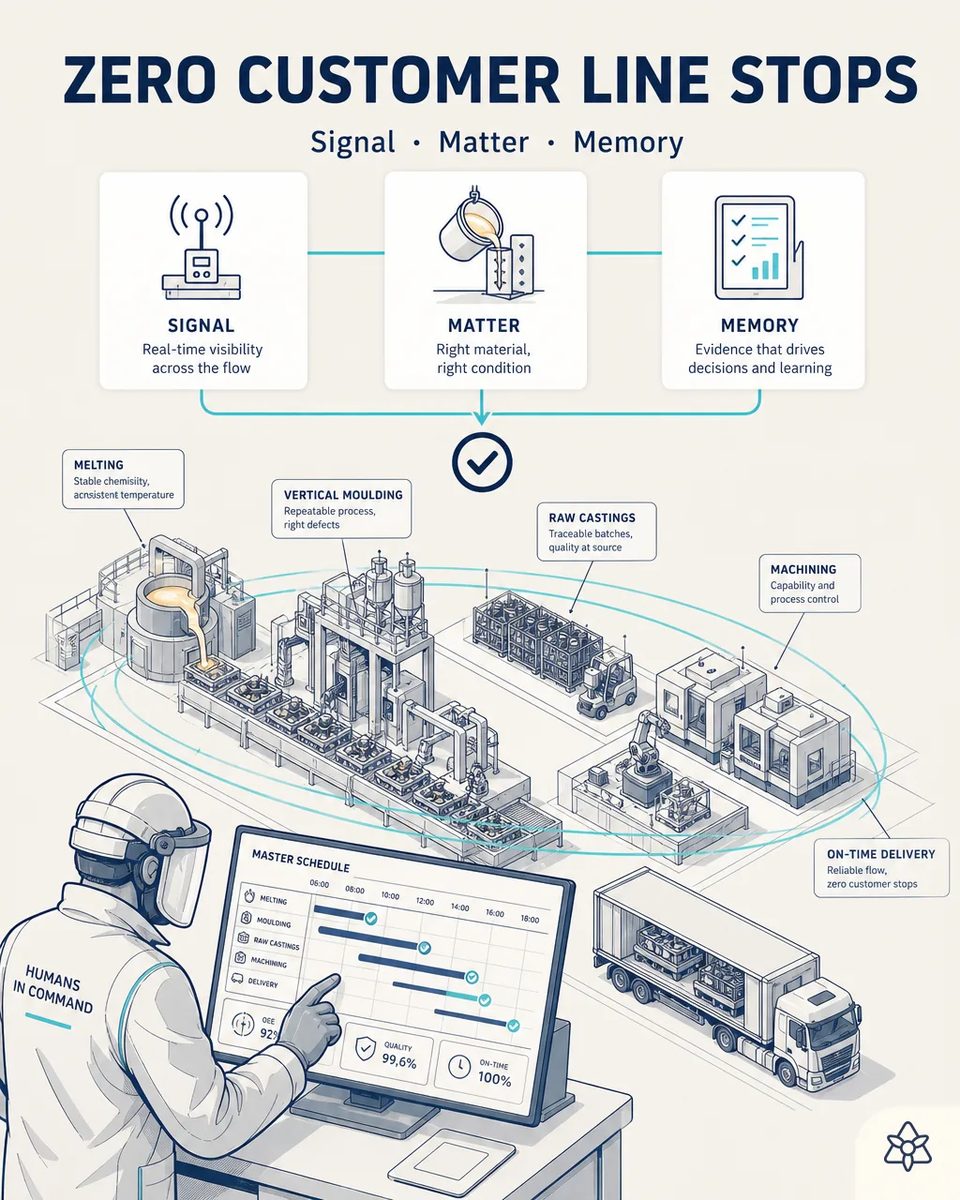
The schedule rests on yesterday's information and the imbalance is hidden with inventory.
A vertical molding line produces far faster than machining consumes. Between the two stages a stock of raw castings builds up that protects service, ties up working capital and hides parts from heats that later get questioned. Every new signal — an EDI release, a furnace down, low nodularity, a carrier that will not make it — forces the schedule to be rebuilt by hand on incomplete data, because the information needed is scattered across emails, shop-floor paper, spreadsheets and the memory of several supervisors. And when a metallurgical question arises on a safety part, bounding which parts of that heat are raw, in machining, in the warehouse or already shipped means cross-referencing systems by hand that do not talk to each other. If traceability does not close, containment goes from hundreds of parts to everything shipped in the period.
- The vertical molding line produces far faster than machining consumes. Between the two, a stock of raw castings protects service, ties up working capital and hides parts from heats that later get questioned.
- Every new signal — an EDI release, a furnace down, low nodularity, a carrier that will not make it — forces the master schedule to be rebuilt by hand from emails, shop-floor paper, spreadsheets and the memory of several supervisors.
- One customer line stop is billed in tens of thousands per hour and paid for years in the supplier scorecard.
- And when a metallurgical question arises on a safety part, bounding which parts of that heat are raw, in machining, in the warehouse or already shipped means crossing systems by hand. If traceability does not close, containment goes from hundreds of parts to everything shipped in the period.
Three rings that work at once — it is all of the above, coordinated.
The flagship case adds no new pieces: it coordinates the previous eleven into three rings working at once.
The flagship case adds no new pieces. Ring 1 brings every signal in at second zero; ring 2 makes sure the matter is right before machining spends an hour on it; ring 3 gives every heat its full origin. Above them, the planning agents propose what to melt, what to machine first and what to promise, with the impact calculated. The person signs; the AI does not schedule on its own.
- Ring 1 · Signal (Connect): the heat sheet, the furnace curve, the customer and carrier emails, the observation dictated while walking, the lab spreadsheet and inbound receiving all enter at second zero. The master schedule stops being fed by what was known yesterday.
- Ring 2 · Matter (Edge + legacy integration): bad parts are diverted before machining is spent on them, no pattern change starts without evidence, and the marker engraves exactly what the order says. JIDOKA AI stops on anomaly; SMED AI shortens the changeover so coordination costs no cadence.
- Ring 3 · Memory (Agents): every heat carries its full origin — ferroalloy lot, charge, furnace curve, lab result, defects seen on the line, machined parts, container and shipment. Bounding a heat stops being an investigation and becomes a query.
- Above the three, the planning agents: with live signals and the real state of raw stock between stages, they propose the rebalancing — what to melt, what to machine first, what can be promised to the customer — with the impact calculated. The person signs; the AI does not schedule on its own.
The three rings, and what each one closes
| Ring | Which cases it draws on | What it closes |
|---|---|---|
| 1 · Signal (Connect) | Heat sheet (1) + furnace panel (2) + customer alerts (3) | The schedule stops being fed by what was known yesterday |
| 1 · Signal (Connect) | Hands-free planning (4) + lab spreadsheet (6) + charge receiving (7) | The real state of metal, lab and raw stock, at second zero |
| 2 · Matter (Edge) | Casting defects (9) + pattern changeover (10) | No machine hour spent on a bad part; no start without evidence |
| 2 · Matter (integration) | Traceability marker (8) + first-piece release (5) | The part carries what the order says, signed by a person |
| 3 · Memory (Agents) | IATF evidence pack (11) | Every heat with its full origin, from ferroalloy lot to shipment |
| Above the rings | The planning agents | Rebalancing proposed with its impact; the person signs |
from a master schedule rebuilt by hand several times a week to a schedule that absorbs the signal in minutes · from raw stock as the only cushion to inventory sized with information · from containment covering the whole period to containment bounded by heat in minutes · from customer line stoppages caused by supply failure to zero.
Impact estimate — to be validated with your numbers.
The block below is an estimate to be validated against your plant's actual data. We put it forward so the committee has an order of magnitude; we refine it during the assessment.
- Estimated payback 6-12 months against the first customer line stop avoided, whose single impact is in the tens of thousands per hour plus multi-year damage to the scorecard.
- A 20-35% reduction in raw casting stock between molding and machining at the same service level.
- The drop in premium freight caused by late reaction.
- And containment that goes from everything shipped in the period to the heat actually affected, bounded in minutes.
the case is built on three items. One customer line stoppage avoided, with a single impact in the tens of thousands per hour plus multi-year damage to the supplier scorecard. A 20-35% reduction in raw casting stock between stages at the same service level. And the drop in premium freight caused by late reaction. Estimated payback 6 to 12 months against the first stoppage avoided. *Estimate to validate*.
And the fair question from the production manager
“Do we have to deploy all twelve cases to get this?” — no, and framing it that way would be the way never to start. The rings are built in layers and each case pays on its own from the first month. With the heat sheet, the lab spreadsheet and charge receiving you already have most of ring 3, which is where bounding a heat in minutes comes from. Each layer rests on anchored extraction where the best models drop below 1.5% error [1], with a person confirming at the release gate.
[1] OpenAI paper "Why Language Models Hallucinate", 2025 — on the reliability of AI in anchored tasks.
What people ask about the complete system
Where do you start?
With the case that has fewest dependencies and the shortest deployment, which in this matrix is the heat sheet, followed by the lab spreadsheet. What matters is that each layer pays on its own.
How does it reduce raw stock without hurting service?
Because the stock exists to cover the absence of information. With live signals and the real state of every stage, the planning agents size the cushion with data instead of with fear.
Does the AI change the master schedule on its own?
No. It proposes the rebalancing — what to melt, what to machine first, what can be promised — with the impact calculated, and the planner signs. Humans in command is the architecture, not a setting.
What happens when a heat is questioned?
Ring 3 answers in one query which parts of that heat are raw, in machining, in the warehouse or already shipped, because every part carries its heat and every heat its origin.
Can the return be estimated before committing?
Yes: with molds per hour on the line, parts per hour in machining and days of raw coverage between them, the business case is sent back with the return per layer.
More cases from this series
- The audit evidence pack, generated as the process happensEvery heat and every changeover leaves evidence organized by standard: IATF 16949, VDA 6.3, CQI-9,…
- The alert that arrives by email, turned into a scheduling decisionPull-ins, delays and incidents arrive by email and messaging. iLEAN cross-checks them against the EDI…
- First-piece release with early human verificationNo AI-captured data enters the ERP unsigned. The line tablet shows what was captured beside its photo…
- The closed induction furnace that finally talksAn external camera digitizes the isolated induction furnace curve: energy-metal-defect correlation with…
- Planning while walking the bay, hands freeThe planner walks. With an industrial earpiece, iLEAN listens, structures and answers in seconds: the…
- The heat sheet, digitized at second zeroThe heat sheet stops waiting hours on a desk: one photo and the heat exists in the central system, with…
Tell us your molds per hour, your parts per hour in machining and your days of raw coverage.
We work on your plant's real data, not ours. Assessment with no commitment.
Request estimated ROI within 48h ‹ See all cases of iron castings See automotive