The alert that arrives by email, turned into a scheduling decision
The EDI release is the official version of demand, but real demand arrives earlier and through another channel: the buyer asking to pull a shipment forward, the carrier warning it will miss the window, the ferroalloy supplier pushing a delivery back. With iLEAN Connect on silent copy, that message becomes a concrete action on the schedule in the same minute it arrives.
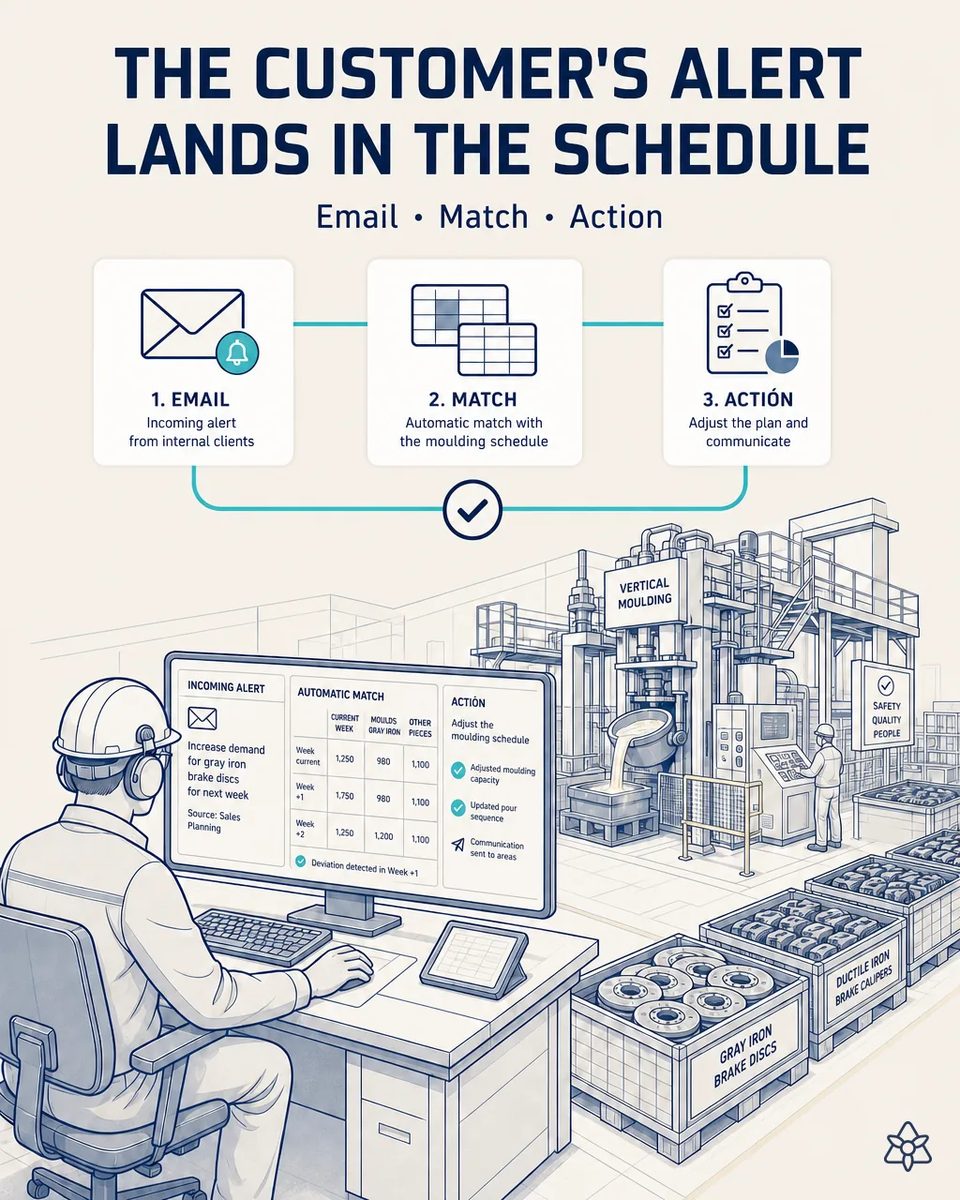
The official demand comes by EDI; the real one comes by email.
A foundry master schedule is built with one firm week and several forecast weeks. Every change not absorbed in time is paid twice: in premium freight to hit the window, and in an unplanned pattern change on the molding line, which costs hours of cadence at the plant's bottleneck. Critical alerts arrive mixed with dozens of routine messages in one person's mailbox. What happens next depends on that person being at their screen with time to cross-check the alert against the real state of the plant. Read late in the afternoon, tomorrow's schedule is already frozen.
- The EDI release fixes one firm week and several forecast weeks. What changes the week arrives another way: the buyer pulling a shipment forward, the carrier missing the window, the ferroalloy supplier slipping two days.
- Those messages land in one planner's mailbox, mixed with dozens of routine ones, and are read when that person is at their screen with time to cross-check them against the plant. On a night shift, nobody is.
- Read late in the afternoon, tomorrow's molding schedule is already frozen. The response is premium freight to hit the window, or an unplanned pattern change at the plant's bottleneck.
- Every unplanned pattern change costs an hour of cadence on the molding line, and that hour is never recovered: the line is the constraint, and lost molds are lost forever.
Connect in chaotic-sources mode — silent copy, around the clock.
Connect in "chaotic sources" mode:
Finding out sooner is not the point; knowing what to do is. The alert comes back already crossed with the EDI release, the molding schedule, the raw stock between stages and the shipping windows, as a concrete proposal with its impact calculated. The planner decides; iLEAN does not touch the schedule. The difference is deciding while there is still room instead of reacting when there is none. A pull-in read on Tuesday morning is a sequence change on Wednesday's molding schedule; the same pull-in read on Tuesday evening is a truck paid at premium rate on Thursday.
- iLEAN sits on silent copy of a dedicated mailbox and messaging number, around the clock.
- It extracts intent as soon as the message lands: pull-in, delay, quantity change, non-conformity, transport incident.
- It cross-checks against live data: EDI release, molding schedule, raw stock between stages, finished goods and shipping windows.
- It alerts the right role with a concrete proposal and its calculated impact, not a forwarded email. The person decides.
Today's alert versus the cross-checked alert
| Aspect | Today, in the inbox | With iLEAN Connect |
|---|---|---|
| When it is read | When the planner opens the email | In minute one, day or night |
| A pull-in from the customer | Premium freight to hit the window | A sequence change while there is room |
| Ferroalloy delivery slipping | Discovered at the furnace | Crossed with the melting schedule in time |
| Unplanned pattern changes | Several a week | A significant drop |
| What you receive | One more email | A proposal with its impact on the schedule |
| Who decides | Whoever read it | The planner — iLEAN proposes |
from hours or a full day between alert and reaction to minutes · from an undifferentiated inbox to a list prioritized by impact on the schedule · from reacting with no room left to deciding while there is room.
Impact estimate — to be validated with your numbers.
The block below is an estimate to be validated against your plant's actual data. We put it forward so the committee has an order of magnitude; we refine it during the assessment.
- Estimated payback 3-8 months.
- A 30-50% reduction in premium freight caused by late reaction.
- A significant drop in unplanned changes to the master schedule, each of which costs an hour of molding cadence at the bottleneck.
- And the alert arrives sorted by impact instead of by the order it landed in the inbox.
estimated payback 3 to 8 months, with a 30-50% reduction in premium freight caused by late reaction and a significant drop in unplanned changes to the master schedule. *Estimate to validate*.
And the fair question from the production manager
“Are you going to read my planner's email?” — no. iLEAN sits in copy on a dedicated mailbox and a company messaging number: the operational channels with customers, carriers and suppliers, nothing else. On extraction, classifying the intent of a message — pull-in, delay, quantity change, non-conformity, transport incident — is an anchored task where the best models drop below 1.5% error [1], and the action is always executed by a person. What the planner gains is not being the only filter between the inbox and the plant.
[1] OpenAI paper "Why Language Models Hallucinate", 2025 — on the reliability of AI in anchored tasks.
What people ask about reading customer alerts
Does it tell a pull-in from a routine message?
Yes, and that is what matters most. A pull-in on a firm week is flagged top priority because its cost grows by the hour, while a routine carrier confirmation interrupts nobody. Priority comes from the calculated impact on the schedule, not from who sent it.
Does it know whether the pull-in can be served from raw stock?
When it is crossed with the live data, yes: raw castings between stages, parts in machining and finished goods. That is the difference between a proposal — ship from finished goods, machine these containers first — and a forwarded email.
Does it replace the EDI release?
No. EDI remains the official demand and is fed into the cross-check. This case covers what EDI never carries: the change communicated by hand, which is what breaks the week and what no system reads today.
What about messages in another language or on messaging apps?
That is normal with an international OEM and a foreign carrier, and intent extraction does not depend on the language or the channel. A voice note from the carrier is handled the same way as an email from the buyer.
Who does the alert reach?
The role that has to act: the planner for a pull-in, purchasing for a ferroalloy slip, logistics for a missed window, quality for a non-conformity. Each one receives the proposal with its scope, not the whole thread.
More cases from this series
- The audit evidence pack, generated as the process happensEvery heat and every changeover leaves evidence organized by standard: IATF 16949, VDA 6.3, CQI-9,…
- Zero stoppages on the customer's line: the three coordinated ringsThree rings — signal, matter and memory — coordinate Connect, Edge and Agents to eliminate customer line…
- First-piece release with early human verificationNo AI-captured data enters the ERP unsigned. The line tablet shows what was captured beside its photo…
- The closed induction furnace that finally talksAn external camera digitizes the isolated induction furnace curve: energy-metal-defect correlation with…
- Planning while walking the bay, hands freeThe planner walks. With an industrial earpiece, iLEAN listens, structures and answers in seconds: the…
- The heat sheet, digitized at second zeroThe heat sheet stops waiting hours on a desk: one photo and the heat exists in the central system, with…
Tell us how many times a week you rebuild the schedule because of an email.
We work on your plant's real data, not ours. Assessment with no commitment.
Request estimated ROI within 48h ‹ See all cases of iron castings See automotive