First-piece release with early human verification
This is what separates iLEAN from an autonomous AI agent writing data nobody signed. In a plant making brake and chassis parts, nothing the AI captures crosses into the ERP or the MES without a human seeing it first. The tablet at the line shows the summary of what was captured next to the original photo, and the operator confirms or corrects in two taps.
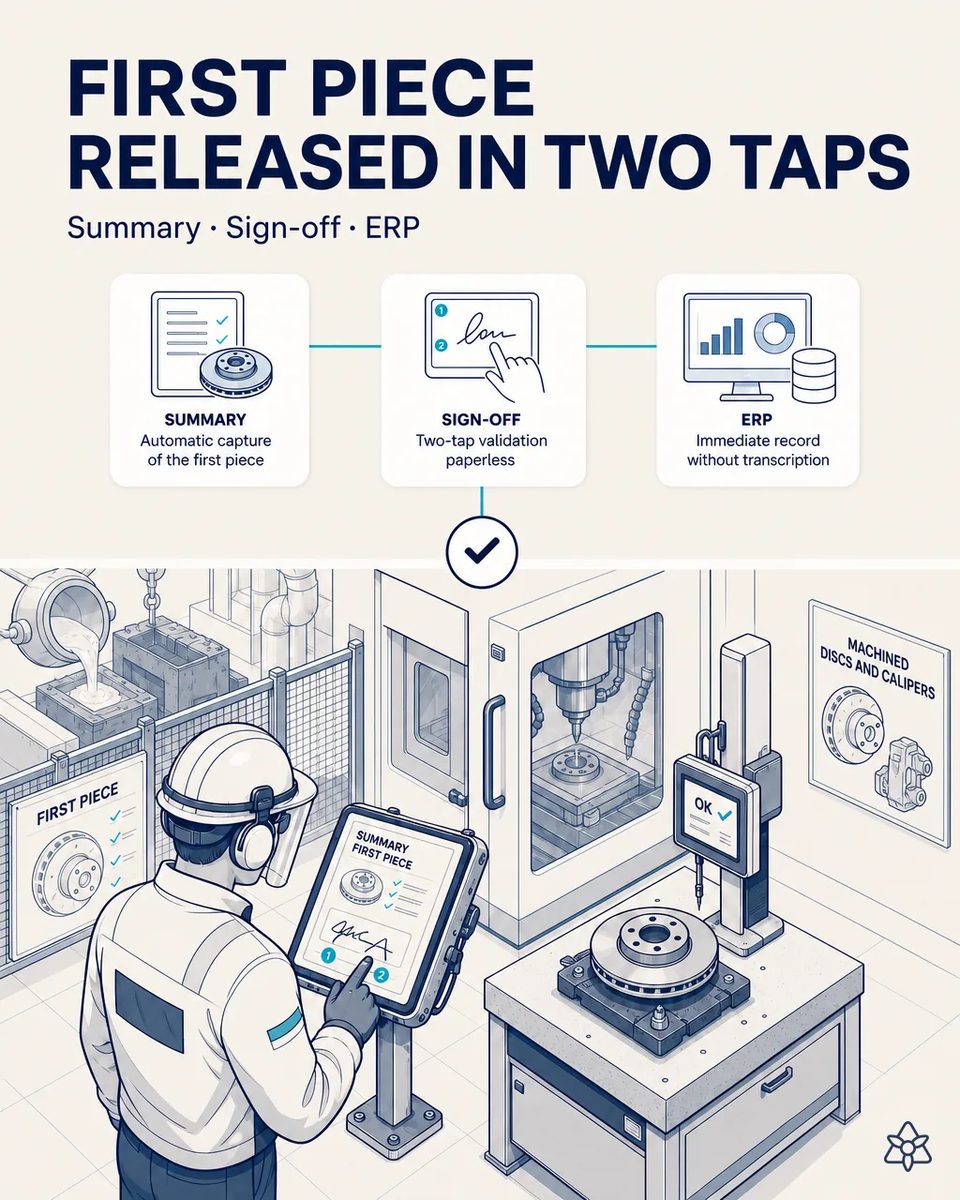
The release is signed fast because it asks for data that already exists.
First-piece release and heat start-up decide whether the shift comes out good or goes to scrap. Today they are signed on paper or on a screen that forces you to retype data that already exists in another system. The result is fast signatures, fields filled in out of habit, and releases that prove very little when a problem appears. The alternative many AI projects offer — letting the system write on its own — is worse in this context: it contaminates the master data with unverified figures and breaks the trust of customer and auditor exactly where it matters most.
- First-piece release and heat start-up decide whether the shift comes out good or goes to scrap. Today they are signed on paper or on a screen that forces the operator to retype what the heat sheet and the lab already hold.
- The result is fast signatures, fields filled in out of habit and releases that prove very little when a caliper comes back from the customer.
- The alternative many AI projects sell — letting the system write on its own — is worse here: it contaminates the master data with unverified figures, and a contaminated master is worse than no data at all.
- And it breaks the trust of the customer and the IATF auditor exactly where it matters most: on the record that says who released a safety part and on what.
Connect with early human verification — the gate everything else passes through.
Connect in early-human-verification mode, the gate everything else passes through:
This is the piece that makes the other eleven approvable. Everything captured by photo, voice, folder parser, panel reading or receiving lands in a validation queue, and the tablet shows it next to its evidence. The operator confirms or corrects in under thirty seconds; only then does the figure cross into the ERP or the MES. Without this gate, no quality manager signs off on AI writing into the system a release depends on. With it, authorship moves from whoever had time to type to whoever actually looked at the disc, and that is the name the customer will ask for.
- Everything captured by the other cases — photo, voice, folder parser, panel reading, receiving — lands in a validation queue prioritized by criticality.
- The industrial tablet shows the extracted data next to the original evidence: heat number, chemistry, mounted pattern, first-piece measurements.
- The operator confirms or corrects in under thirty seconds. Only then does the data cross into the central system.
- The correction is kept as a signal: the system learns from the craft of the person on the line.
Today's release versus the signed release
| Aspect | Today | With iLEAN |
|---|---|---|
| Time per release | 3-6 minutes of typing | Under 30 seconds of reviewing |
| What the signature proves | That somebody signed | Which chemistry, pattern and measurements they saw |
| Heat number on the release | Retyped from the sheet | Already there, next to its photo |
| Who writes to the master | The AI, or whoever types | A person, confirming |
| Capture quality | Unknown | A measured correction rate |
| When the auditor asks | A checkbox | Evidence and a name |
from 3-6 minutes of typing per release to under 30 seconds of reviewing · from data with no evidence to every figure with its source photo and signature · from no visibility on capture quality to a measured correction rate.
Impact estimate — to be validated with your numbers.
The block below is an estimate to be validated against your plant's actual data. We put it forward so the committee has an order of magnitude; we refine it during the assessment.
- Estimated payback 4-8 months.
- A 60-80% reduction in the time spent on releases and recording, at the line, without walking to a terminal.
- Above all, zero unsigned data in the central system: every figure has its source evidence and the name of who confirmed it.
- And every correction is kept as a signal, so capture improves where the person on the line says it fails.
estimated payback 4 to 8 months, with a 60-80% reduction in time spent on releases and recording and, above all, zero unsigned data in the central system. *Estimate to validate*.
And the fair question from the production manager
“If a person signs anyway, what is the AI saving?” — the work is not in deciding, it is in assembling. Today the operator walks to a terminal, finds the order and retypes the heat, the chemistry and the measurements. With the gate it all arrives assembled from sources where the best models drop below 1.5% error on anchored extraction [1], and the operator only confirms or corrects. Every correction is stored with its author, which is what an auditor wants to see and what the model learns from.
[1] OpenAI paper "Why Language Models Hallucinate", 2025 — on the reliability of AI in anchored tasks.
What people ask about the first-piece release gate
Can the AI release a first piece on its own?
No, and it is not a setting: it is the architecture. Nothing crosses into the ERP or the MES without a human confirmation, on every case in the matrix, and there is no configuration that switches it off.
What does the operator see on the tablet?
The extracted data next to its evidence: the heat number beside the heat sheet photo, the chemistry beside the lab result, the mounted pattern beside its image, the first-piece measurements. Anything that looks wrong is corrected on the same screen.
How are releases prioritized in the queue?
By criticality: a heat start-up on a safety part is shown before a routine receiving line. The queue is ordered by what would cost most if it waited, not by arrival time.
What gets recorded for the audit?
What summary was shown, who confirmed it, when, and what they corrected if anything. That is exactly the record IATF 16949 asks for on special characteristics, and it is generated by the act of releasing, not afterwards.
Is this the case to deploy first?
In practice yes: it is what guarantees the master is not contaminated, and it is why the other cases get approved by quality and by the customer. It is also the cheapest, because it is a screen and a queue.
More cases from this series
- The audit evidence pack, generated as the process happensEvery heat and every changeover leaves evidence organized by standard: IATF 16949, VDA 6.3, CQI-9,…
- Zero stoppages on the customer's line: the three coordinated ringsThree rings — signal, matter and memory — coordinate Connect, Edge and Agents to eliminate customer line…
- The alert that arrives by email, turned into a scheduling decisionPull-ins, delays and incidents arrive by email and messaging. iLEAN cross-checks them against the EDI…
- The closed induction furnace that finally talksAn external camera digitizes the isolated induction furnace curve: energy-metal-defect correlation with…
- Planning while walking the bay, hands freeThe planner walks. With an industrial earpiece, iLEAN listens, structures and answers in seconds: the…
- The heat sheet, digitized at second zeroThe heat sheet stops waiting hours on a desk: one photo and the heat exists in the central system, with…
Tell us who appears as the author of your first-piece release data today.
We work on your plant's real data, not ours. Assessment with no commitment.
Request estimated ROI within 48h ‹ See all cases of iron castings See automotive