The heat sheet, digitized at second zero
In a gray and ductile iron foundry the document that carries the most weight is still a sheet of paper: the heat sheet. It records the furnace charge, the pouring temperature, the magnesium treatment time and the heat number that will identify every safety part for its entire life. Today that sheet waits four to eight hours before somebody types it in. With iLEAN Connect, one photo when the sheet is closed is enough for the heat to exist in the central system immediately.
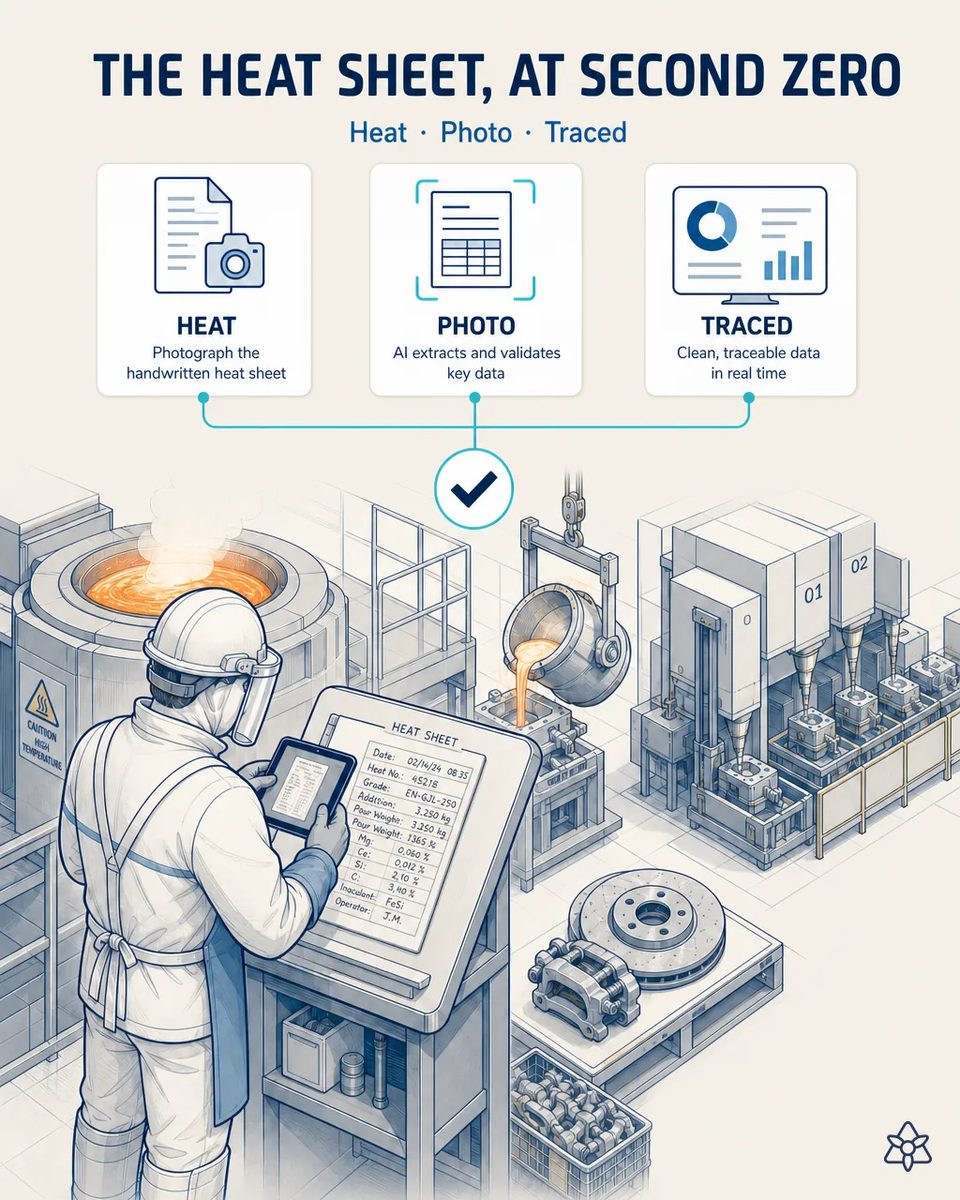
The most important document in the plant is still a sheet of paper.
Traceability for a brake disc or a caliper is anchored to the heat number. While the sheet is paper, that number only exists on the shop floor. The planner does not know which heats are running clean, quality cannot cross chemistry with defects, and logistics cannot bound a batch if a question appears tomorrow. When it finally gets transcribed, it gets transcribed late and sometimes wrong. A mistyped figure on a heat sheet is a quality investigation that starts from false data, and on safety-critical parts that multiplies the scope of any later containment. On top of that, the richest information on the sheet is the operator's handwritten notes — what they saw, what they adjusted, what looked odd — and those notes never reach any system at all.
- The heat sheet carries the charge makeup, the tapping and pouring temperature, the magnesium treatment time, the inoculant and the heat number that will follow every brake disc and caliper for its whole life.
- It is closed by hand at the furnace and typed at the end of the shift, or the next morning. Four to eight hours in which the heat exists physically but in no system. Over a weekend, two days.
- A mistyped magnesium percentage or a heat number off by one digit starts a quality investigation from false data, and on safety parts that widens any later containment to heats that were never suspect.
- The melter's margin notes — a slow tap, a cold ladle, an extra addition — are the richest information on the sheet, and they reach nobody. When the defect shows up two weeks later, the note that explained it is in a folder.
Connect in photo mode — the melter keeps closing the sheet by hand.
IRIS handles this with Connect in "photo of the analog" mode, built for whatever is still paper on the floor:
Nothing changes at the furnace: the sheet is still the plant's own form, filled in the way it always was. What changes is that one photo when it is closed makes the heat exist in the central system at second zero, with the melting supervisor confirming what was read before it crosses into the ERP. It is the simplest of the twelve to deploy and the one the melters accept first, because it asks nothing of them.
- The operator photographs the sheet with a phone or industrial tablet when closing it. No habit change.
- A grounded model recognizes the plant's own form layout and extracts the fields: heat number, alloy, target chemistry, temperature, treatment time, furnace, shift and the handwritten notes.
- What is extracted appears on the line tablet next to the original photo for early human verification: confirmed or corrected in two taps.
- Only then does the data enter central memory and become available to the rest of the system: the furnace curve, the lab result, the defects seen in line.
Humans in command: iLEAN structures and proposes, the person signs.
Today's heat sheet versus the captured heat sheet
| Aspect | Today, on paper | With iLEAN Connect |
|---|---|---|
| Metal-to-data latency | 4-8 h, longer over a weekend | Second zero |
| Heat number in the system | Typed at end of shift | Extracted and confirmed at the furnace |
| Magnesium treatment time | A figure in a folder | Queryable by heat and by furnace |
| Melter's handwritten notes | Never leave the sheet | Searchable text tied to the heat |
| Typing errors | Silent until the investigation | Verified against the source photo |
| Melter's habit | — | Unchanged: one photo |
from 4-8 h of latency between metal and data to second zero · from handwritten notes nobody reads to text searchable by heat · from manual end-of-shift transcription to none · from silent typing errors to data verified against its source photo.
Impact estimate — to be validated with your numbers.
The block below is an estimate to be validated against your plant's actual data. We put it forward so the committee has an order of magnitude; we refine it during the assessment.
- Estimated payback 4-9 months, depending on the number of heats per day.
- Transcription time released for the melting supervisor at the end of every shift, which today is the last thing done and the first thing skipped.
- From 4-8 hours of latency between metal and data down to second zero, heat after heat.
- Errors eliminated in the one figure the whole traceability chain rests on: the heat number.
estimated payback 4 to 9 months depending on heats per day, combining the melting supervisor's transcription time released and the elimination of errors in the one figure the whole traceability chain rests on. *Estimate to validate*.
And the fair question from the production manager
“What if it misreads the magnesium percentage or the pouring temperature?” — reading fields from a form with a known layout is an anchored task, where the best models drop below 1.5% error [1]. And there is a second net: the extracted values appear on the line tablet next to the photo, each one checked against its physical range — a pouring temperature of 2,400 °C is rejected, not stored — and the melting supervisor confirms or corrects before anything enters the ERP.
[1] OpenAI paper "Why Language Models Hallucinate", 2025 — on the reliability of AI in anchored tasks.
What people ask about digitizing the heat sheet
Do we have to redesign the heat sheet?
No. The model learns the layout of the form the plant already uses, columns, boxes and margin notes included. Asking the melters to change their sheet would be the fastest way to lose the case, and it is not necessary.
Does it read the melter's handwriting?
Yes, and that is where the value is: the notes about a slow tap or an extra ferroalloy addition are extracted like any other field and become searchable text tied to the heat. A low-confidence value is flagged for the supervisor to confirm instead of guessed.
What happens to the heat number if the photo is blurred?
The heat number is checked against the furnace sequence and the shift, so an impossible number is rejected instead of accepted. A blurred photo simply asks for a second shot on the spot, while the sheet is still in the melter's hand.
Do we need the ERP connected from day one?
No. The first heats live in iLEAN's central memory and are already queryable by heat number; the push to the ERP is connected afterwards, once the read quality has been measured on your own forms and your own handwriting.
Does it work with several furnaces and several shifts?
Yes. Furnace and shift are two of the fields extracted, so the heat is anchored to its furnace from the first minute and the history can be compared across shifts, which is where the differences in treatment time usually hide.
More cases from this series
- The audit evidence pack, generated as the process happensEvery heat and every changeover leaves evidence organized by standard: IATF 16949, VDA 6.3, CQI-9,…
- Zero stoppages on the customer's line: the three coordinated ringsThree rings — signal, matter and memory — coordinate Connect, Edge and Agents to eliminate customer line…
- The alert that arrives by email, turned into a scheduling decisionPull-ins, delays and incidents arrive by email and messaging. iLEAN cross-checks them against the EDI…
- First-piece release with early human verificationNo AI-captured data enters the ERP unsigned. The line tablet shows what was captured beside its photo…
- The closed induction furnace that finally talksAn external camera digitizes the isolated induction furnace curve: energy-metal-defect correlation with…
- Planning while walking the bay, hands freeThe planner walks. With an industrial earpiece, iLEAN listens, structures and answers in seconds: the…
Tell us how many hours your heat sheet spends on a desk today.
We work on your plant's real data, not ours. Assessment with no commitment.
Request estimated ROI within 48h ‹ See all cases of iron castings See automotive