Planning while walking the bay, hands free
In a foundry the planner is not sitting down: they walk the bay to see how many molds the line is really producing, how many raw containers are piling up in front of machining and what can be promised to the customer this afternoon. That knowledge lives in someone's head and in a notebook, and it dies at the end of the shift. With iLEAN Connect in voice mode, you speak while walking and the observation is recorded the moment it happens.
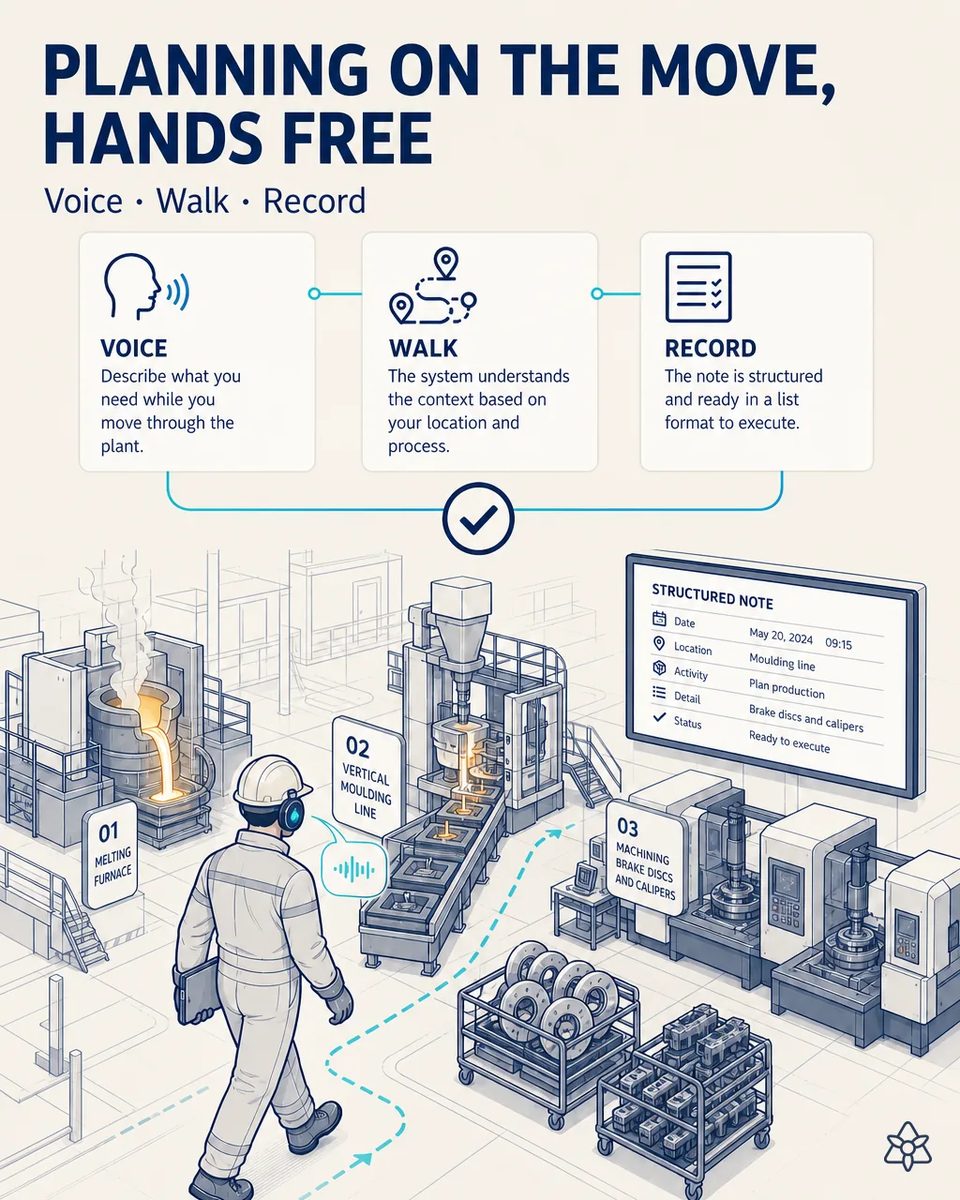
The real state of the plant is known by one person, walking.
The plant's most valuable operational knowledge is generated while walking, and it is exactly the knowledge nobody records. With foundry noise and both hands busy, typing is not a realistic option: so the real state of the plant is passed on by phone at handover, and much of it is lost on the way. The cost never shows up as a line item, but it shows up every morning: the incoming shift reconstructs what was already known, repeats checks and makes decisions without the context somebody had twelve hours earlier. Much of the schedule slippage is born right there.
- How many molds the line is really producing, how many raw containers are piling up in front of machining and what can be promised to the customer this afternoon is learned on foot, not on a screen.
- With foundry noise and both hands busy, typing is not an option. So it goes into a notebook and is passed on by phone at handover — and much of it is lost on the way.
- The incoming shift reconstructs what was already known twelve hours earlier, repeats checks and decides without the context somebody had. The same container gets counted three times a day.
- A good part of the schedule slippage is born right there, and it never appears as a line item because nobody measures what was forgotten.
Connect in voice mode — the planner speaks, iLEAN structures and answers.
Connect in voice mode with an industrial Bluetooth earpiece:
The earpiece does two things at once. It records the observation the moment it happens, anchored to that furnace, that pattern, those containers. And it answers out loud with the data already crossed, so the question asked at the molding line — is there coverage for this part number tomorrow? — is resolved before the planner reaches the next bay. At the end of the shift, the handover is already written, resource by resource, and the incoming planner starts from the real state instead of reconstructing it. Humans in command taken literally: it records what the planner chooses to say, when they choose to say it, and nothing else.
- Recognition robust to industrial noise, trained on the language of the trade: heat, riser, core, pattern plate, nodularity, flash.
- iLEAN listens, structures the observation and anchors it to the actual resource: that furnace, that pattern, those containers.
- It answers out loud in seconds, with the data already cross-checked: "with those three containers that part number has two days of coverage, shall I propose it for tomorrow's schedule?".
- At the end of the shift, handover receives the real state in writing instead of a phone call.
Today's walk versus the captured walk
| Aspect | Today | With iLEAN Connect |
|---|---|---|
| Observation at the line | A notebook, if that | Recorded and anchored to the resource |
| Raw coverage by part number | Counted by eye, kept in the head | Answered out loud in seconds |
| Shift handover | A phone call from memory | The real state, in writing |
| Operational decisions | No trace | History searchable by furnace, pattern or container |
| Planner's time | Walk, then type | Speak while walking |
| Operators on the floor | — | Not recorded |
from knowledge that dies at the end of the shift to a continuous searchable record · from handover by phone and memory to handover with the real state written down · from no traceability of operational decisions to a history searchable by resource.
Impact estimate — to be validated with your numbers.
The block below is an estimate to be validated against your plant's actual data. We put it forward so the committee has an order of magnitude; we refine it during the assessment.
- Estimated payback 4-9 months.
- 45-90 minutes a day recovered for the role that walks the plant, today spent walking back to a desk to type what was seen.
- A direct improvement in handover quality between shifts: the real state written down instead of a phone call.
- And a searchable history of operational decisions, by resource, that today does not exist anywhere.
estimated payback 4 to 9 months, with 45-90 minutes a day recovered for the role that walks the plant and a direct improvement in handover quality between shifts. *Estimate to validate*.
And the fair question from the production manager
“Will it understand a melter's vocabulary over the noise of the molding line?” — recognition is trained on the language of the trade — heat, riser, core, pattern plate, nodularity, flash — and prepared for industrial noise, and the headset is compatible with hearing protection. Structuring a dictated observation into resource, symptom and quantity is an anchored task where the best models drop below 1.5% error [1], and what was understood is read back so the planner can correct it on the spot, before it is stored.
[1] OpenAI paper "Why Language Models Hallucinate", 2025 — on the reliability of AI in anchored tasks.
What people ask about planning by voice
Is this a tracking device for people?
No. iLEAN listens to the planner, not to the operators, and only to what they choose to dictate. There is no continuous listening and no position tracking; the earpiece is a tool for the person wearing it, not a sensor on them.
What kind of question can it answer while walking?
Anything the crossed data already holds: raw coverage for a part number, which heats are confirmed fit, how many containers are in front of a machining cell, when the next pattern change is due. The more of the other cases are live, the more it can answer.
Does it generate the shift handover on its own?
Yes, from what was dictated during the shift, structured by resource. It is the first thing people notice, because today that handover depends on the memory of whoever is leaving and on the incoming shift asking the right questions.
How does it know which furnace or pattern I am talking about?
From what is said and from context: the active schedule, the pattern mounted at that minute and the furnace in holding. If the reference is ambiguous, it asks, the way a colleague would.
Can we try it on one shift only?
That is the recommended start: one week with an earpiece on the molding shift, and then compare Monday's handover with Friday's. The difference is usually visible by Wednesday, when the incoming shift stops phoning the outgoing one to ask what happened at the furnace.
More cases from this series
- The audit evidence pack, generated as the process happensEvery heat and every changeover leaves evidence organized by standard: IATF 16949, VDA 6.3, CQI-9,…
- Zero stoppages on the customer's line: the three coordinated ringsThree rings — signal, matter and memory — coordinate Connect, Edge and Agents to eliminate customer line…
- The alert that arrives by email, turned into a scheduling decisionPull-ins, delays and incidents arrive by email and messaging. iLEAN cross-checks them against the EDI…
- First-piece release with early human verificationNo AI-captured data enters the ERP unsigned. The line tablet shows what was captured beside its photo…
- The closed induction furnace that finally talksAn external camera digitizes the isolated induction furnace curve: energy-metal-defect correlation with…
- The heat sheet, digitized at second zeroThe heat sheet stops waiting hours on a desk: one photo and the heat exists in the central system, with…
Tell us how much of your plant's real state is passed on by phone today.
We work on your plant's real data, not ours. Assessment with no commitment.
Request estimated ROI within 48h ‹ See all cases of iron castings See automotive