In-line AI vision for the raw casting defect
At the pace of a vertical molding line, raw casting inspection is done by eye, shift after shift, with criteria that shift from one colleague to the next. What slips past carries on into machining, where the plant invests expensive machine hours in a part that will end up as scrap. With iLEAN Edge, the camera sees the defect in milliseconds and the part is diverted first.
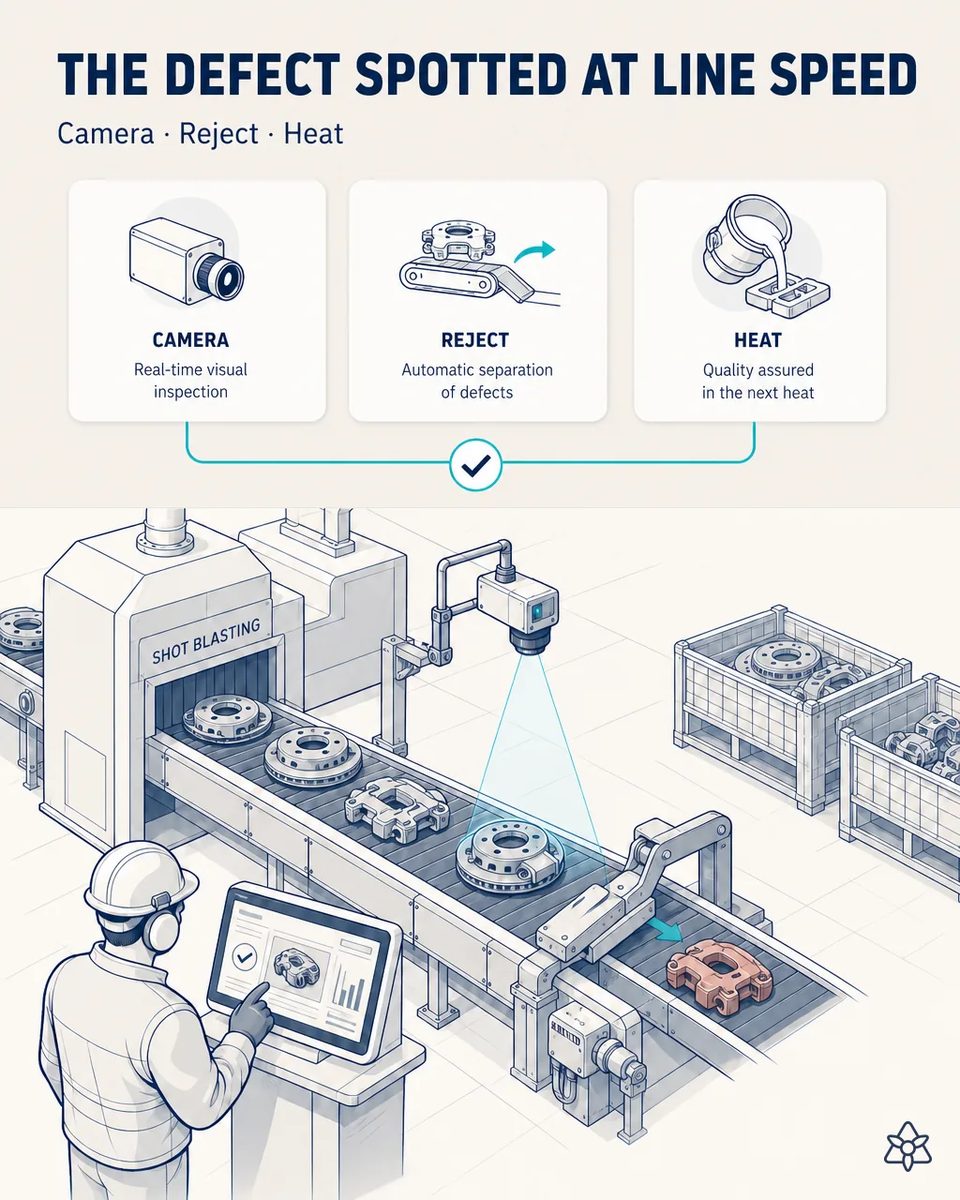
The defect is discovered after the plant has paid machine hours on it.
In a foundry, scrap is not an anomaly, it is a structural cost line, and late detection multiplies the damage. A rejected raw casting costs metal and energy; the same part rejected after machining also costs machine hours, tooling and the capacity of a cell that is usually the bottleneck of the whole plant. One hundred percent inspection at line speed is not humanly sustainable, and sampling lets exactly the sporadic defect through — which is the one that reaches the customer. The defects themselves are known and recurring: shrinkage, gas porosity, trapped sand, inclusions, mold mismatch, badly cut risers, flash. And there is a second, invisible loss: with no systematic record of the defect, root cause is investigated by intuition and never fully closed.
- At line speed, raw casting inspection is done by eye, shift after shift, with criteria that move from one colleague to the next. Sampling lets exactly the sporadic defect through, which is the one that reaches the customer.
- A rejected raw casting costs metal and energy. The same part rejected after machining also costs machine hours, tooling and the capacity of the cell that is the bottleneck of the plant.
- The defects are known and recurring: shrinkage, gas porosity, trapped sand, inclusions, mold mismatch, badly cut risers, flash. None of them is new; what is new is seeing all of them on every part.
- With no systematic record by heat, root cause is investigated by intuition and never fully closed, so the same shrinkage comes back three months later.
Edge — inspection in milliseconds at the shot-blasting outfeed, before machining.
Edge, AI vision running on the line itself:
Catching the defect before machining does two things. It stops the plant spending its scarcest hours on scrap. And it builds the record nobody has: every detection with its image, anchored to the heat number, the furnace and the lab result, so that when trapped sand concentrates in one shift or shrinkage in one chemistry range, the system says so. Inference is local, on the line, with no cloud and no plant network in the loop, and the diverter acts before the next part arrives. Scrap stops being a structural cost line nobody can explain and becomes a set of dated patterns with a heat number attached.
- An industrial camera over the shot-blasting outfeed conveyor, with controlled lighting.
- A neural network trained on real defect images from the part numbers this plant actually produces, not a generic catalog.
- Local inference in milliseconds — no cloud or plant-network dependency — and automatic diversion of the part before it reaches machining.
- Every detection is stored with its image and anchored to the heat number and lab result: when a defect type concentrates in a chemistry range, a furnace or a shift, the system says so.
Today's inspection versus Edge vision
| Aspect | Visual inspection | With iLEAN Edge |
|---|---|---|
| Coverage | Sampled, depends on fatigue | One hundred percent at line speed |
| Criteria | Shift from one inspector to the next | Stable and traceable |
| Point of detection | After machining, or at the customer | Before machining |
| Machine hours on defective parts | Paid | Not spent |
| Defect record | None | Image, heat, furnace and lab result |
| Root cause | By intuition | Defect to heat to sand to furnace correlation |
from sampled, subjective inspection to continuous inspection with stable criteria · from defects discovered after machining to defects diverted before · from root cause by intuition to a defect ↔ heat ↔ sand ↔ furnace correlation.
Impact estimate — to be validated against real scrap by stage.
The block below is an estimate to be validated against your plant's actual data. We put it forward so the committee has an order of magnitude; we refine it during the assessment.
- Estimated payback 6-12 months.
- A 30-50% reduction in machining spent on parts that were defective from the start.
- A drop in the cost of poor quality detected downstream, including at the customer, where a sporadic defect costs the most.
- And root cause that closes, because the defect is finally correlated with heat, sand and furnace.
estimated payback 6 to 12 months, with a 30-50% reduction in machining spent on parts that were defective from the start and a drop in the cost of poor quality detected downstream. *Estimate to validate against real scrap by stage*.
And the fair question from the production manager
“What if it diverts good castings?” — the false reject is the real risk of any vision system, which is why the network is trained on images of good and defective parts of your own part numbers, at that outfeed and with that lighting, not on a generic catalog. Borderline cases are not simply diverted: they are escalated for a person to decide, and every decision feeds back into training. Classifying a known defect against reference images is an anchored task where the best models drop below 1.5% error [1], and the diverted part is still a raw casting: it can be reviewed and returned to the flow.
[1] OpenAI paper "Why Language Models Hallucinate", 2025 — on the reliability of AI in anchored tasks.
What people ask about casting defect vision
Which defects does it detect?
The ones the plant already knows: shrinkage, gas porosity, trapped sand, inclusions, mold mismatch, badly cut risers and flash. The catalog is built from your own rejects, not from a generic library, and grows as new ones appear.
Does it keep up with a vertical molding line?
Yes: inference runs locally on the line in milliseconds per part, with no dependency on the cloud or the plant network, and the diverter acts before the part reaches machining. If the network goes down, inspection continues.
How many images are needed to train it?
In the order of a hundred good parts and a hundred defective ones per part number to start a pilot, which most plants have in a week of rejects. The model keeps improving with every escalated decision.
Does it inspect before or after shot blasting?
After: at the shot-blasting outfeed the surface is clean and the defects are visible. That is also the last point before the part enters machining, so it is where diverting is cheapest.
How does it help with root cause?
Every detection is stored with its image and anchored to the heat, the furnace and the lab result. When a defect type concentrates in a chemistry range, a furnace or a shift, it shows up as a pattern with a date instead of a hunch.
More cases from this series
- The audit evidence pack, generated as the process happensEvery heat and every changeover leaves evidence organized by standard: IATF 16949, VDA 6.3, CQI-9,…
- Zero stoppages on the customer's line: the three coordinated ringsThree rings — signal, matter and memory — coordinate Connect, Edge and Agents to eliminate customer line…
- The alert that arrives by email, turned into a scheduling decisionPull-ins, delays and incidents arrive by email and messaging. iLEAN cross-checks them against the EDI…
- First-piece release with early human verificationNo AI-captured data enters the ERP unsigned. The line tablet shows what was captured beside its photo…
- The closed induction furnace that finally talksAn external camera digitizes the isolated induction furnace curve: energy-metal-defect correlation with…
- Planning while walking the bay, hands freeThe planner walks. With an industrial earpiece, iLEAN listens, structures and answers in seconds: the…
Tell us what percentage of your scrap is discovered after machining.
We work on your plant's real data, not ours. Assessment with no commitment.
Request estimated ROI within 48h ‹ See all cases of iron castings See automotive