The metallurgical lab spreadsheet, pushed into the ERP without retyping
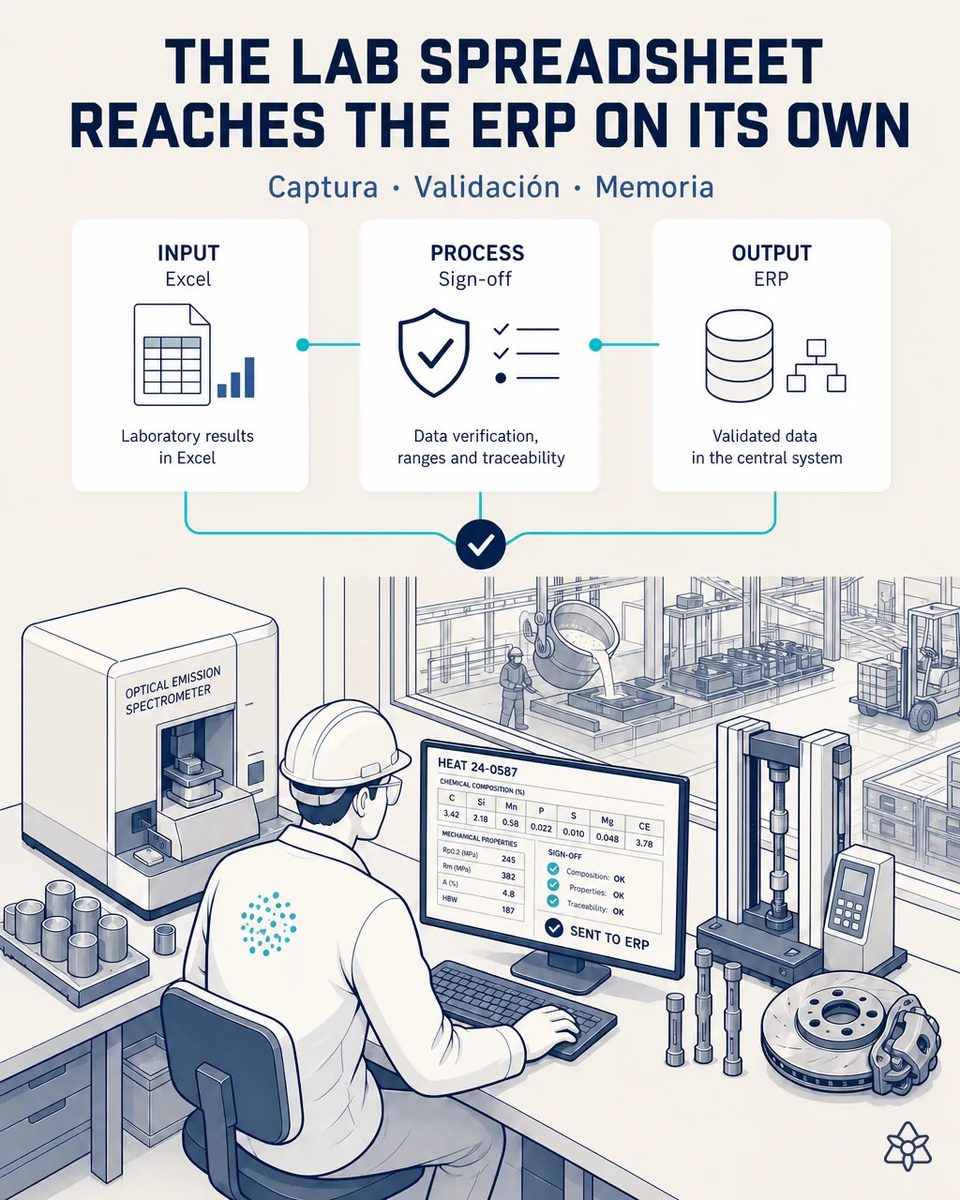
Every foundry has a shared folder holding the plant's most important spreadsheet: the metallurgical lab's — spectrometer chemistry, thermal analysis, nodule count, hardness, tensile — and the sand control sheet. It is the data that says whether the metal is fit and whether the sand is about to cause defects. With iLEAN Connect it is read as soon as it is saved and, after human validation, pushed into the ERP on its own.
The lab works in Excel because Excel is fast and the ERP is not.
The lab works in Excel because Excel is fast and the ERP is not. But then somebody has to retype, and the gap between the real figure and the ERP figure is measured in days or weeks. Meanwhile the planner does not know which heats are confirmed fit, and when a metallurgical question appears, files have to be opened by hand to reconstruct the history. Sand control suffers the same problem with a different consequence: a drift in moisture, compactability or active clay shows up in the casting defect before it shows up in any report. And there is a cost nobody looks at: every lab person who logs into the ERP purely to enter results consumes a full license.
- Spectrometer chemistry, thermal analysis, nodule count, hardness and tensile live in the lab's spreadsheet; moisture, compactability and active clay in the sand control sheet. Somebody retypes both.
- The gap between the real figure and the ERP figure is measured in days or weeks. Meanwhile the planner does not know which heats are confirmed fit and schedules them anyway.
- A sand drift shows up in the casting defect before it shows up in any report, because the report is typed after the fact and read after that.
- And every lab person who logs into the ERP purely to enter results consumes a full quality module license, year after year, for a task that is pure copying.
Connect in listen-inward mode — the folder, not the person.
Connect in "listen inward" mode:
It reads the sheet the lab already has, in the layout it already has, the moment it is saved. Results are structured by heat and by control point, crossed with the heat sheet and the furnace curve, and the quality lead validates on the tablet before the push. Chemistry, energy and outcome end up in the same place for the first time, and the lab keeps working the way it works. The planner sees which heats are confirmed fit in the schedule itself, without phoning the lab.
- iLEAN watches the shared folder and reads the file when it is saved. What it observes is the folder, never people.
- A grounded parser copes with every lab having its own sheet layout and structures results by heat and by control point.
- It cross-references them with the heat sheet and the furnace curve, so chemistry, energy and outcome end up in the same place.
- The quality lead validates on the tablet and, after that signature, Connect pushes to the ERP through its API.
Today's lab versus the connected lab
| Aspect | Today | With iLEAN Connect |
|---|---|---|
| Real figure to ERP figure | Days or weeks | Minutes |
| Heats confirmed fit | The planner asks the lab | Visible in the schedule |
| Sand drift | Discovered in the defect | Visible in the report first |
| History of a heat | Files opened by hand | One query by heat number |
| Sheet layout | Has to be respected | Read as it is, even as it changes |
| Quality module licenses | Four | One, the quality lead who validates |
from a gap of days or weeks between the real figure and the ERP figure to minutes · from manual reconstruction of history to a query by heat · from a sand drift discovered in the defect to a drift visible in the report · from 4 quality-module licenses to 1.
Impact estimate — to be validated against the actual ERP invoice.
The block below is an estimate to be validated against your plant's actual data. We put it forward so the committee has an order of magnitude; we refine it during the assessment.
- Estimated payback 3-7 months — the fastest in this matrix.
- CFO angle: the ERP bills per named user. If four lab people log in purely to enter results, that is four licenses: 50-80% reduction, recurring every year, in the order of thousands depending on vendor pricing.
- Transcription time released in the lab and in quality, on top of the license saving.
- And a sand drift caught in the report instead of in the shot-blasted casting.
estimated payback 3 to 7 months — the fastest in the pool. The saving on quality/lab module licenses is typically 50-80% and it is recurring, in the order of thousands per year depending on vendor pricing, on top of the transcription time released. *Estimate to validate against the actual ERP invoice*.
And the fair question from the production manager
“That spreadsheet has been changed by three lab techs over ten years — will it cope?” — that is the anticipated case: parsing does not depend on fixed cell positions, it interprets columns, units, merged cells and margin notes without asking anyone to standardize anything. It is an anchored task, where the best models drop below 1.5% error [1], every value is checked against its metallurgical range — a carbon equivalent of 9 is rejected, not pushed — and the quality lead validates before the push.
[1] OpenAI paper "Why Language Models Hallucinate", 2025 — on the reliability of AI in anchored tasks.
What people ask about connecting the lab spreadsheet
Do we have to standardize the lab sheet?
No, and it is better not to. Asking the lab to change its sheet is the fast route to the system going unused. iLEAN reads the one that exists, in the layout it has today, and keeps reading it when a column is added next year.
Does it cover the sand control sheet as well?
Yes, and it is the one with the earliest warning: moisture, compactability and active clay drifting show up in the report before they show up as trapped sand in a casting. That is a defect avoided rather than one detected.
Can licenses really be cut from four to one?
It depends on your contract, which is why it is framed as an estimate to validate against last year's invoice. The logic is that anyone logging in purely to type stops needing to; only the person who validates keeps a seat.
Does it help with PPAP or a customer metallurgical query?
It is one of the biggest time savers: chemistry, nodularity and hardness by heat are exactly what gets reconstructed by hand against the clock today, and with the push done they are one query away.
Does it watch the folder or the person?
The folder. The file is read when it is saved; there is no tracking of who opens what or how long they spend on it. The lab notices nothing except that nobody asks them to retype.
More cases from this series
- The audit evidence pack, generated as the process happensEvery heat and every changeover leaves evidence organized by standard: IATF 16949, VDA 6.3, CQI-9,…
- Zero stoppages on the customer's line: the three coordinated ringsThree rings — signal, matter and memory — coordinate Connect, Edge and Agents to eliminate customer line…
- The alert that arrives by email, turned into a scheduling decisionPull-ins, delays and incidents arrive by email and messaging. iLEAN cross-checks them against the EDI…
- First-piece release with early human verificationNo AI-captured data enters the ERP unsigned. The line tablet shows what was captured beside its photo…
- The closed induction furnace that finally talksAn external camera digitizes the isolated induction furnace curve: energy-metal-defect correlation with…
- Planning while walking the bay, hands freeThe planner walks. With an industrial earpiece, iLEAN listens, structures and answers in seconds: the…
Tell us how many people log into the ERP today purely to key in lab results.
We work on your plant's real data, not ours. Assessment with no commitment.
Request estimated ROI within 48h ‹ See all cases of iron castings See automotive