Metallic charge receiving: from weighbridge ticket to ERP in one tap
The chemistry of a heat depends on what came through the gate. The truck weighs in and the receiving supervisor is handed a weighbridge ticket, a multi-line delivery note and an analysis certificate for each lot of scrap, pig iron or ferroalloy — and has to sign and then key it all into the ERP. With iLEAN Connect, one photo of the ticket and the certificate, one validation tap, and everything enters with the lot tied to the future heat.
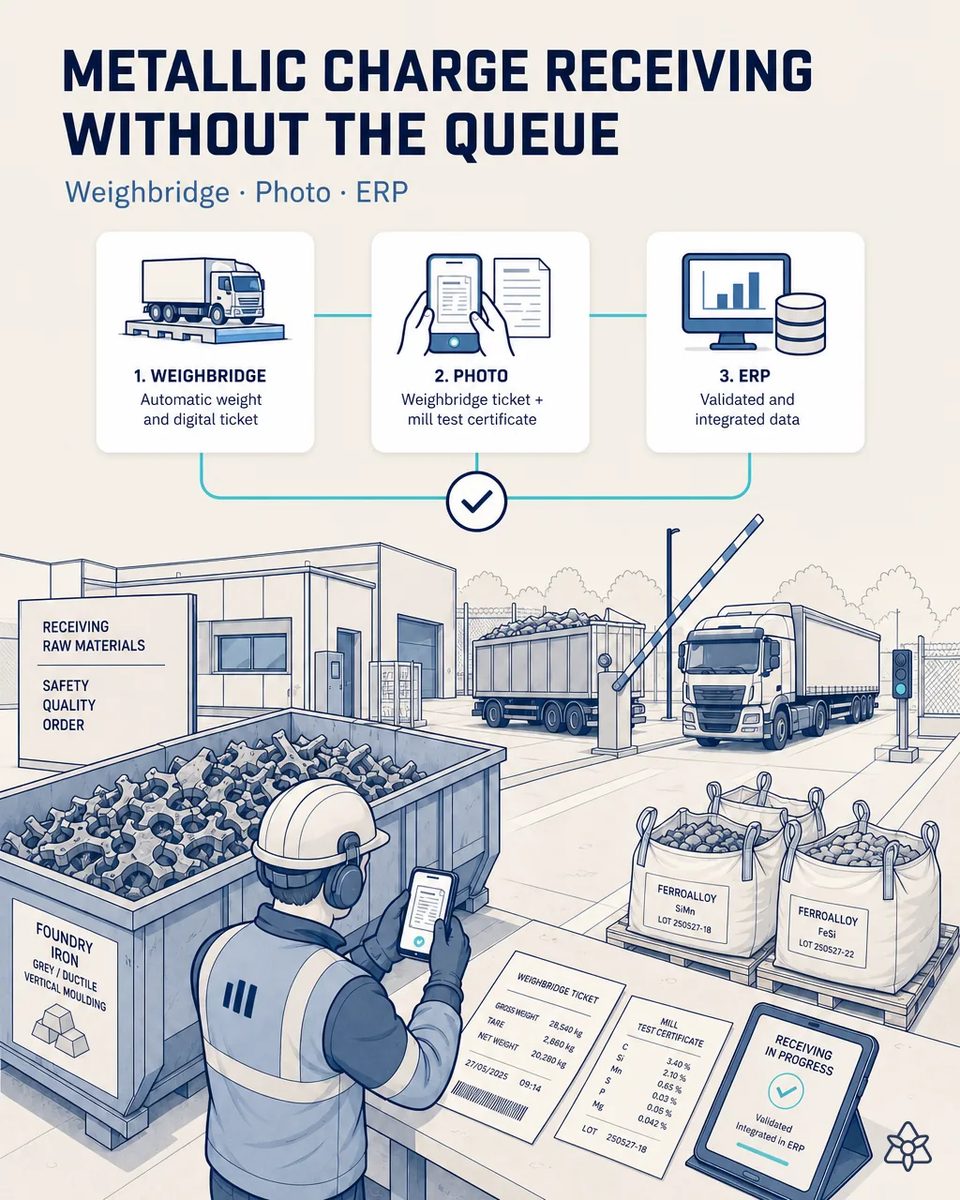
Traceability is impeccable downstream and wide open upstream.
While somebody types, the truck occupies the dock and the carrier bills demurrage. The usual escape is to type fast, and then the lot ends up badly traced. That comes back weeks later, when a heat lands out of specification and nobody can say which ferroalloy lot it came from. Supplier analysis certificates are the first link in the whole metallurgical traceability chain, and today they are filed on paper or as PDFs in a folder nobody cross-references with the heat that consumed the material. Traceability, impeccable downstream because the customer demands it, is wide open upstream.
- Every truck brings a weighbridge ticket, a multi-line delivery note and an analysis certificate for each lot of scrap, pig iron, FeSi or FeSiMg — and the receiving supervisor signs and then keys it all into the ERP.
- While somebody types, the truck occupies the dock and the carrier bills demurrage by the hour. With several trucks a day, the queue at the barrier is the normal state.
- The escape is to type fast, and then the lot ends up badly traced. It comes back weeks later, when a heat lands out of specification and nobody can say which ferroalloy lot it came from.
- The supplier certificate is the first link of the metallurgical chain, and it sits on paper or as a PDF that nobody cross-references with the heat that consumed the material.
Connect in photo mode — ticket, delivery note, certificate and lot label, no supplier changes.
Connect in photo mode applied to receiving documents:
The certificate stops being a filed sheet and becomes linked to the lot from minute one. When that lot is charged into the furnace, the heat inherits its certified chemistry, so an out-of-spec heat can be traced back to its ferroalloy lot in one query instead of a week of phone calls. The supplier changes nothing; the plant photographs what it is already handed. And the truck leaves the dock while the supervisor is still validating the summary, because the barrier no longer waits for the ERP screen. Three levers in one case: licenses, demurrage and the upstream end of the traceability chain.
- It recognizes weighbridge tickets, multi-line delivery notes, analysis certificates and lot labels, with barcodes, QR codes or plain text.
- It extracts supplier, material, lot, weight and certified chemistry, and summarizes it on screen.
- The supervisor validates with one tap and Connect pushes to the ERP via API.
- The lot stays linked, so when the material is charged into the furnace the heat inherits its certified origin.
Today's receiving versus captured receiving
| Aspect | Today | With iLEAN Connect |
|---|---|---|
| Truck at the dock | 30-45 minutes | Under 10 |
| Supplier analysis certificate | Filed, unlinked | Tied to the lot from minute one |
| Lot to heat link | Reconstructed after a problem | Inherited when the charge is made |
| Traceability upstream | Wide open | Closed from supplier to part |
| Carrier demurrage | Recurring | Eliminated |
| Receiving module licenses | Three | One, the supervisor who validates |
from 30-45 minutes of dock time per truck to under 10 · from certificates filed without cross-reference to a lot linked to the heat that consumed it · from traceability open upstream to traceability closed from supplier to part · from 3 receiving-module licenses to 1.
Impact estimate — to be validated with your numbers.
The block below is an estimate to be validated against your plant's actual data. We put it forward so the committee has an order of magnitude; we refine it during the assessment.
- Estimated payback 4-8 months.
- CFO angle: the receiving and warehouse module typically needs three active licenses; with Connect only the supervisor validates: 50-70% reduction, recurring.
- Carrier demurrage — billed by the hour — eliminated, truck after truck.
- And traceability closed upstream, which is what bounds a containment to the heats that actually consumed a suspect lot instead of a month of production.
estimated payback 4 to 8 months. Three levers: a recurring 50-70% saving on receiving/warehouse module licenses, the elimination of carrier demurrage — billed by the hour — and closing traceability upstream. *Estimate to validate*.
And the fair question from the production manager
“Does it read every supplier's certificate and delivery note?” — yes, and without asking any of them to change theirs: the model extracts the table structure with no per-supplier template, and lot labels are read by barcode or QR where present and by optical recognition where not. It is an anchored task, where the best models drop below 1.5% error [1], and the supervisor validates the summary before anything enters the ERP. A certified silicon content outside the grade's range is flagged, not accepted.
[1] OpenAI paper "Why Language Models Hallucinate", 2025 — on the reliability of AI in anchored tasks.
What people ask about digitizing charge receiving
Is the certified chemistry actually extracted?
Yes, element by element, and it is the part that adds most: the certified values end up on the lot, so proving which FeSiMg lot a questionable heat used stops being a search through a folder and becomes a query.
Does it work for scrap, pig iron and ferroalloys alike?
Yes. What differs is the format of the document and the label, and the model reads the structure without a template per supplier or per material. A new supplier needs no setup, and a supplier who changes the layout of their certificate does not break anything.
What if the ticket weight and the delivery note disagree?
The discrepancy is highlighted in the summary before the supervisor validates. Today nobody does that cross-check with a truck waiting at the barrier, and the difference is discovered at the month-end inventory.
How does the heat inherit the lot?
The lot stays linked in the central memory; when the charge is recorded on the heat sheet, the heat picks up the certified origin of every lot charged. That is what closes traceability from supplier to part.
Can we start with receiving alone?
Yes, and it is a good starting point: the result is visible from the first truck and it does not depend on the other cases being deployed. The link to the heat is added when the heat sheet case goes live.
More cases from this series
- The audit evidence pack, generated as the process happensEvery heat and every changeover leaves evidence organized by standard: IATF 16949, VDA 6.3, CQI-9,…
- Zero stoppages on the customer's line: the three coordinated ringsThree rings — signal, matter and memory — coordinate Connect, Edge and Agents to eliminate customer line…
- The alert that arrives by email, turned into a scheduling decisionPull-ins, delays and incidents arrive by email and messaging. iLEAN cross-checks them against the EDI…
- First-piece release with early human verificationNo AI-captured data enters the ERP unsigned. The line tablet shows what was captured beside its photo…
- The closed induction furnace that finally talksAn external camera digitizes the isolated induction furnace curve: energy-metal-defect correlation with…
- Planning while walking the bay, hands freeThe planner walks. With an industrial earpiece, iLEAN listens, structures and answers in seconds: the…
Tell us what your dock demurrage costs per year.
We work on your plant's real data, not ours. Assessment with no commitment.
Request estimated ROI within 48h ‹ See all cases of iron castings See automotive