What changed between shot forty and shot fifty-five
Tryout is the moment of truth for a mold: it gets mounted, shot, and the part is inspected. Today a person with years of craft inspects it shot by shot for hours, noting on a sheet. They get it right, but they cannot correlate a hundred shots with a hundred parameter combinations. With iLEAN Edge a camera over the press classifies each part's defect in milliseconds and ties it to that shot's exact parameters.
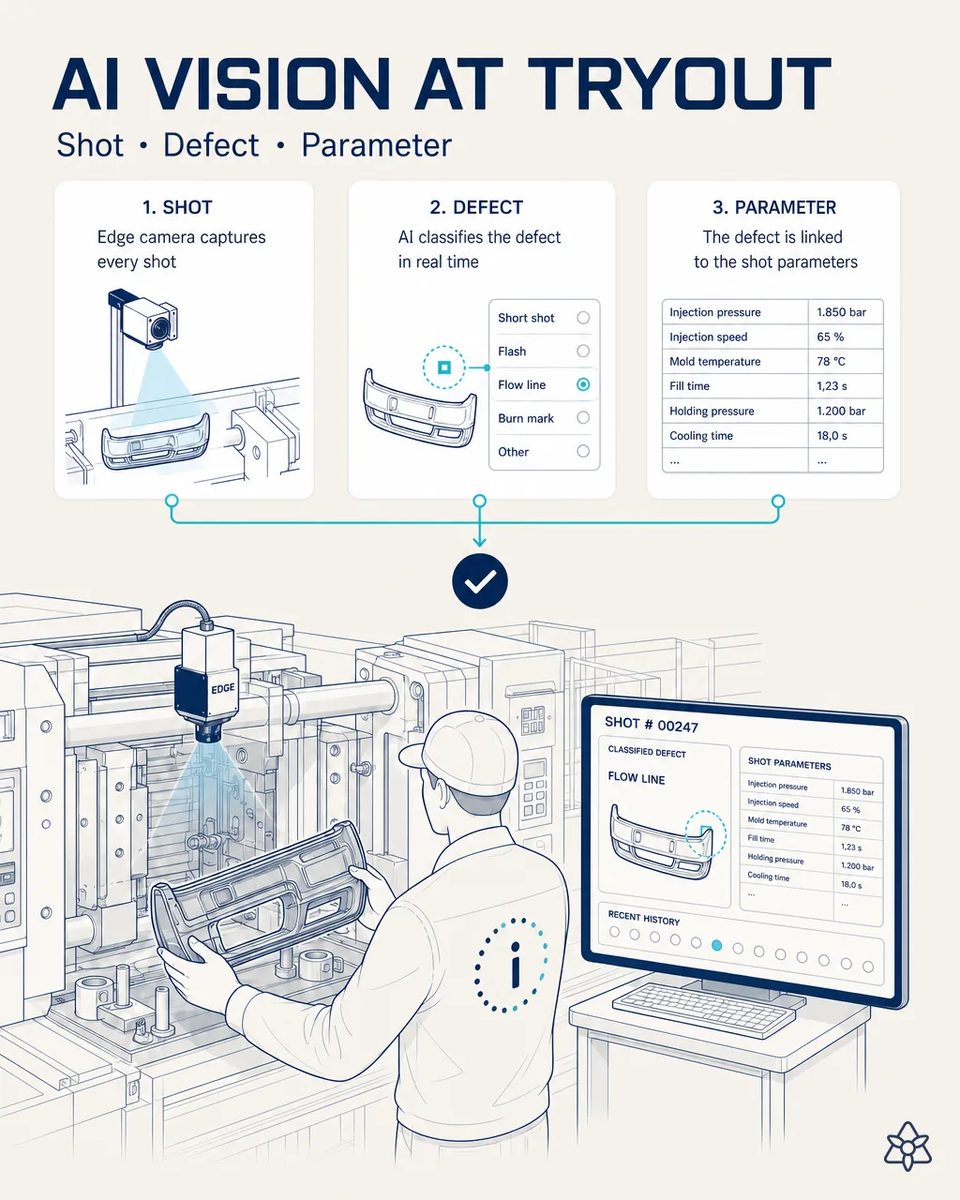
At tryout, what is missing is not the eye. It is memory and correlation.
Every tryout loop costs press time, steel, bench hours and calendar. And what decides whether another loop is needed is one person's reading of a handful of parts, at the end of a long day. When the defect sits on a Class A surface — the one the car buyer will see — the tolerance is zero and the discussion with the customer is long, because neither side has structured evidence: only impressions and loose photos. What is missing at a tryout is not the eye. It is memory and correlation.
- Tryout is the moment of truth: the mold is mounted, shot, and the part inspected. A person with years of craft reads it shot by shot for hours, noting on a sheet.
- They get it right, but they cannot correlate a hundred shots with a hundred parameter combinations, and what decides whether another loop is needed is their reading of a handful of parts at the end of a long day.
- Every loop costs press time, steel, bench hours and calendar on the critical path.
- On a Class A surface the tolerance is zero and the discussion with the customer is long, because neither side has structured evidence: only impressions and loose photos.
Edge — AI vision at the press itself, with local inference and nothing leaving the plant.
Edge: AI vision at the press itself, with local inference and nothing leaving the plant.
The camera classifies each part in milliseconds against the shop's real defect catalog — sink marks, flash, flow lines, gas burn, ejector marks, warpage, short shots — and stores the verdict next to that shot's pressure, times and temperatures and the suspect detail: venting, cooling, insert. The technician stays in command: the AI gives the pattern, he decides the adjustment. What changed between shot forty and shot fifty-five stops being a question asked from memory at the end of the day.
- An industrial camera over the ejection area of the tryout press.
- A vision model trained on good parts and on the shop's real defect catalog: sink marks, flash, flow lines, gas burn, ejector marks, warpage, short shots.
- Every classification is stored next to that shot's parameters (pressure, times, temperatures) and to the suspect mold detail: venting, cooling, insert.
- The tryout technician stays in command: the AI gives the pattern, he decides the adjustment.
The cumulative effect is a history that lets the shop start the next similar mold knowing what happened on the last one.
Today's tryout versus the tryout with Edge
| Aspect | Today | With iLEAN Edge |
|---|---|---|
| Record of each shot | A handwritten sheet of impressions | Defect per shot, tied to parameters |
| What changed between shot 40 and 55 | Nobody can say | The parameter and the defect, side by side |
| Root cause | By experience | With evidence, pointing at the suspect detail |
| Discussion with the customer | Impressions and loose photos | Structured evidence per shot |
| Loops per complex mold | The historical number | At least one fewer |
| Next similar mold | Starts from zero | Starts knowing what happened on the last one |
from a handwritten sheet of impressions → defect history per shot correlated with parameters. From diagnosing root cause by experience → reaching it with evidence, and taking that evidence into the customer meeting.
Impact estimate — to be validated against your loops-per-mold history.
The block below is an estimate to be validated against your plant's actual data. We put it forward so the committee has an order of magnitude; we refine it during the assessment.
- An estimated reduction of at least one tryout loop on complex molds.
- Estimated payback 5-11 months.
- Every loop avoided frees press, bench and calendar days on the critical path.
- And the customer meeting on a Class A defect is held with evidence per shot instead of impressions.
an estimated reduction of at least one tryout loop on complex molds; estimated payback 5-11 months. Every loop avoided frees press, bench and calendar days on the critical path. *Estimate to validate against the loops-per-mold history*.
And the fair question from the production manager
"Will it call a good part defective and send us chasing a ghost?" — the false positive is the real risk of any vision system, which is why the model is trained on good parts and on the shop's own defect catalog, under that press's lighting, not on a generic model. Borderline shots are not silently classified: they are escalated for the tryout technician to decide, and every decision feeds back into training. The model proposes the pattern; the adjustment is always his [1].
[1] OpenAI paper "Why Language Models Hallucinate", 2025 — on the reliability of AI in anchored tasks.
What people ask about AI vision at tryout
Does it work on a textured or high-gloss Class A part?
Yes, with lighting set for that surface at commissioning. Gloss is the harder case and the one where structured evidence per shot is worth most in front of the customer, because a flow line on a visible trim part is a discussion about the gate, not about the press.
How many shots are needed before it is useful?
Fewer than feared, because the defect catalog of an injection part is short and repetitive. What it needs is real parts from the shop's own tryouts, good and bad, and the first loop of a new mold already adds its shots to the training set.
Does it replace the tryout technician's judgment?
No. It gives him what he cannot hold in his head: which parameter moved when the defect appeared and whether the same defect showed on the last mold with that gate layout. The adjustment remains his call, and it is recorded with the shot it was made on.
Where do the shot parameters come from?
From the press if it exposes them, or from the panel read by camera if it does not — the same pattern as the EDM case. Injection pressure, speed, mold temperature, fill, hold and cooling times are stored next to each shot's verdict.
Is the history useful for the next mold?
That is the cumulative value: the next similar mold starts with the record of which venting or cooling change solved which defect on the last one.
More cases from this series
- The old machine stays itself, but now it reportsAn external camera digitizes the isolated panel of an older EDM: no more blind nights, without opening…
- The human gate sits at the bench, not in an officeNothing the AI captures crosses into the system without a sign-off from the person who knows: two taps…
- The knowledge that walks around and dies at end of shiftThe shop supervisor dictates what he decides while walking: iLEAN structures it against the mold and…
- The job traveler, in the system at second zeroReal progress on every mold detail in the system instantly: one photo of the job traveler and zero habit…
- The shop's most valuable quality data stops living in a folderiLEAN reads the dimensional report as it is saved, ties it to the mold and posts it to the ERP after…
- The mold book writes itself while the mold is builtPhotos, dimensions, parameters, heats and signatures assembled per mold and ordered by automotive…
Send us photos of your typical tryout defects and we will set up a classification pilot.
We work on your plant's real data, not ours. Assessment with no commitment.
Request estimated ROI within 48h ‹ See all cases of injection mold shops See automotive