The job traveler, in the system at second zero
In a mold shop every component travels with its paper job traveler: mold number, detail number, drawing revision, operation sequence and actual hours written by hand. That sheet is today the only place where real project progress lives, until someone collects it and types it in days later. With iLEAN Connect the machinist takes a photo as each operation closes and detail progress exists in central memory immediately.
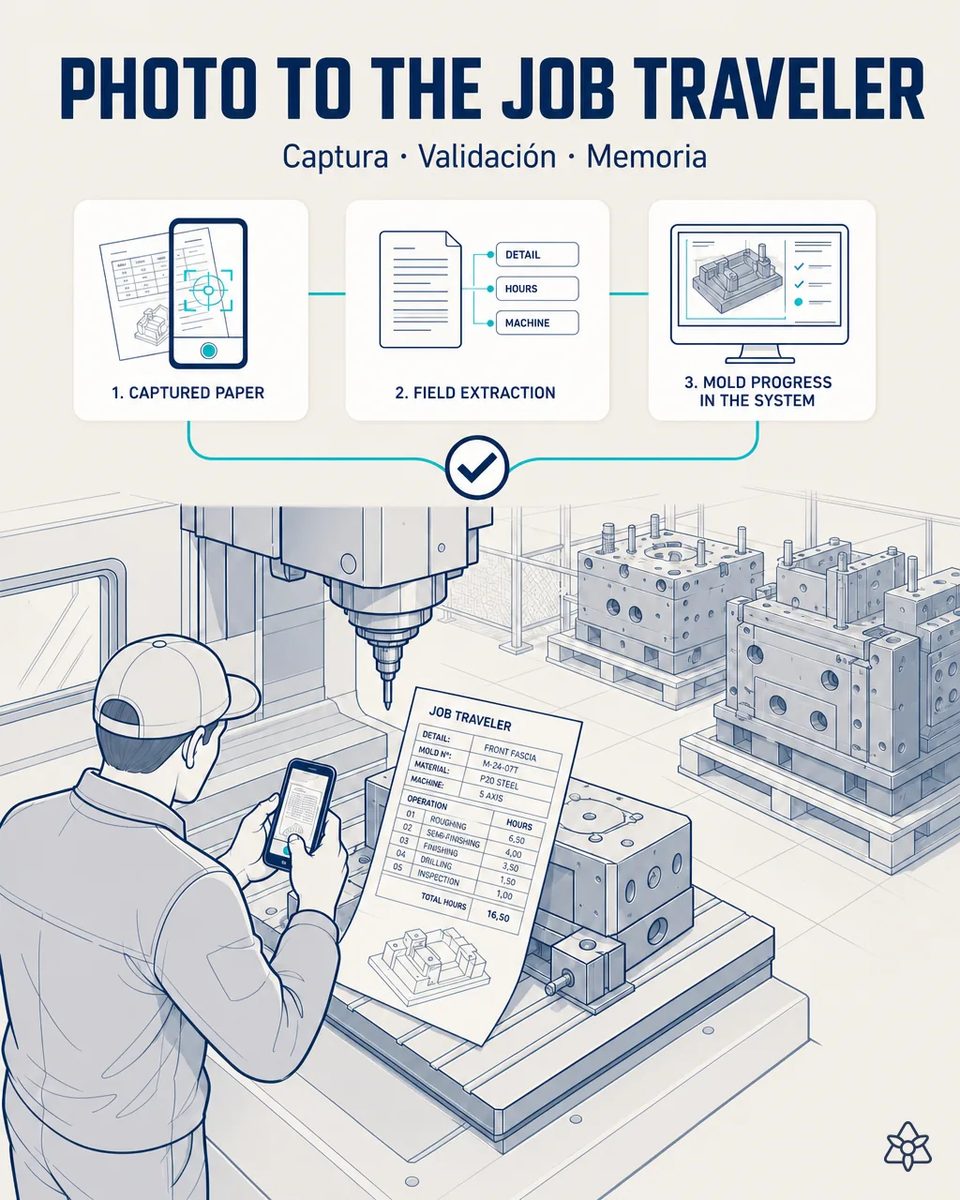
The only record of real progress is a sheet clamped to the part.
A large mold breaks down into hundreds of details. Each one passes through roughing, heat treatment, five-axis finishing, EDM, grinding and the bench, and each one carries its paper. The project lead needs to know every morning what share of the mold is genuinely done in order to defend — or correct — the delivery date, and what he actually has is a folder of sheets scattered across the machines. By the time the data reaches the system it is history: it supports billing, not decisions. And the margin notes that really matter ("roughing left more stock than planned", "drawing revision C is missing") never reach anyone. The result is a shop that works well and a schedule flying blind. The committed date gets defended with perceptions because the system has nothing better to offer.
- Every detail carries its traveler through roughing, heat treatment, five-axis finishing, EDM, grinding and the bench. The operator writes the actual hours and closes each operation by hand, and that sheet is the only place the truth lives.
- The project lead defends the tooling date every morning from a folder of sheets scattered across the machines. What the system holds was typed one to three days ago, and it feeds billing, not the schedule.
- The margin notes are the ones that matter — "roughing left more stock than planned", "drawing revision C missing" — and they die on paper because nobody types margins.
- The result is a shop that works well and a schedule flying blind. The committed date is argued with perceptions because nothing better exists.
Connect in photo mode — the traveler stays, it just stops being the only copy.
Connect in photo mode, the cheapest capture mode to deploy because it changes nobody's habits.
It is the cheapest of the twelve to deploy because it changes nobody's habits: the machinist adds a photo to what he already does when he closes an operation. From that moment the detail exists in central memory with its hours, its revision and its handwritten issue, and the project lead sees the mold as the sum of its real details. The scheduling, the cost roll-up and the mold dossier all draw on the same capture, so one photo feeds three uses that today are fed by three separate transcriptions.
- The machinist photographs the job traveler with a phone or industrial tablet as each operation ends.
- A grounded LLM reads the document structure and extracts the fields: mold, detail, operation, drawing revision, hours and the handwritten issue.
- What was captured is summarized on screen and passes the human validation gate before entering central memory.
- Progress is tied to the project and available for scheduling, for cost roll-up and for the mold dossier.
The paper can stay if the shop wants it. It simply stops being the only carrier of the data.
Today's traveler versus the captured traveler
| Aspect | Today, on paper | With iLEAN Connect |
|---|---|---|
| Latency to the system | 1-3 days, more over a weekend | Second zero |
| Mold progress | Eyeballed in the morning meeting | Sum of real details, per operation |
| Actual hours per detail | Typed later, rounded | Read from the sheet, tied to the detail |
| Handwritten issue | Dies on paper | Extracted and routed to whoever can act |
| Drawing revision on the sheet | Nobody cross-checks | Compared with the current revision |
| Machinist's habit | — | Unchanged: one photo |
from 1-3 days of latency between "the operation is done" and "the system knows" → immediate. From project progress eyeballed in the morning meeting → real progress per detail. From handwritten issues dying on paper → signals that reach whoever can act.
Impact estimate — to be validated with your numbers.
The block below is an estimate to be validated against your plant's actual data. We put it forward so the committee has an order of magnitude; we refine it during the assessment.
- Estimated payback 4-9 months, depending on the number of live details in the shop.
- Transcription time recovered by the project lead and the office.
- From one to three days of latency down to second zero, detail by detail.
- Early detection of the details eating the project margin — the ones where roughing left stock or an operation ran twice the planned hours.
estimated payback 4-9 months depending on the number of live details, between recovered transcription time and early detection of details eating the project margin. *Estimate to validate*.
And the fair question from the production manager
"What if it misreads the hours a machinist wrote in a hurry?" — reading fields from a document whose structure is known is an anchored task, where the best models drop below 1.5% error [1]. And there is a second net: the summary reaches the bench tablet and a person confirms or corrects it before anything crosses into central memory, so a doubtful digit never becomes project data on its own.
[1] OpenAI paper "Why Language Models Hallucinate", 2025 — on the reliability of AI in anchored tasks.
What people ask about photographing the job traveler
Do we have to redesign our job traveler?
No. The model reads the structure the sheet already has: mold number, detail number, operation sequence, hours and the notes in the margin. If the shop uses two or three different templates, all of them are read.
What if the machinist photographs the wrong sheet or half of it?
The capture is cross-checked against the detail expected at that machine and the operation that was open on it. A traveler that does not match, or that arrives cut off, is flagged for a person before it counts as progress, and the machinist is asked for a second photo from the tablet rather than the sheet being silently dropped.
Does it cover subcontracted operations like heat treatment?
Yes. The traveler comes back from the subcontractor with its stamp and dates, and the photo on return closes that operation the same way as an in-house one.
Can the project lead see progress per mold, not just per detail?
That is the point: the mold is the sum of its details, so progress rolls up from the details actually closed rather than from an estimate of the whole. A cavity insert with three operations left and a core with none are no longer averaged into a percentage; the lead sees which details are behind and on which machine.
Does the paper have to disappear?
No. The paper can keep traveling with the part if the shop wants it. It simply stops being the only carrier of the data.
More cases from this series
- The old machine stays itself, but now it reportsAn external camera digitizes the isolated panel of an older EDM: no more blind nights, without opening…
- The human gate sits at the bench, not in an officeNothing the AI captures crosses into the system without a sign-off from the person who knows: two taps…
- The knowledge that walks around and dies at end of shiftThe shop supervisor dictates what he decides while walking: iLEAN structures it against the mold and…
- The shop's most valuable quality data stops living in a folderiLEAN reads the dimensional report as it is saved, ties it to the mold and posts it to the ERP after…
- The mold book writes itself while the mold is builtPhotos, dimensions, parameters, heats and signatures assembled per mold and ordered by automotive…
- The most expensive minute in the shop is the press closingEdge cameras verify clean mold face, ejectors home and connections made before closing is authorized. A…
Show us one of your job travelers and we will tell you which fields iLEAN would extract.
We work on your plant's real data, not ours. Assessment with no commitment.
Request estimated ROI within 48h ‹ See all cases of injection mold shops See automotive