The most expensive minute in the shop is the press closing
A large mold comes in on the crane, gets clamped, cooling circuits and the hot runner are connected, and the press closes. If it closes on a stuck part, a proud ejector or a badly seated insert, the damage runs into tens of thousands and weeks of repair on a mold that was already tight on date. With iLEAN Edge the cameras compare actual state against reference and the press does not close until every point is clear and the lead signs.
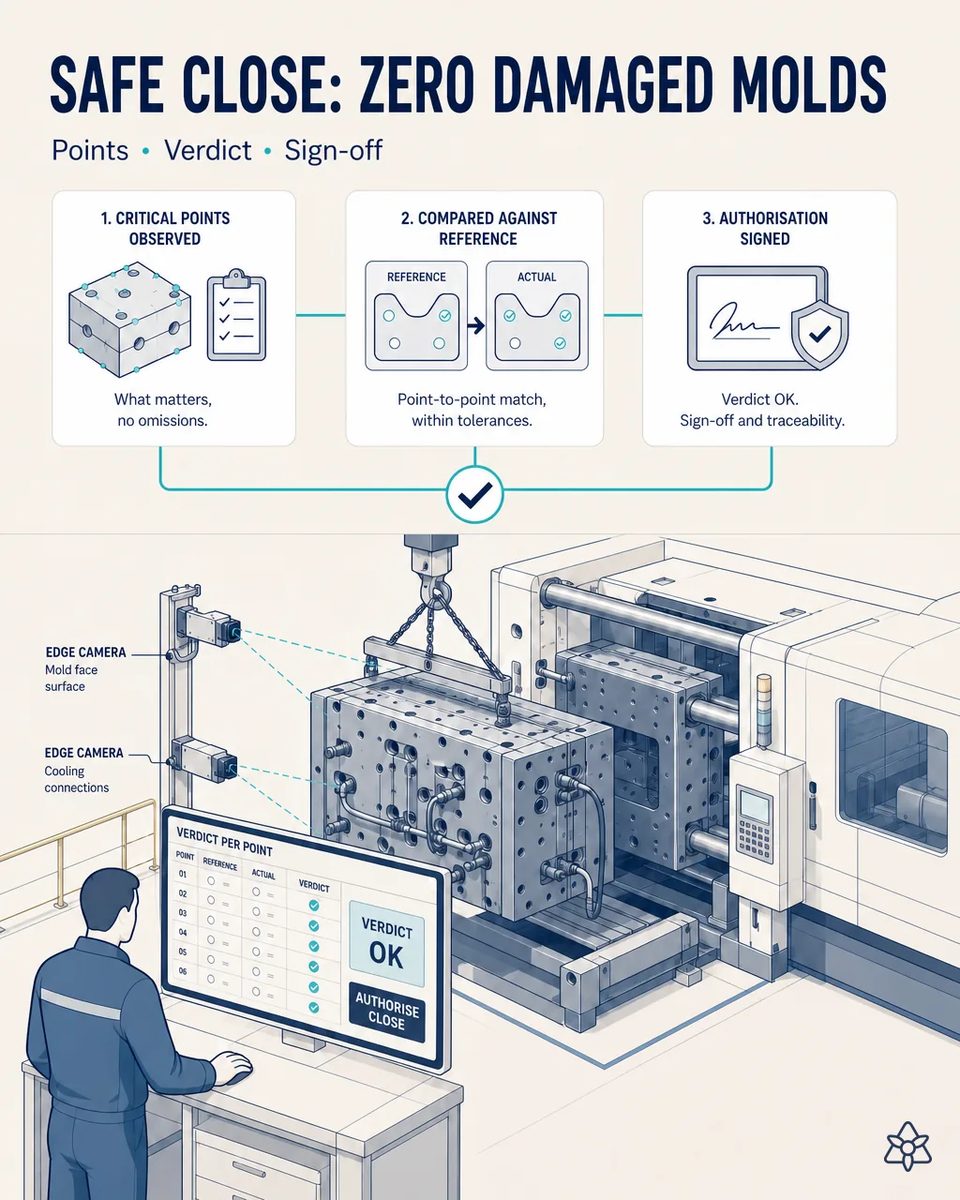
The most expensive minute in the shop is the one when the press closes.
Between initial setup, adjustments and project changes, a mold goes in and out of the press many times while it is being built, often in a hurry and often across different shifts with different people. One lapse — a part not ejected, crossed cooling lines, incomplete clamping — is enough to turn an hours problem into a weeks problem. And the cost is not only the repair: it is the hole that mold leaves in the press calendar and the domino effect on the date committed to the customer.
- Between initial setup, adjustments and project changes, a mold goes in and out of the press many times while it is being built, often in a hurry and across shifts with different people.
- If it closes on a stuck part, a proud ejector or a badly seated insert, the damage runs into tens of thousands and weeks of repair on a mold that was already tight on date.
- One lapse — a part not ejected, crossed cooling lines, incomplete clamping — turns an hours problem into a weeks problem.
- And the cost is not only the repair: it is the hole that mold leaves in the press calendar and the domino effect on the date committed to the customer.
Edge plus JIDOKA AI — the ring that halts the machine in front of an anomaly.
Edge plus JIDOKA AI, the ring that halts a machine in front of an anomaly.
Cameras on the critical points the shop itself defines: mold face, ejectors, water and hot runner connections, clear closing area. iLEAN compares the current state against the reference and issues a verdict per point. If any point is not clear, closing is not authorized and the screen says which one and why. The press lead signs. Humans in command, with the machine supplying evidence rather than opinion, on every close and on every shift.
- Cameras on the critical points the shop itself defines: mold face, ejectors, water and hot runner connections, clear closing area.
- iLEAN compares the current state against the reference state and issues a verdict per point.
- If any point is not clear, closing is not authorized and the screen shows exactly which one and why.
- The press lead signs the authorization. Humans in command, with the machine supplying evidence rather than opinion.
Today's close versus the verified close
| Aspect | Today | With iLEAN Edge |
|---|---|---|
| The pre-close check | Visual, depends on rush and shift | Objective and repeatable at every close |
| A proud ejector | Seen if someone looks | Blocked, named on screen |
| Crossed cooling lines | Found when the mold overheats | Compared with the reference before closing |
| Who authorizes | Whoever is at the press | The press lead, on evidence |
| Record of a blocked close | None | Every block with its reason |
| Damage events | Now and then | A trend to zero |
from a visual check that depends on the rush and the shift → objective, repeatable verification at every close. From incidents that show up "now and then" → a trend to zero, with every block and its reason on record.
Impact estimate — to be validated against your incident history.
The block below is an estimate to be validated against your plant's actual data. We put it forward so the committee has an order of magnitude; we refine it during the assessment.
- Avoidance is the metric: a single serious mold damage incident avoided — repair plus calendar impact — usually covers the entire installation.
- Estimated payback 4-10 months, counting also the setup time no longer repeated.
- The hole that a damaged mold leaves in the press calendar stops happening.
- And the domino effect on the date committed to the customer stops with it.
avoidance is the metric here: a single serious mold damage incident avoided (repair plus calendar impact) usually covers the entire installation. Estimated payback 4-10 months, counting also the setup time no longer repeated. *Estimate to validate against the incident history*.
And the fair question from the production manager
"What if the camera blocks the press for no reason during a rush?" — that is the right objection, because the press sits on the critical path. The comparison is against the reference state for that specific mold, defined by the shop's own toolmakers, and it blocks on a verifiable discrepancy at a named point, not on model uncertainty. In case of doubt the system does not block silently: it escalates to the press lead, who signs on the image. The 1.5% error figure that applies to anchored reading tasks [1] is not the safety argument here; the human signature is.
[1] OpenAI paper "Why Language Models Hallucinate", 2025 — on the reliability of AI in anchored tasks.
What people ask about the safe mold close
Which points are checked?
Whatever the shop defines at commissioning: mold face free of parts and debris, ejectors home, cooling and hot runner connections made, clamps complete, closing area clear. Points can be added per mold.
Does it need a reference image for every mold?
Yes, captured at the first correct setup of that mold in that press. It takes minutes and it is the same picture the toolmakers would want anyway. When the mold changes — a new slide, a relocated water fitting — the reference is updated and signed like any other change.
Can the press lead override a block?
An exception can be signed and it is recorded as such, with the image of the point that was not clear. What cannot happen is a close with no trace of who decided to override, which is exactly what the investigation after a damaged mold runs into today.
Does it connect to the press safety circuit?
It can, through the press's own interlock, or it can act as an authorization screen the lead confirms before pressing close. Both keep the decision human.
Does it slow down the setup?
The verdict takes seconds. What slows a setup today is the second look people take because they are not sure, and the weeks lost when nobody took it.
More cases from this series
- The old machine stays itself, but now it reportsAn external camera digitizes the isolated panel of an older EDM: no more blind nights, without opening…
- The human gate sits at the bench, not in an officeNothing the AI captures crosses into the system without a sign-off from the person who knows: two taps…
- The knowledge that walks around and dies at end of shiftThe shop supervisor dictates what he decides while walking: iLEAN structures it against the mold and…
- The job traveler, in the system at second zeroReal progress on every mold detail in the system instantly: one photo of the job traveler and zero habit…
- The shop's most valuable quality data stops living in a folderiLEAN reads the dimensional report as it is saved, ties it to the mold and posts it to the ERP after…
- The mold book writes itself while the mold is builtPhotos, dimensions, parameters, heats and signatures assembled per mold and ordered by automotive…
How many mold damage events have you had in the press? We will size the return on that number.
We work on your plant's real data, not ours. Assessment with no commitment.
Request estimated ROI within 48h ‹ See all cases of injection mold shops See automotive