The mold book writes itself while the mold is built
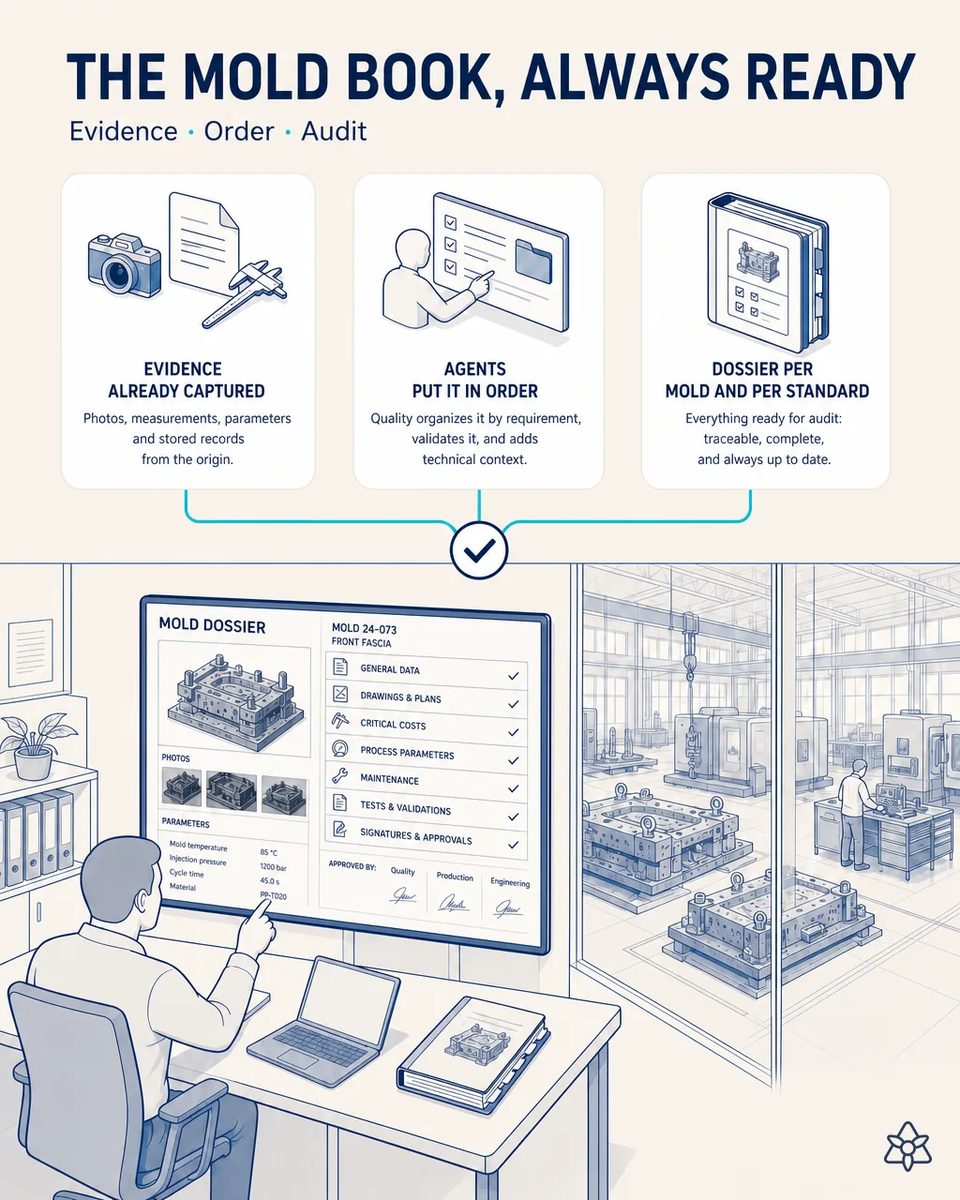
The day a customer asks for the full history of a mold delivered two years ago, someone spends days rebuilding it across the system, a network folder, photos on phones and three people's memory. The same happens, concentrated, at every audit. With iLEAN the Agents collect what Connect and Edge already captured and organize it into a per-mold dossier, ordered by what each standard asks for.
Every mold is a unique story, and its evidence is scattered.
Automotive documentation requirements are not negotiable, but the evidence is generated scattered and gets ordered by hand and out of time. In a project shop the problem is worse: there is no procedure repeated a hundred times, there are a hundred unique stories. Every mold had its own engineering changes, its own tryout loops and its own repairs. The typical result is an enormous effort concentrated exactly when the team should be pushing the next molds out — and a gap the auditor eventually finds.
- The day a customer asks for the full history of a mold delivered two years ago, someone spends days rebuilding it across the system, a network folder, photos on phones and three people's memory.
- Automotive documentation requirements are not negotiable, but the evidence is generated scattered and gets ordered by hand and out of time.
- In a project shop it is worse: there is no procedure repeated a hundred times, there are a hundred unique stories, each with its own engineering changes, tryout loops and repairs.
- The typical result is an enormous effort concentrated exactly when the team should be pushing the next molds out — and a gap the auditor eventually finds.
Agents on top of central memory — nothing new has to be captured.
Agents on top of central memory. Nothing new has to be captured: it is all in the system already from the previous cases.
It is all in the system already from the previous cases: job travelers, panel data, alerts and engineering changes, bench decisions, validations, dimensional reports, heats and certificates, machine hours, tryout defects and blocked closings. The Agents order that evidence by the requirements of each applicable standard, publish a browsable dossier, and the quality manager reviews and signs. Gaps are flagged during the build, not on audit day, while the detail is still on the bench and the missing measurement can still be taken.
- The Agents assemble per mold the job travelers, the machine panel data, the alerts and engineering changes, the bench decisions, the validations, the dimensional reports, the heats and certificates, the machine hours, the tryout defects and the blocked closings.
- They order that evidence by the requirements of each applicable automotive standard.
- They publish a browsable dossier; the quality manager reviews and signs.
- The auditor or the customer logs in and downloads the package for the mold or period requested.
And the most valuable part: gaps are flagged by the system during the build, while they can still be closed.
Today's mold history versus the living mold book
| Aspect | Today | With iLEAN Agents |
|---|---|---|
| History of a delivered mold | Days of document archaeology | The dossier already exists |
| Where the evidence is | System, folder, phones and memory | One package per mold |
| Ordering by standard | By hand, before the audit | By the Agents, as it happens |
| A documentation gap | Found by the auditor | Flagged by the system in time |
| Heat, revision and tryout history | Three different searches | One lookup by mold |
| The customer's access | An email with attachments | A scoped download of the mold requested |
from days of document archaeology per audit or complaint → the dossier already exists. From gaps found by the auditor → gaps flagged by the system in time.
Impact estimate — to be validated with your numbers.
The block below is an estimate to be validated against your plant's actual data. We put it forward so the committee has an order of magnitude; we refine it during the assessment.
- Estimated payback 5-11 months from quality and engineering time recovered.
- Reduced nonconformity risk, which in automotive is paid in competitive position at the next award.
- The effort no longer concentrates in the weeks when the team should be pushing the next molds out.
- And a complaint on a delivered mold is answered from the dossier, not from three people's memory.
estimated payback 5-11 months from quality and engineering time recovered, plus reduced nonconformity risk — which in automotive is paid in competitive position at the next award. *Estimate to validate*.
And the fair question from the production manager
"Isn't this just a document manager with a nicer name?" — the difference is direction. A document manager stores what somebody decides to upload, after the fact, and inherits the same gaps. Here the evidence enters at the moment it happens, signed at the bench, and what the Agents do is reorganize it by whichever standard asks. Each piece of evidence was read as an anchored task, where the best models drop below 1.5% error [1], and validated by a person before it became part of the mold's history.
[1] OpenAI paper "Why Language Models Hallucinate", 2025 — on the reliability of AI in anchored tasks.
What people ask about the mold book
Which standards can it order the evidence by?
The automotive quality standards and the customer-specific requirements the shop is audited against, including the OEM's own tooling specification. The mapping from evidence to requirement is set up once with the quality manager and reused for every mold that follows.
Does it include the engineering changes and which details were remade?
Yes, and that is the part rebuilt most painfully by hand today: each data level, the details affected, what was saved and what was remachined, with dates and with the steel repurchased. When the customer disputes a change order months later, the sequence is already written.
Can the customer see other customers' molds?
No. Access is scoped to the mold or period requested; the customer or auditor sees nothing else, and the download is logged like any other access to the dossier.
What happens to molds delivered before iLEAN?
They stay where they are. The mold book builds from the first mold captured forward; bringing in older history is optional, and usually done only for the molds a customer is still running in series and likely to ask about.
Who signs the dossier?
The quality manager reviews and signs. The Agents assemble and order; they do not certify anything on their own. Where a section needs production or engineering sign-off as well, the dossier shows whose signature is still missing before it can be released to the customer.
More cases from this series
- The old machine stays itself, but now it reportsAn external camera digitizes the isolated panel of an older EDM: no more blind nights, without opening…
- The human gate sits at the bench, not in an officeNothing the AI captures crosses into the system without a sign-off from the person who knows: two taps…
- The knowledge that walks around and dies at end of shiftThe shop supervisor dictates what he decides while walking: iLEAN structures it against the mold and…
- The job traveler, in the system at second zeroReal progress on every mold detail in the system instantly: one photo of the job traveler and zero habit…
- The shop's most valuable quality data stops living in a folderiLEAN reads the dimensional report as it is saved, ties it to the mold and posts it to the ERP after…
- The most expensive minute in the shop is the press closingEdge cameras verify clean mold face, ejectors home and connections made before closing is authorized. A…
Pick a delivered mold and we will show you what its automatic dossier would look like.
We work on your plant's real data, not ours. Assessment with no commitment.
Request estimated ROI within 48h ‹ See all cases of injection mold shops See automotive