The knowledge that walks around and dies at end of shift
The shop supervisor spends the day walking between the fitting bench, the five-axis machines, EDM and the spotting press, drawing in one hand and caliper in the other. He makes dozens of calls a day and none of them get written down, because recording would mean walking back to the office. With iLEAN Connect he talks to the AI without stopping: it listens, structures, stores it against the mold and hands support back in seconds.
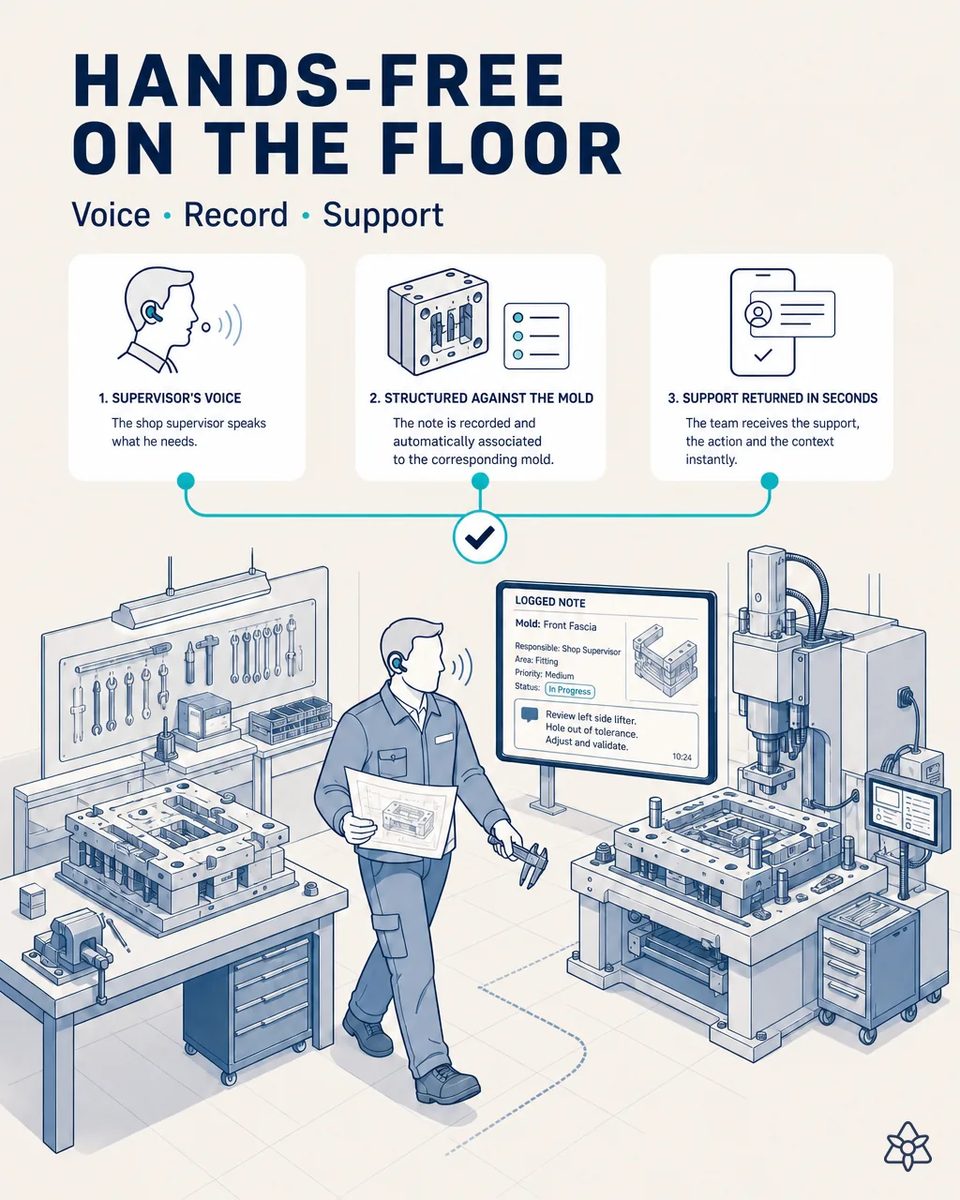
The shop's critical knowledge is oral and it walks.
The critical knowledge of a mold shop is oral and it walks. Nobody asks the supervisor anything in writing because they know he cannot type, and he records nothing because the cost of recording is interrupting what he is doing. There are three consequences and all of them show: the project lead does not know what he knows, the night shift gets second-hand instructions, and the day he is out the shop measurably slows down. This usually gets called "key person dependency" and accepted as inevitable. It is not: it is an interface problem.
- The supervisor spends the day between the fitting bench, the five-axis machines, EDM and the spotting press, drawing in one hand and caliper in the other. He makes dozens of calls a day and none of them get written down.
- Nobody asks him anything in writing because he cannot type, and he records nothing because recording means walking back to the office.
- The project lead does not know what he knows, the night shift gets second-hand instructions, and the day he is out the shop measurably slows down.
- This gets called key person dependency and accepted as inevitable. It is not: it is an interface problem.
Connect in voice mode — iLEAN listens to the supervisor, not to the toolmakers.
Connect in voice mode over a Bluetooth earpiece — the hands-free mode of IRIS.
He dictates what he has just decided without stopping: this cavity needs weld repair and remachining, that slide insert moves to the night machine. iLEAN structures it against the mold and the detail, tells whoever needs to know, and hands support back in seconds — including the warning that the finishing program was already released and needs rebuilding. The call is always his; what the shop gains is that the call survives the end of his shift and reaches the toolmaker who has to execute it.
- He dictates what he has just decided while walking: this cavity needs weld repair and remachining, that slide insert moves to the night machine.
- iLEAN listens to what he directs at it, structures it (mold, detail, decision, who needs to know) and stores it against the right project.
- And it returns immediate support: "logged against that mold; the finishing program was already released, alerting programming to rebuild it with the weld repair included".
- The shift handover inherits written context instead of someone else's memory.
Humans in command, without qualification: the call is always his. The AI records, alerts and prepares the ground.
Today's shop versus the captured shop
| Aspect | Today | With iLEAN Connect |
|---|---|---|
| A bench decision | In one head | Logged against mold and detail |
| Shift handover | Memory of whoever is leaving | Written context for whoever arrives |
| Released program after a weld repair | Found out at the machine | Programming alerted in seconds |
| Who decided what and when | Nobody can say | Traceable |
| Supervisor's effort | Walk back to the office | Speak while walking |
| Ordinary floor conversation | — | Not recorded |
from zero record of bench decisions → history per mold and per detail. From a handover based on the memory of whoever is leaving → context available for whoever arrives. From rework caused by lost instructions → traceability of who decided what and when.
Impact estimate — to be validated with your numbers.
The block below is an estimate to be validated against your plant's actual data. We put it forward so the committee has an order of magnitude; we refine it during the assessment.
- Estimated payback 4-10 months.
- Mostly from rework that stops happening: the instruction that got lost between shifts and was machined the wrong way.
- And from how much faster each shift starts, because the night crew inherits written context instead of second-hand orders.
- Humans in command, without qualification: the AI records, alerts and prepares the ground.
estimated payback 4-10 months, mostly from rework that stops happening and from how much faster each shift starts. *Estimate to validate*.
And the fair question from the production manager
"Is this for tracking my supervisor?" — no: iLEAN listens only to what he directs at it, when he chooses to. There is no continuous listening and no location tracking. Structuring a dictated note into mold, detail, decision and recipient is an anchored task, where the best models drop below 1.5% error [1], and what he gains is not having to remember at the end of the shift what he decided eight hours earlier.
[1] OpenAI paper "Why Language Models Hallucinate", 2025 — on the reliability of AI in anchored tasks.
What people ask about the hands-free headset
Does it work with the noise of a five-axis machine and a grinder next door?
That is the design condition. The earpiece is compatible with hearing protection and recognition is trained for industrial noise and for toolmaking vocabulary: slide, lifter, spotting, weld repair, bluing. A note the recognizer is unsure of is read back to him in the earpiece before it is logged, so a misheard detail number never reaches the mold.
Does he have to say the mold number every time?
No. He speaks the way he would to a toolmaker. If the mold is not named, iLEAN infers it from the bench he is at and what he was last discussing, and asks only when it cannot. A note it could not place is held as unassigned rather than guessed against the wrong mold.
What does the night shift actually receive?
A written summary per mold of what was decided during the day, with the pending actions: which detail goes to which machine, which cavity is waiting for a weld repair, which insert must not be touched until programming confirms. It is the first thing people notice, because today that handover depends on memory.
Can it warn about a consequence of the decision?
Yes, that is the support part: if the finishing program for that detail was already released, programming is told to rebuild it with the weld repair included.
Can the supervisor correct something he dictated?
Yes, by voice or on the bench tablet. The correction is stored with its author and its time, like any other change, so the history of a detail shows the decision and the amendment rather than a silently overwritten note.
More cases from this series
- The old machine stays itself, but now it reportsAn external camera digitizes the isolated panel of an older EDM: no more blind nights, without opening…
- The human gate sits at the bench, not in an officeNothing the AI captures crosses into the system without a sign-off from the person who knows: two taps…
- The job traveler, in the system at second zeroReal progress on every mold detail in the system instantly: one photo of the job traveler and zero habit…
- The shop's most valuable quality data stops living in a folderiLEAN reads the dimensional report as it is saved, ties it to the mold and posts it to the ERP after…
- The mold book writes itself while the mold is builtPhotos, dimensions, parameters, heats and signatures assembled per mold and ordered by automotive…
- The most expensive minute in the shop is the press closingEdge cameras verify clean mold face, ejectors home and connections made before closing is authorized. A…
Run the headset for a week with your shop supervisor and see what gets recorded.
We work on your plant's real data, not ours. Assessment with no commitment.
Request estimated ROI within 48h ‹ See all cases of injection mold shops See automotive