The human gate sits at the bench, not in an office
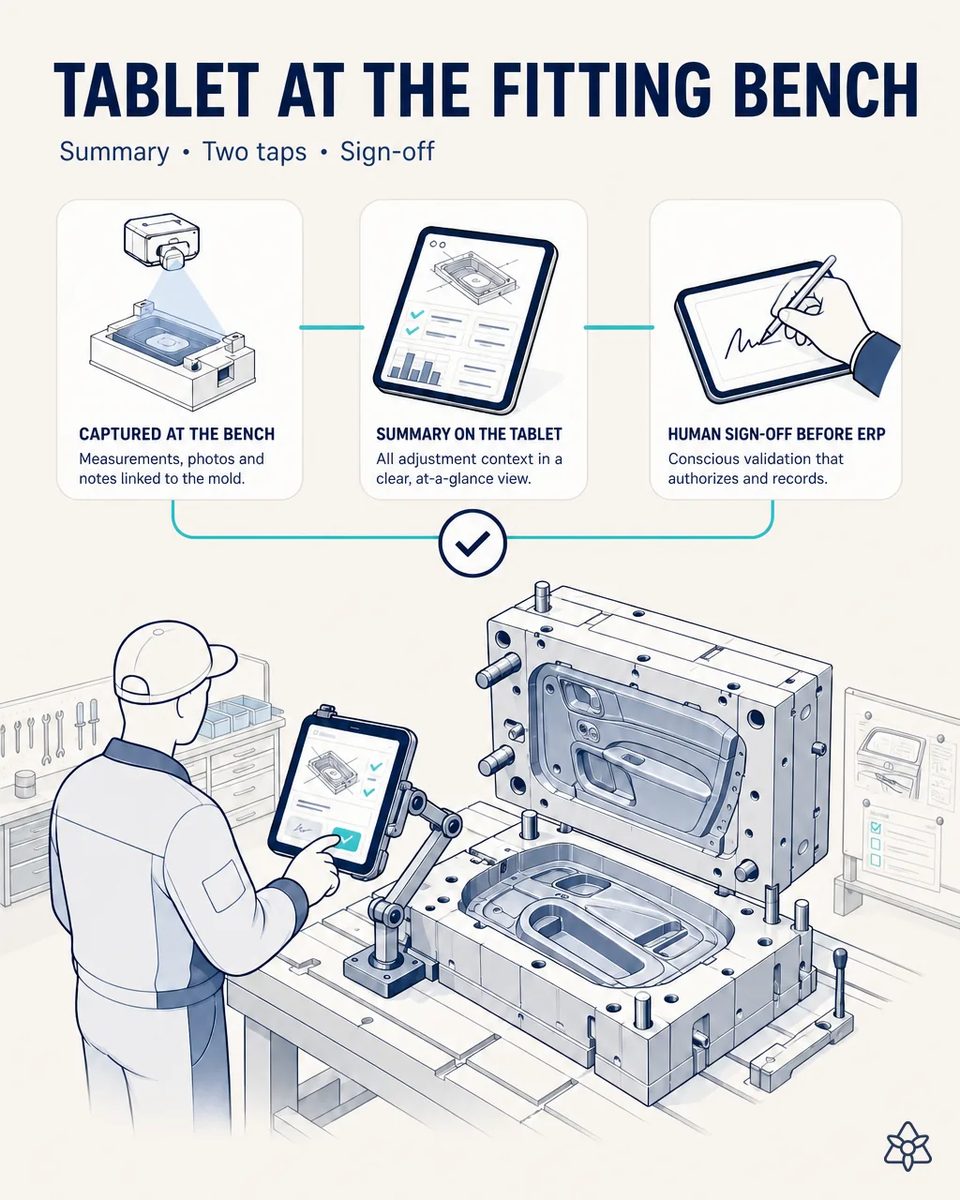
Everything iLEAN captures in the shop — a detail's progress, a dictated issue, a measurement read from a report — appears summarized on an industrial tablet at the bench. The fitter confirms with two taps and only then does the data cross into central memory. Seconds of his time; in exchange, a project history solid enough for management to commit a date without crossing their fingers.
Badly captured data is worse than missing data.
In a mold shop, badly captured data is worse than missing data. If the system believes a detail is finished when it is not, the entire schedule is built on that belief and the date is defended with false data until the mold reaches the bench and does not fit. This is exactly what happens when an "autonomous" AI agent is deployed that writes into the system unsigned: it ends up contaminating project history, and from then on nobody trusts any figure. The only person able to say whether something is genuinely done is the one holding it. The problem is that this person cannot afford an approval flow that steals their time.
- If the system believes a detail is finished when it is not, the whole schedule is built on that belief and the date is defended with false data until the mold reaches the bench and does not fit.
- That is exactly what an "autonomous" agent writing into the system unsigned produces: it contaminates the project history, and from then on nobody trusts any figure.
- The only person able to say whether something is genuinely done is the one holding it. That person cannot afford an approval flow that steals their time.
- So today the choice is between data nobody signed and approvals that wait until end of day.
Connect in early human verification mode — two taps at the bench, not a form in an office.
Connect in early human verification mode — the safety ring that defines the IRIS architecture.
It is the safety ring that defines the IRIS architecture. Every capture from the other cases appears as a card on the bench tablet with the doubtful field highlighted; the fitter confirms or corrects, and only then does the data cross into central memory stamped with who validated it and when. Seconds of his time for a history management can commit a date on. Nothing to search for, no forms, no walk to a terminal: the card comes to the bench where the part is.
- The bench tablet shows cards with what iLEAN has just captured, with the doubtful field highlighted.
- Two taps: confirm or correct. No forms, nothing to search for.
- The correction feeds the system too, which learns which fields it gets wrong on each document type and improves the next capture.
- Only then does the data cross into central memory, stamped with who validated it and when.
The human gate costs seconds, not approvals that wait until end of day.
Today's data versus the signed data
| Aspect | Today | With iLEAN |
|---|---|---|
| Who says a detail is done | Whoever types it | Whoever holds it |
| Time it costs the fitter | A walk to a terminal, or nothing | Two taps |
| A wrong capture | Found weeks later, or never | Corrected on the spot |
| What the correction does | Nothing | Improves the next capture of that document |
| Arguing whether the system is lying | Every morning | One version of the truth |
| Who writes to central memory | An unsigned agent | A person, confirming |
from an unquantified share of unreliable project data → data signed by the person who knows. From corrections made weeks later (or never) → made on the spot. From arguing about whether the system is lying → a single version of the truth.
Impact estimate — to be validated with your numbers.
The block below is an estimate to be validated against your plant's actual data. We put it forward so the committee has an order of magnitude; we refine it during the assessment.
- Estimated payback 4-9 months, through planning quality rather than throughput.
- Fewer late replans, because the schedule is built on details genuinely closed.
- Fewer management hours reconciling what the system says with what the shop sees.
- And every figure in the project history has a name and a time behind it, which is what a customer asks for when the date is discussed.
estimated payback 4-9 months through planning quality: fewer late replans and fewer management hours reconciling what the system says with what the shop sees. *Estimate to validate*.
And the fair question from the production manager
"If a person signs anyway, what is the AI saving?" — the work is not in deciding, it is in assembling. Today somebody would have to leave the bench, find the mold and the detail in the system and type the result. Extracting the fields is an anchored task, where the best models drop below 1.5% error [1]; the fitter only confirms or corrects what arrives assembled, and every correction is stored so the system learns where it fails.
[1] OpenAI paper "Why Language Models Hallucinate", 2025 — on the reliability of AI in anchored tasks.
What people ask about validation at the bench
Does the fitter validate everything, or only his own work?
Each card goes to the role that can judge it: the fitter for bench progress, the machinist for his traveler, the quality manager for a dimensional report, the receiving manager for a steel slip. Nobody signs what they did not see, and the stamp on the data says who did.
What happens if nobody validates a card?
It stays pending and visible. The data does not enter as true by default, and the project lead sees how many captures are waiting on which bench. A detail with a pending card is shown as unconfirmed in the schedule, which is more honest than the closed status it would have got from a typed sheet.
Can the AI write into the system on its own?
No, and it is not configurable: it is the architecture. Data crosses into central memory only after human confirmation, whether it came from a photo, a dictated note, a CMM file or a machine stream. The only thing that enters unsigned is the raw capture, and it is marked as such until someone looks at it.
Is the tablet also useful for the toolmaker himself?
Yes: it shows the detail's drawing revision, the last decisions dictated about that mold, the CMM verdict on the insert he is fitting and the pending actions, so it is worth looking at even when there is nothing to sign.
Does this have to be deployed before the other cases?
In practice yes. It is the piece that makes everything else approvable, because it guarantees the project history is not contaminated.
More cases from this series
- The old machine stays itself, but now it reportsAn external camera digitizes the isolated panel of an older EDM: no more blind nights, without opening…
- The knowledge that walks around and dies at end of shiftThe shop supervisor dictates what he decides while walking: iLEAN structures it against the mold and…
- The job traveler, in the system at second zeroReal progress on every mold detail in the system instantly: one photo of the job traveler and zero habit…
- The shop's most valuable quality data stops living in a folderiLEAN reads the dimensional report as it is saved, ties it to the mold and posts it to the ERP after…
- The mold book writes itself while the mold is builtPhotos, dimensions, parameters, heats and signatures assembled per mold and ordered by automotive…
- The most expensive minute in the shop is the press closingEdge cameras verify clean mold face, ejectors home and connections made before closing is authorized. A…
Ask for a demo of the validation gate using a real document from your shop.
We work on your plant's real data, not ours. Assessment with no commitment.
Request estimated ROI within 48h ‹ See all cases of injection mold shops See automotive