The shop's most valuable quality data stops living in a folder
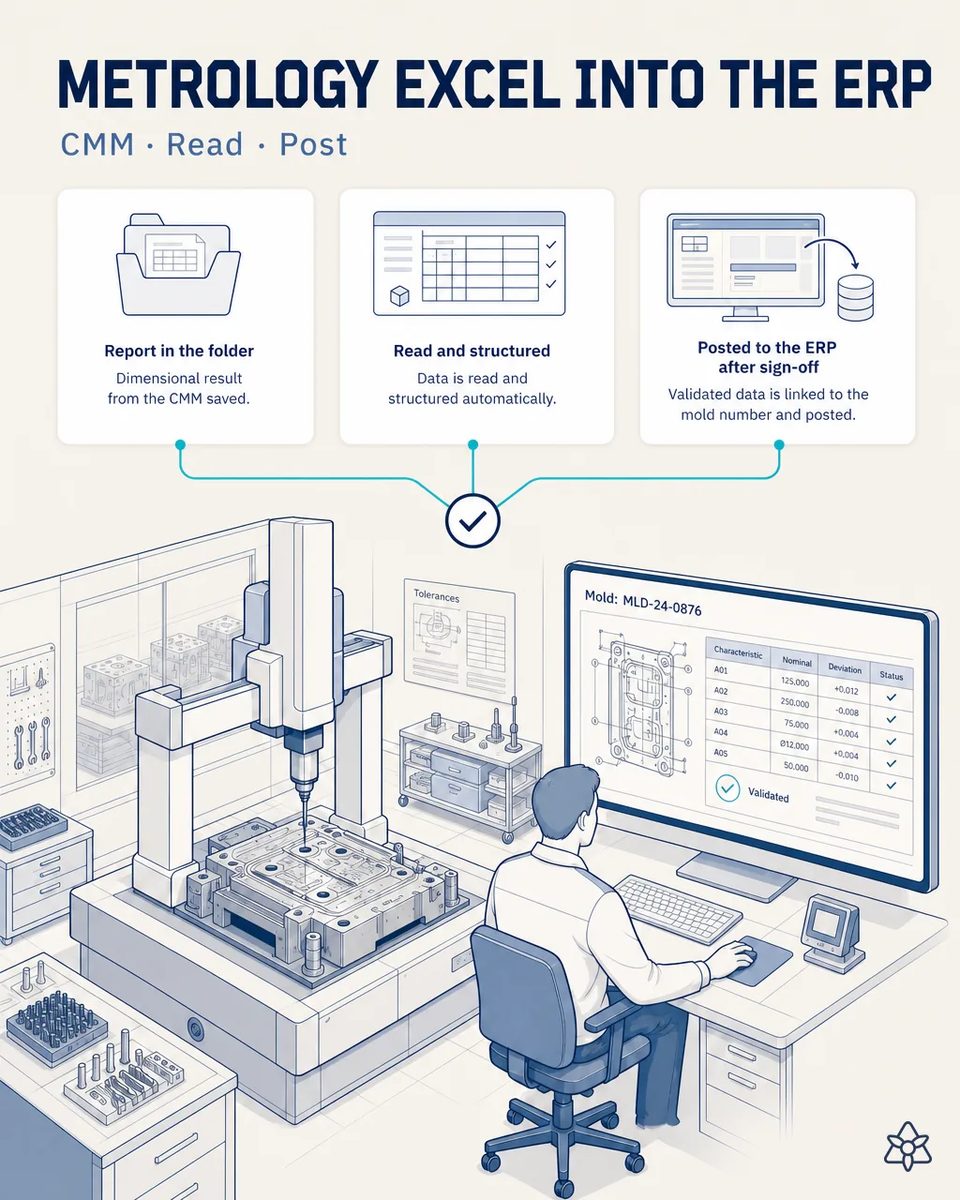
Every time a detail or a tryout part is measured, the CMM leaves a report with dimensions, deviations and a verdict in a shared folder. It is the backbone of the part submission file, and today somebody retypes it into the ERP — or does not. With iLEAN Connect the system reads the file as it is saved, ties it to the mold and detail, and after the quality manager's sign-off posts it to the ERP through the API.
The shop's most valuable quality data lives in a folder.
Dimensional reports carry the part submission file and first article inspection, and they are also what decides whether a detail goes back to the machine. While they live in a folder, every lookup is a manual search and every ERP entry is a transcription with risk. There is also a quiet cost that almost nobody looks at: several metrology and quality people hold an ERP seat purely to enter this data. Every one of those licenses is paid for every year. And when the customer asks about the dimensional report of a mold delivered two years ago, the answer depends on someone remembering which folder it was in.
- Every detail and every tryout part leaves a CMM report with dimensions, deviations and a verdict. It carries the part submission file and first article inspection, and it decides whether a detail goes back to the machine.
- While it lives in a folder, every lookup is a manual search and every ERP entry is a transcription with risk.
- Several metrology and quality people hold an ERP seat purely to enter this data, and every one of those licenses is paid for every year.
- When the customer asks for the dimensional report of a mold delivered two years ago, the answer depends on someone remembering which folder it was in.
Connect in listening-inward mode — the directory, not the people.
Connect in listening-inward mode: iLEAN observes the directory — not the people — and reads the file as it is saved.
iLEAN observes the folder and reads the report the moment it is saved: dimensions, deviations and verdict are normalized and associated with the mold and detail number. The quality manager validates, the API posts to the ERP. The report stops being a file and becomes project data, retrievable years later by mold. The decision to send a detail back to the machine is taken from the verdict in the system, on the same day it was measured.
- A grounded LLM parses the report: it normalizes dimensions, deviations and verdict.
- It associates them with the corresponding mold and detail number.
- It passes the quality manager's validation gate.
- It posts to the ERP through the API. The report stops being a file and becomes project data, retrievable years later.
Today's metrology versus the connected metrology
| Aspect | Today | With iLEAN Connect |
|---|---|---|
| Measurement to data in the system | Days or weeks | Minutes |
| Transcription | Half a day per person per month | Zero |
| Report of a mold delivered two years ago | Hunted through folders | Direct lookup by mold |
| Detail sent back to the machine | Decided from a printout | Decided from the verdict in the system |
| Part submission file | Rebuilt by hand | Assembled from posted reports |
| Quality module licenses | Four or five | One, the manager who validates |
from days or weeks between measurement and data in the system → minutes. From half a day per person per month spent transcribing → zero. From hunting for an old dimensional report in folders → a direct lookup by mold.
Impact estimate — to be validated against your actual ERP invoice.
The block below is an estimate to be validated against your plant's actual data. We put it forward so the committee has an order of magnitude; we refine it during the assessment.
- 💰 CFO angle: if four or five people log into the ERP purely to type measurement results, only the person who validates needs a seat — a typical 50% to 80% cut in that module's licenses, recurring every year.
- Estimated payback 3-7 months, among the fastest because it stacks two savings.
- Half a day per person per month of transcription recovered.
- And the dimensional report of any delivered mold is a query, not an archaeology exercise.
estimated payback 3-7 months, among the fastest because it stacks two savings. Financial angle: if four or five people log into the ERP purely to type measurement results, only the person who validates needs a seat — a typical 50% to 80% cut in that module's licenses, recurring every year. *Estimate to validate against the actual ERP invoice*.
And the fair question from the production manager
"Our CMM exports change format whenever the program is edited — does it cope?" — that is the anticipated case: parsing does not depend on fixed positions, it interprets characteristics, nominals, deviations and verdicts wherever they sit in the file. It is an anchored task, where the best models drop below 1.5% error [1], and the quality manager validates before the API post.
[1] OpenAI paper "Why Language Models Hallucinate", 2025 — on the reliability of AI in anchored tasks.
What people ask about connecting the CMM report
Which report formats does it read?
The native export of the CMM software and the spreadsheet a technician builds from it, including the sheet where tryout part dimensions are compared against the customer's nominals. Neither has to be standardized; the structure is read as it is.
How does it know which mold and detail the report belongs to?
From the identifiers on the report itself, cross-checked against the details currently open in the shop and the CMM program that was run. If the identifier is missing or ambiguous, the card asks the technician before posting; nothing is booked to a guessed mold.
Does it post the raw dimensions or only the verdict?
Both. The verdict feeds the decision on that detail; the dimensions build the history the part submission file and the customer's audit need. A deviation that is inside tolerance today but drifting across three tryout parts is visible only if the numbers are there, not just the pass.
Can the license reduction really be taken?
It depends on your ERP contract, which is why it is framed as an estimate to validate against last year's invoice. The logic is that anyone logging in purely to type stops needing to.
Does it track what the metrology technician does?
No. It watches the folder, not the person: the file is read when it is saved, and there is no record of who opened what or how long a measurement took. The technician keeps working exactly as before; the only new step in the shop is the quality manager's tap to validate.
More cases from this series
- The old machine stays itself, but now it reportsAn external camera digitizes the isolated panel of an older EDM: no more blind nights, without opening…
- The human gate sits at the bench, not in an officeNothing the AI captures crosses into the system without a sign-off from the person who knows: two taps…
- The knowledge that walks around and dies at end of shiftThe shop supervisor dictates what he decides while walking: iLEAN structures it against the mold and…
- The job traveler, in the system at second zeroReal progress on every mold detail in the system instantly: one photo of the job traveler and zero habit…
- The mold book writes itself while the mold is builtPhotos, dimensions, parameters, heats and signatures assembled per mold and ordered by automotive…
- The most expensive minute in the shop is the press closingEdge cameras verify clean mold face, ejectors home and connections made before closing is authorized. A…
Tell us how many ERP users log in only to type measurements and we will size the saving.
We work on your plant's real data, not ours. Assessment with no commitment.
Request estimated ROI within 48h ‹ See all cases of injection mold shops See automotive