Receiving mold steel is not warehouse routine: it is a project milestone
The truck arrives with mold steel plates, the hot runner and boxes of standard components, each item destined for a specific mold. The manager faces a packing slip with many lines, one mill certificate per plate and labels of imported references, and has to sign and also key it in. With iLEAN Connect: photo to the slip, photo to the certificates, one validation tap and everything enters the ERP tied to its project.
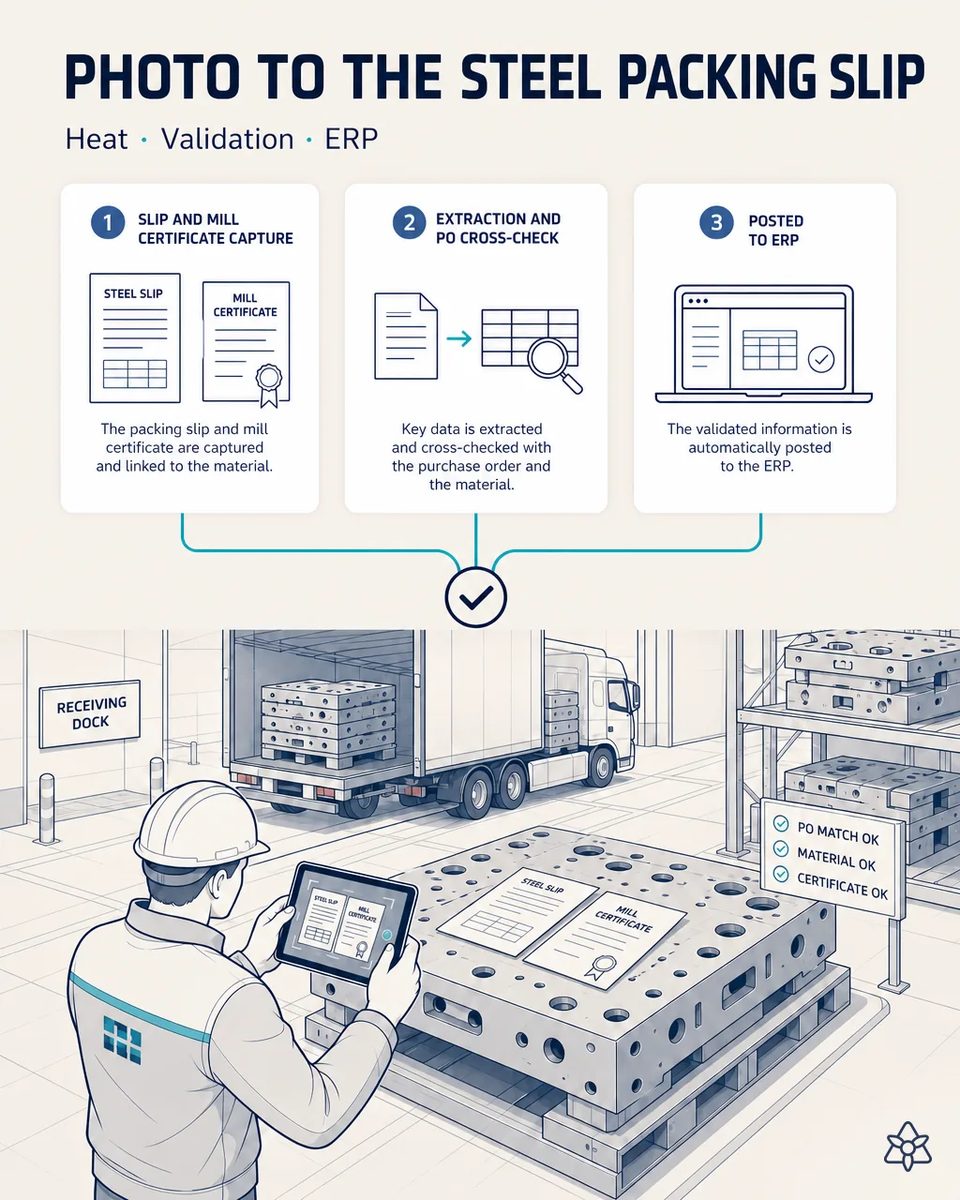
Receiving steel is a project milestone signed under a waiting carrier.
Until the plate is in, the detail does not go to the machine. That is why every receipt is a milestone on the mold calendar and not a warehouse formality. The mill certificate, moreover, is documentation that must be retrievable years later, when the customer asks which heat a cavity came from. Today that traceability depends on someone typing accurately under the pressure of a waiting carrier. When material is imported, the number of document lines multiplies and with it the chance that the steel ends up loosely tied to its mold.
- Until the plate is in, the detail does not go to the machine. Every receipt is a milestone on the mold calendar, not a warehouse formality.
- The truck brings plates, the hot runner and boxes of standard components, each destined for a specific mold: a slip with many lines, one mill certificate per plate and labels of imported references.
- The mill certificate must be retrievable years later, when the customer asks which heat a cavity came from. Today that traceability depends on someone typing accurately with a carrier waiting.
- With imported material the number of document lines multiplies, and with it the chance that the steel ends up loosely tied to its mold.
Connect in photo-over-document mode — slip, certificates and labels, then the ERP.
Connect in photo-over-document mode, with an ERP post after validation.
Photo of the slip, photo of the certificates, photo of the labels. Connect reads plain text, barcodes, GS1-128 and QR, cross-checks references, quantities and heat numbers against the open purchase orders and the target mold's bill of materials, and posts after one validation tap. The certificate is archived linked to the detail that will be built from that plate, and the detail's traveler can be released to the machine the same hour the truck leaves.
- Photo of the packing slip, the mill certificates and the labels. Connect reads plain text, barcodes, GS1-128 and QR.
- It extracts references, quantities and heat numbers and cross-checks them against open purchase orders and the target mold's bill of materials.
- On-screen summary, one-tap validation.
- Posted to the ERP through the API. The certificate is archived and linked to the detail that will be built from that plate.
Today's receipt versus the captured receipt
| Aspect | Today | With iLEAN Connect |
|---|---|---|
| Signing and keying a complex receipt | 30-60 minutes | Minutes |
| Mill certificate | Filed on paper, unlinked | Archived against the detail |
| Which heat a cavity came from | Rebuilt if the paper turns up | Immediate lookup by mold |
| Slip versus purchase order | Checked by eye, or not | Cross-checked line by line |
| Carrier demurrage | Recurring | Eliminated |
| Purchasing and receiving licenses | Two or three | One, the manager who validates |
from 30-60 minutes per complex receipt between signing and keying → minutes. From heat traceability rebuildable "if the paper turns up" → an immediate lookup by mold. From carrier demurrage → eliminated.
Impact estimate — to be validated against your actual ERP invoice.
The block below is an estimate to be validated against your plant's actual data. We put it forward so the committee has an order of magnitude; we refine it during the assessment.
- 💰 CFO angle: people who log into the ERP only to register goods receipts no longer need a seat — a typical 50% to 70% cut in purchasing and receiving licenses, recurring.
- Estimated payback 3-8 months.
- Demurrage avoided, truck after truck.
- And heat-to-detail-to-mold traceability that exists from the receipt, not from a search two years later.
estimated payback 3-8 months. Financial angle: people who log into the ERP only to register goods receipts no longer need a seat — a typical 50% to 70% cut in purchasing and receiving licenses, plus the demurrage avoided. *Estimate to validate against the actual ERP invoice*.
And the fair question from the production manager
"Every steel mill lays out its certificate differently — does it read all of them?" — yes, and without asking any supplier to change anything: the model extracts the table structure and the heat number without a per-supplier template, and labels are read by symbology where present and by optical recognition where not. It is an anchored task, where the best models drop below 1.5% error [1], and the receiving manager validates before anything enters.
[1] OpenAI paper "Why Language Models Hallucinate", 2025 — on the reliability of AI in anchored tasks.
What people ask about photographing the steel packing slip
Does it read the mill certificate or just the slip?
Both, and the certificate is the part that adds most: its heat number, grade and hardness end up linked to the plate and, through it, to the detail machined from it. When a cavity cracks in the customer's press three years on, which heat it came from is one query.
What if the slip says one plate size and the label another?
The discrepancy is highlighted on the summary before the manager validates, with both values side by side. Today nobody makes that check with a carrier waiting, and a plate cut short is discovered when the roughing program does not fit it.
Does it handle hot runners and standard components too?
Yes. What differs is the document and the label format, and the structure is read without a per-supplier template. The hot runner is tied to its mold like any plate.
Does it need the purchase order to exist in the ERP?
For the cross-check, yes: the receipt is compared with the open order line by line, including the mold each line was bought for. If there is no order, the receipt is still captured and flagged for purchasing instead of being left in a tray.
Can we start with receiving alone?
Yes, and it is a good starting point: the result shows from the first truck and it does not depend on the other pieces being deployed. Many shops begin here because the receiving manager is the person most visibly stuck between a carrier and a keyboard.
More cases from this series
- The old machine stays itself, but now it reportsAn external camera digitizes the isolated panel of an older EDM: no more blind nights, without opening…
- The human gate sits at the bench, not in an officeNothing the AI captures crosses into the system without a sign-off from the person who knows: two taps…
- The knowledge that walks around and dies at end of shiftThe shop supervisor dictates what he decides while walking: iLEAN structures it against the mold and…
- The job traveler, in the system at second zeroReal progress on every mold detail in the system instantly: one photo of the job traveler and zero habit…
- The shop's most valuable quality data stops living in a folderiLEAN reads the dimensional report as it is saved, ties it to the mold and posts it to the ERP after…
- The mold book writes itself while the mold is builtPhotos, dimensions, parameters, heats and signatures assembled per mold and ordered by automotive…
Send us a typical packing slip with its mill certificate and we will show you the extraction.
We work on your plant's real data, not ours. Assessment with no commitment.
Request estimated ROI within 48h ‹ See all cases of injection mold shops See automotive