The machines already know what they do; the project needs to find out
Program running, spindle cutting, feed, stop, alarm: that data has existed in the control of the shop's modern machines since day one. Nobody stitched it to the ERP because "there was never time to integrate it properly", so what the machine already had exactly gets typed by hand. With iLEAN Connect both systems are stitched through the API, without replacing either.
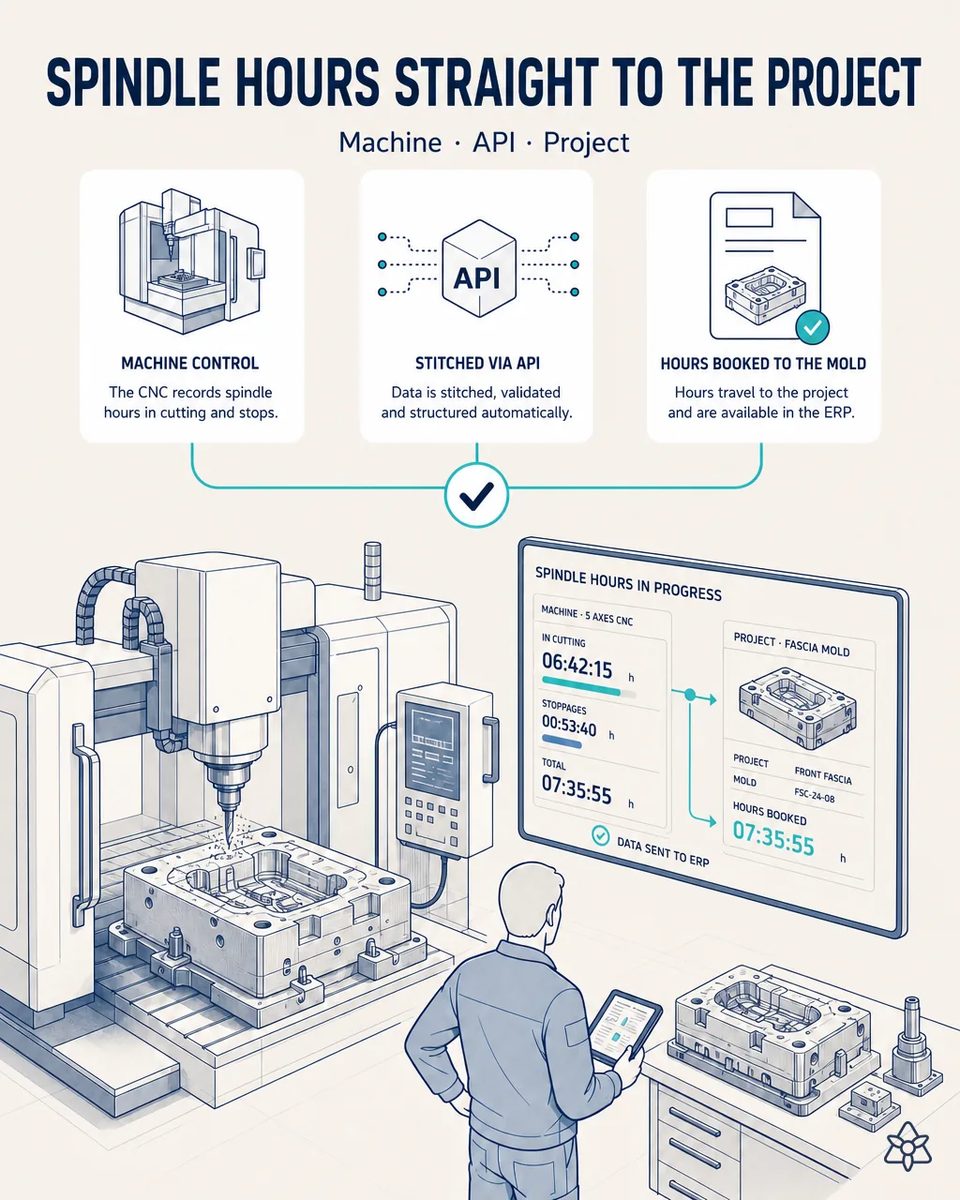
The machine already knows its hours; the project finds out when the mold has shipped.
In a project shop the margin is won or lost in the booking. If machine hours arrive estimated, rounded or late, the real cost of the mold is known once it has shipped — which is to say once nothing can be done with that information. There is a second, less visible and more expensive effect: the next quote's date is promised on the planner's experience rather than on the real availability of the work centers. In a sub-sector where winning or losing a program depends on the date offered, that is margin left on the table.
- Program running, spindle cutting, feed, stop, alarm: that data has existed in the control of the shop's modern machines since day one. It was never stitched to the ERP because there was never time to integrate it properly.
- So what the machine already has exactly gets typed by hand, estimated, rounded or late, and the real cost of the mold is known once it has shipped.
- In a project shop the margin is won or lost in the booking. Cost known at project close is cost nothing can be done about.
- The next quote's date is promised on the planner's experience rather than on the real availability of the work centers, and winning or losing a program depends on the date offered.
Connect stitching the control and the ERP through the API — replacing neither.
Connect stitching two modern systems through the API — without replacing the control and without replacing the ERP.
iLEAN reads the stream the control already exposes — MTConnect, FOCAS or the builder's equivalent — ties it to the program and the detail loaded in that machine, and publishes cutting hours, stoppages and alarms with their reason into the ERP. When a stoppage reason has to be assigned, the human gate remains: the machinist picks, the system records. The project lead sees the real cost of the mold accumulating detail by detail while it is still being built.
- iLEAN reads the stream the control already exposes (MTConnect, FOCAS or the builder's equivalent).
- It ties it to the program and the detail currently loaded in that machine.
- It publishes spindle cutting hours, stoppages and alarms with their reason into the ERP.
- When a stoppage reason has to be assigned, the human gate remains: the machinist picks, the system records.
Today's booking versus the stitched booking
| Aspect | Today | With iLEAN Connect |
|---|---|---|
| Machine hours | Estimated and typed twice | Measured and published on their own |
| Real mold cost | Known at project close | Live, day by day |
| Stoppage reason | Forgotten by end of shift | Picked by the machinist at the moment |
| Availability per work center | By feel | A real series |
| Quoting the next mold's date | On experience | On measured capacity |
| The control and the ERP | — | Neither replaced |
from hours estimated and typed twice → measured and published on their own. From real mold cost known at project close → live cost, day by day. From machine availability "by feel" → a real series per work center.
Impact estimate — to be validated with your numbers.
The block below is an estimate to be validated against your plant's actual data. We put it forward so the committee has an order of magnitude; we refine it during the assessment.
- Estimated payback 4-9 months.
- The end of double keying: the machinist stops typing at end of shift what the control already measured.
- Real cost per mold while it is still being built, when a detail eating hours can still be resequenced.
- And better reliability on future quotes, which in this sub-sector is pure margin.
estimated payback 4-9 months, between the end of double keying and better reliability on future quotes, which in this sub-sector is pure margin. *Estimate to validate*.
And the fair question from the production manager
"Isn't a classic control-to-ERP integration cleaner?" — it is, the day the project reaches the top of the IT list, and that is the problem: this is the classic case of a modern machine still isolated because there was never time. This stitching replaces neither system, asks for no shutdown window and does not compete in that queue. Mapping the control's stream to the detail loaded is an anchored task, where the best models drop below 1.5% error [1], and the stoppage reason is always a human choice.
[1] OpenAI paper "Why Language Models Hallucinate", 2025 — on the reliability of AI in anchored tasks.
What people ask about booking spindle hours
Which controls does it read?
Any that exposes MTConnect, FOCAS or the builder's equivalent, which covers most five-axis machines from the last fifteen years. We confirm it per machine before committing; an older machine without a stream is handled with the panel camera of the EDM case instead.
How does it know which detail is on the machine?
From the program loaded and the job traveler case if it is in place. Without the traveler, the machinist confirms the detail at program start from the tablet.
Does it distinguish cutting from idle spindle?
Yes: spindle in cut, spindle running out of cut, program paused and alarm are separate states, so hours booked to the mold are cutting hours, not power-on hours. That distinction is what makes the figure usable for costing a detail and for quoting the next one.
Does it feed the quote for the next mold?
Indirectly and decisively: the real hours per operation type on delivered molds become the basis for the next estimate, and availability per work center becomes a measured series. A date offered on measured capacity is a date the shop can defend at the award meeting.
Does the machinist have to do anything?
Only assign a reason when a stoppage happens, with one tap on the tablet: tool change, waiting for a program, waiting for a crane, alarm. Everything else is published by the control, and the reason list is the shop's own.
More cases from this series
- The old machine stays itself, but now it reportsAn external camera digitizes the isolated panel of an older EDM: no more blind nights, without opening…
- The human gate sits at the bench, not in an officeNothing the AI captures crosses into the system without a sign-off from the person who knows: two taps…
- The knowledge that walks around and dies at end of shiftThe shop supervisor dictates what he decides while walking: iLEAN structures it against the mold and…
- The job traveler, in the system at second zeroReal progress on every mold detail in the system instantly: one photo of the job traveler and zero habit…
- The shop's most valuable quality data stops living in a folderiLEAN reads the dimensional report as it is saved, ties it to the mold and posts it to the ERP after…
- The mold book writes itself while the mold is builtPhotos, dimensions, parameters, heats and signatures assembled per mold and ordered by automotive…
Tell us which control your five-axis machines run and we will confirm whether it already exposes data.
We work on your plant's real data, not ours. Assessment with no commitment.
Request estimated ROI within 48h ‹ See all cases of injection mold shops See automotive