The variant changeover is the dangerous moment of the shift
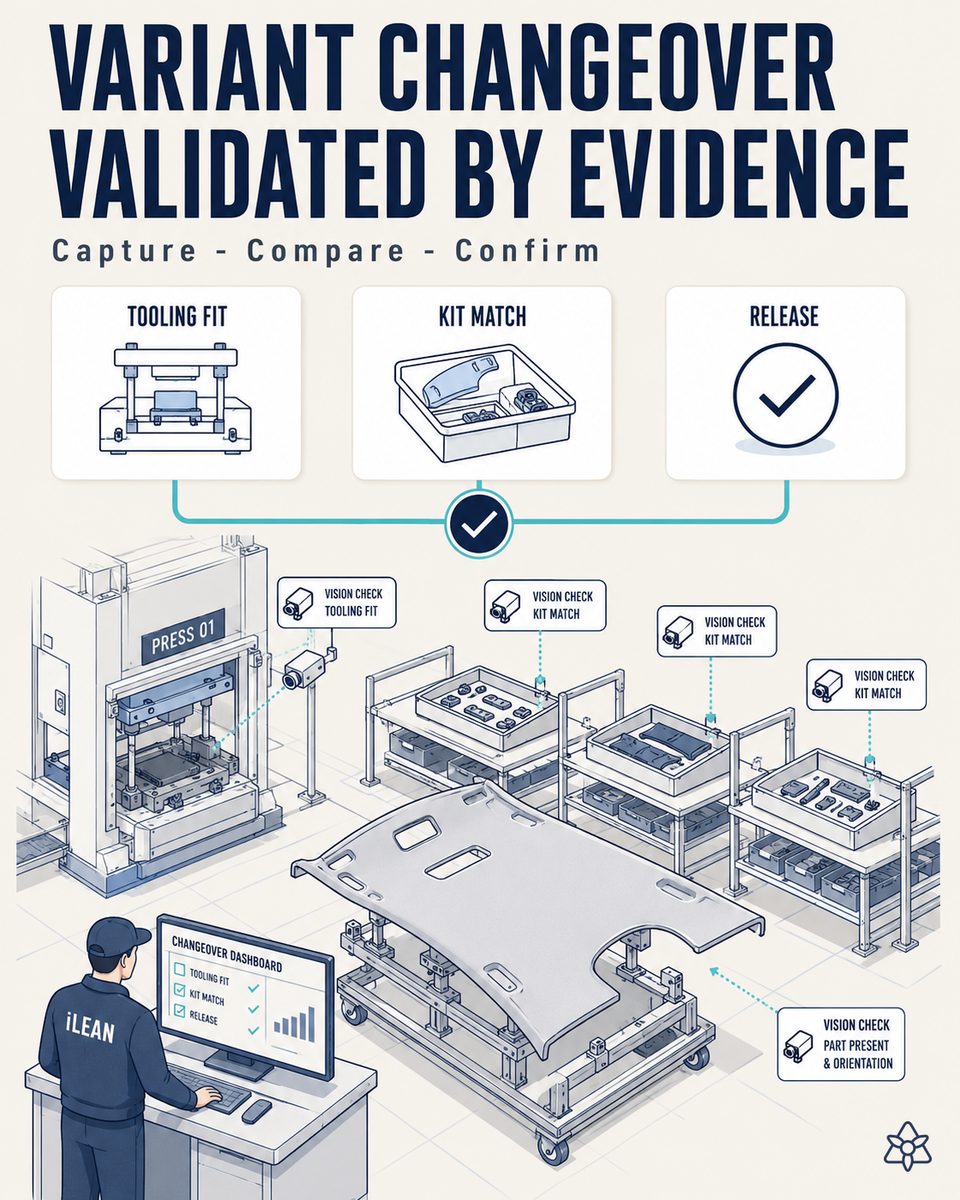
With a hundred variants living side by side, every changeover requires fitting the right tooling, loading the right program and placing at each station the kits of the incoming variant. If anything is left over from the previous one, the first parts are born wrong — and in sequence those parts already have a destination and an hour. Edge compares each critical point with its reference state and does not allow startup until everything matches and the lead signs.
It is not a discipline problem: it is a control design problem.
Today the guarantee that the changeover was done well is that a person signs a checklist. And that checklist is signed under the permanent pressure to shorten the changeover, which is what makes it get signed before everything has been checked. It is not a discipline problem: it is a control design problem. The cost of the error is not the scrap of the first parts. It is that those parts were already committed to a sequence position: the gap has to be filled with urgent, off-plan production while the customer's line keeps moving. And with the usual turnover, a good share of changeovers are executed by people with a few months of experience in a plant with a hundred different configurations.
- The guarantee that the changeover went well is that a person signs a checklist, and that checklist is signed under permanent pressure to shorten the changeover.
- The cost of the error is not the scrap of the first parts: it is that those parts were already committed to a sequence position. The gap has to be filled with urgent, off-plan production.
- With the usual turnover, a good share of changeovers are executed by people with a few months of experience in a plant with a hundred different configurations.
Edge plus JIDOKA AI and SMED AI — verification shortens the changeover, it does not lengthen it.
Edge plus JIDOKA AI and SMED AI.
The same observations that block startup guide the changeover task sequence and flag what is missing while the changeover is happening, not afterwards.
- Fixed cameras at the critical points: tooling fitted in the press, trimming center program, component kits at each station, final verification template.
- Automatic comparison against the reference state of the incoming variant, declared by the production system.
- JIDOKA AI: the line does not start until every point reads OK and the lead signs with the visual evidence in front of them.
- SMED AI: the same observations guide the changeover task sequence and flag what is missing while the changeover is happening, not afterwards.
- The whole event — state of each point, decision, signature — stays as evidence for the auditable dossier.
Signing blind vs. signing on evidence
| Aspect | Current variant changeover | With Edge and JIDOKA AI |
|---|---|---|
| Basis for the signature | One person's judgment in a hurry | Visual evidence point by point |
| Fitted tooling | Checked from memory | Compared against the reference state |
| Kits at each station | Glanced at | Verified against the incoming variant |
| Startup with leftovers | Possible under time pressure | Blocked until the OK |
| Parts committed in sequence | The gap is filled off-plan | They are never built wrong |
| Changeover duration | Pressured downward | Shorter, guided by SMED AI |
From signing blind under time pressure to signing with evidence point by point. From startups with committed parts to a validated startup. And the changeover shorter, not longer.
Impact estimate for your plant — to validate against your numbers.
The block below is an estimate to be validated against your plant's actual data. We put it forward so the committee has an order of magnitude; we refine it during the assessment.
- A hundred variants living together and several changeovers per shift, each with its own tooling, program and kits.
- Pilot on one line and its critical changeover points.
- Indicative payback between 5 and 10 months depending on variant changes per week.
- What gets counted is less startup scrap, less sequence incident risk and shorter changeovers, which is what offsets the verification time.
Estimated payback 5 to 10 months depending on the number of variant changes per week, combining less startup scrap, less sequence incident risk and shorter changeovers. *Estimate to validate*.
And the fair question from the production manager
“Won't it block the line over anything?” — the block applies to the critical points defined with the plant, not to everything the camera sees, and each threshold is calibrated during the pilot with the line crew. The underlying objection is right: a system that over-blocks ends up being bypassed, and a bypassed system protects nothing. That is why SMED AI is part of the case and not an add-on.
[1] OpenAI paper "Why Language Models Hallucinate", 2025 — on the reliability of AI in anchored tasks.
What people ask about validating variant changeovers
Can JIDOKA AI stop the line on its own?
It blocks startup after a changeover until the critical points read OK; it does not interrupt steady-state production. And startup is not authorized by the system: it is authorized by the lead signing with the visual evidence in front of them. The machine provides the check; the person keeps the final word and the accountability.
Doesn't it lengthen the changeover, which is what we need to shorten?
That is the objection to answer well. The verification itself takes seconds. And SMED AI exists to offset it: it guides the task sequence and flags what is missing while the changeover is happening, not afterwards. Where time is really lost in a changeover is in back-and-forth, checking the same thing twice and waiting for confirmations. The goal is a shorter changeover.
Which points are verified?
They are defined with the plant. The usual ones here are the tooling fitted in the press, the program loaded in the trimming center, the component kits at each assembly station and the final verification template. With a hundred variants, the comparison is made against the reference state of the incoming variant declared by the production system.
Does it help with inexperienced staff?
That is where it adds most. With the usual turnover, a good share of changeovers are executed by people with a few months in a plant with a hundred configurations. SMED AI turns changeover knowledge into a guide that flags what is missing, instead of relying on the operator remembering the particularities of that specific variant.
What if somebody bypasses the block?
That is the real risk of any system like this, and why the design matters more than the technology. If it over-blocks or blocks for reasons the floor perceives as absurd, it ends up being bypassed and stops protecting anything. Hence the thresholds are calibrated in the pilot with the line crew and the scope is limited to points where failure has real consequences.
More cases from this series
- The non-conformity does not come from a bad process, it comes from evidence with gapsEvery changeover, first part and validation leaves evidence on the spot. Agents organizes it by…
- In sequence you can stop the customer's line in two waysFour cross-checked verification rings — process, part, order and evidence — so that no rack leaves the…
- The lab measures in a spreadsheet the ERP cannot seeAdhesion, delamination and dimensional tests reach the ERP on their own after validation. Typical saving…
- The truck waits while somebody types twenty linesPhoto of the delivery note and batch labels: reference, quantity and supplier into the ERP after one…
- The most expensive press in the plant is also the most silentA camera and anchored OCR digitize the temperature and pressure curve of an isolated forming press,…
- EDI brings the schedule; email brings realityWhat changes the day does not arrive by EDI: it arrives by email. iLEAN reads it instantly,…
Tell us how many variant changeovers you do per week and how much scrap each startup generates.
We work on your plant's real data, not ours. Assessment with no commitment.
Request estimated ROI within 48h ‹ See all cases of automotive headliners See automotive