The truck waits while somebody types twenty lines
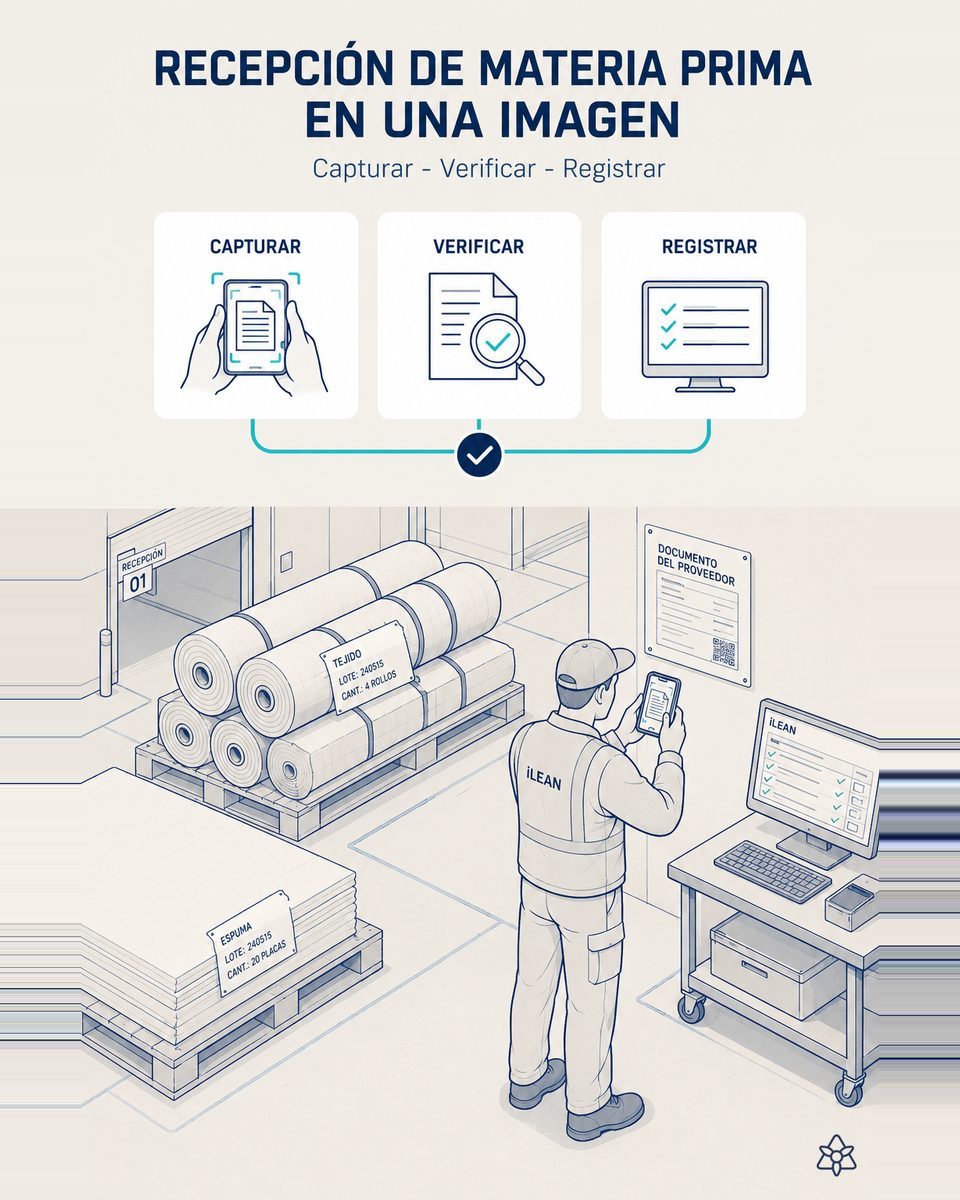
In come fabric rolls, foam sheets, adhesive drums and boxes of components. The receiving lead has a delivery note of twelve or twenty lines and a stack of labeled pallets, and has to sign and also key it into the ERP. With Connect one photo of the delivery note and another of the labels is enough: after a validation tap, everything enters the ERP.
The two conventional ways out are bad.
The two conventional ways out are bad. Either the carrier waits, charging demurrage, while somebody types, or it is typed fast and the batches end up badly traced. The second does not show up that day. It shows up months later, when the customer opens a claim and you have to say exactly which fabric, foam or component batch the affected part carried. If inbound traceability is broken, the plant cannot bound the scope and ends up containing far more material than necessary, with the sorting and scrap cost that drags along. Raw material traceability is the first link in the chain IATF requires, and it is the one that breaks most easily because it depends on manual keying under time pressure.
- Either the carrier waits, charging demurrage, while twenty lines are typed.
- Or it is typed fast and the batches end up badly traced. That does not show up that day: it shows up months later, in a claim.
- If inbound traceability is broken, the plant cannot bound the scope and ends up containing far more material than necessary, with its sorting and scrap cost.
- It is the first link IATF requires and the one that breaks most easily, because it depends on manual keying under time pressure.
Connect in photo-the-analog mode toward the ERP — the supplier's delivery note exactly as they send it.
Connect in photo-the-analog mode toward the ERP.
One photo of the delivery note and another of the pallet labels. Vision recognizes each supplier's format without asking them to change it, and after a validation tap batch traceability is closed from the unloading.
- Photo of the delivery note: vision recognizes each supplier's format without asking them to change it and extracts the full tabular structure.
- Photo of the pallet and container labels: reading GS1-128, QR, barcode or plain text by OCR.
- Summary on the industrial tablet with the lines already extracted and checked against the order.
- The lead validates with one tap; discrepancies are flagged for review.
- Connect pushes to the ERP through the API and closes batch traceability from the moment of unloading.
Keyed receiving vs. captured receiving
| Aspect | Current receiving | With iLEAN Connect |
|---|---|---|
| Truck time at the dock | 45 min | 5 min |
| Delivery note entry | Keyed line by line | Photo and one validation tap |
| Batch errors | Invisible until the claim | Zero errors of human origin |
| Inbound traceability | Easily broken | Closed from unloading |
| Scope of a containment | Over-contained for lack of bounding | Bounded to the actual affected batch |
| Receiving/warehouse licenses | 2-3 active per shift | One, the validating lead |
From 45 minutes of truck waiting to 5. From batch errors invisible until the claim to zero errors of human origin. From broken traceability to complete traceability from the dock.
Impact estimate for your plant — to validate against your numbers.
The block below is an estimate to be validated against your plant's actual data. We put it forward so the committee has an order of magnitude; we refine it during the assessment.
- Continuous inbound flow of fabric rolls, foam sheets, adhesive drums and component boxes.
- The receiving and warehouse module usually requires 2-3 active licenses: lead, support and supervisor.
- With Connect only the lead validates, without logging into the ERP. Typical reduction of 50-70% in receiving and warehouse module licenses, plus avoiding the mass-capture module the ERP vendor would sell for the same.
- Indicative payback between 3 and 8 months, adding the eliminated carrier demurrage.
CFO angle — the receiving and warehouse module usually requires 2-3 active licenses (lead, support and supervisor); with Connect only the lead validates, without logging into the ERP. Typical reduction of 50-70% in receiving/warehouse module licenses, plus avoiding the mass-capture module the ERP vendor would sell for the same purpose. Estimated payback 3 to 8 months, adding the eliminated carrier demurrage. *Estimate to validate*.
And the fair question from the production manager
“What if it misreads a quantity and stock enters wrong?” — extracting a table from a delivery note is an anchored task over a structured document, where the best models drop below 1.5% error [1]. And above all: today's keying error under time pressure is far more frequent, and it is discovered months later. Here the summary is validated with the truck still at the dock.
[1] OpenAI paper "Why Language Models Hallucinate", 2025 — on the reliability of AI in anchored tasks.
What people ask about digitizing receiving
Do suppliers have to use a standard delivery note?
No, and that is what makes the case viable. Each supplier sends theirs however they want, and standardizing formats is an endless project you do not even control. Vision recognizes the tabular structure of the document rather than relying on fixed-coordinate templates, so it lives with different delivery notes from day one.
Which labels can it read?
GS1-128, QR, conventional barcode and plain text by OCR when the label carries no code. In headliner raw material that covers the usual: fabric rolls with a supplier label, foam sheets with a printed batch and component boxes with a logistics label.
Why does inbound traceability matter so much?
Because it is what lets you bound the scope of a claim. When the customer claims months later, you have to say exactly which fabric, foam or component batch the affected part carried. If that link is broken, the plant cannot bound it and ends up containing far more material than necessary: the sorting and scrap cost comes from there, not from the defect itself.
Does it replace the RF terminal?
At the receiving point, largely yes, and part of the saving is there: the mass-capture module and the dedicated terminals that existed only for this step tend to disappear. In the rest of the warehouse nothing is touched: this is not a project to replace your system, it is removing the keying from the point where the truck waits.
What if the delivery note does not match the order?
Discrepancies are flagged for review rather than entering as they are. The lead sees them highlighted on the tablet and decides: accept, correct or reject the line. It is exactly the case where today it gets typed fast and the problem surfaces weeks later.
More cases from this series
- The non-conformity does not come from a bad process, it comes from evidence with gapsEvery changeover, first part and validation leaves evidence on the spot. Agents organizes it by…
- In sequence you can stop the customer's line in two waysFour cross-checked verification rings — process, part, order and evidence — so that no rack leaves the…
- The lab measures in a spreadsheet the ERP cannot seeAdhesion, delamination and dimensional tests reach the ERP on their own after validation. Typical saving…
- The most expensive press in the plant is also the most silentA camera and anchored OCR digitize the temperature and pressure curve of an isolated forming press,…
- EDI brings the schedule; email brings realityWhat changes the day does not arrive by EDI: it arrives by email. iLEAN reads it instantly,…
- A perfect rack with the wrong identityThe labeler prints what the sequencing system dictates and the scale verifies the rack. Zero human error…
Tell us how long unloading a truck blocks your receiving lead.
We work on your plant's real data, not ours. Assessment with no commitment.
Request estimated ROI within 48h ‹ See all cases of automotive headliners See automotive