The most expensive press in the plant is also the most silent
The press that forms the substrate and the one that laminates the decorative fabric are between ten and twenty-five years old, and their panel shows the only thing that really explains headliner quality: temperature curve per zone, pressure, cycle time and alarms. They export nothing. With an external camera and anchored OCR, iLEAN digitizes that curve cycle by cycle without touching the original control.
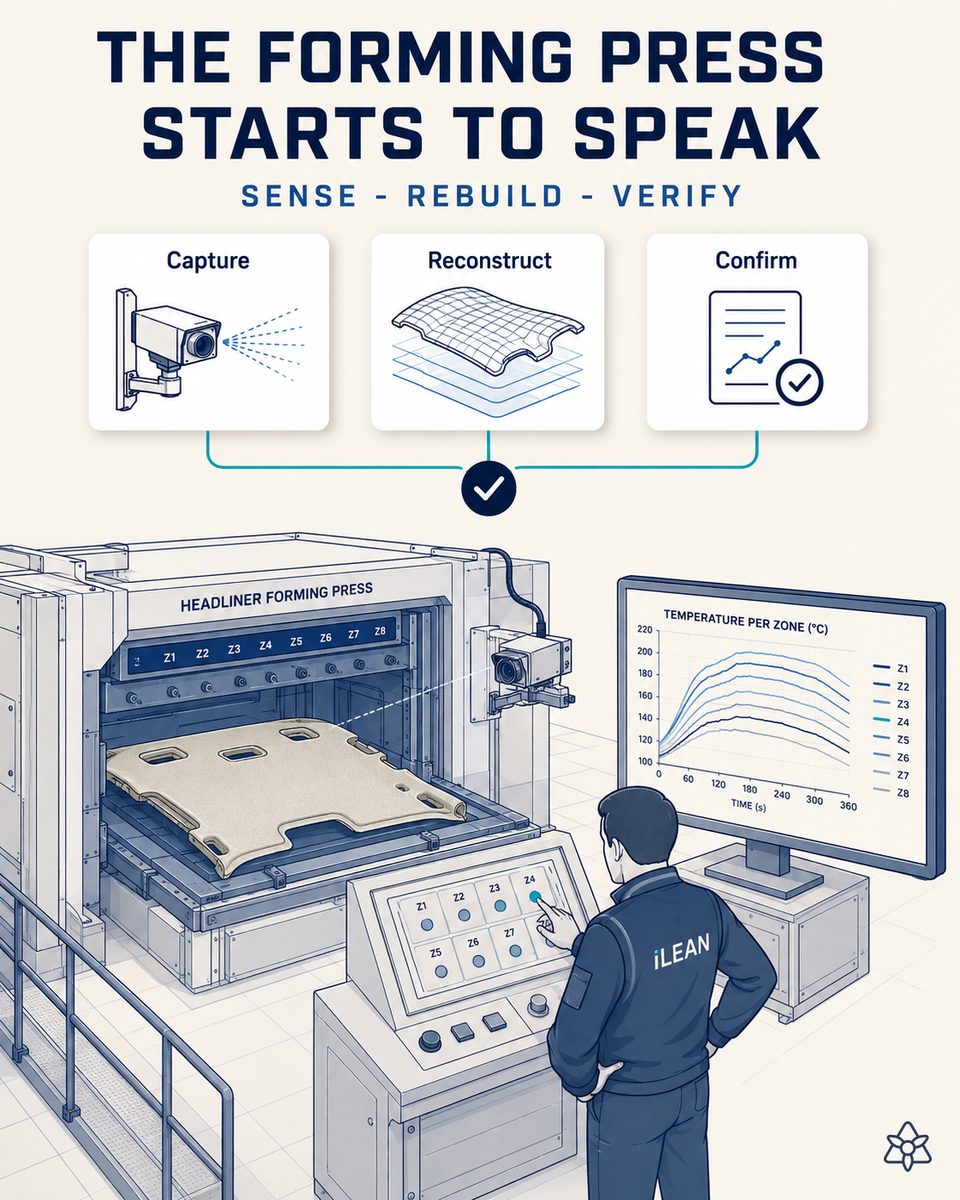
The most expensive asset in the plant is the one that gives the least data.
The press is the bottleneck and the most expensive asset in the plant. The defects that cost the most — delamination, bubbling, mold marks, insufficient adhesion — are explained by the temperature and pressure curve of a specific cycle. But that curve lives and dies on the panel screen. The two conventional ways out are closed. Replacing the equipment is seven-figure CAPEX and weeks of downtime on a line that delivers in sequence. And opening the control to extract data through the official route starts a conversation with the manufacturer and, in the worst case, forces a process revalidation. The result is that nobody correlates parameter with defect. It is adjusted by experience and a scrap level is accepted as if it were a physical constant of the plant.
- The expensive defects are explained by the curve — delamination, bubbling, mold marks, insufficient adhesion — and that curve lives and dies on the panel screen.
- Replacing the equipment is seven-figure CAPEX and weeks of downtime on a line that delivers in sequence.
- Opening the control through the official route starts a conversation with the manufacturer and, at worst, forces a process revalidation.
- The result: nobody correlates parameter with defect, it is adjusted by experience and a scrap level is accepted as a physical constant of the plant.
Connect in photo-the-panel mode — zero intervention on the PLC, the wiring or the machine software.
Connect in photo-the-panel mode.
One camera looking at the panel. Anchored OCR rebuilds the cycle curve and ties it to the active order and variant. The machine stays as it is and the process is not revalidated.
- Fixed industrial camera with controlled lighting pointed at the panel. Zero intervention on the PLC, the wiring or the machine software.
- OCR with an anchored language model interprets each frame and rebuilds the time curve of the cycle: temperature per zone, pressure, time, alarms.
- Connect cross-references each cycle with the active order and variant to know which specific parts it corresponds to.
- The curve stays in central memory and can be correlated with the lab result and with the detections of the Edge cameras on the line.
Replacing the press vs. making the one you have speak
| Aspect | Equipment replacement | With iLEAN Connect on the panel |
|---|---|---|
| Investment | Seven figures per machine | One camera and its lighting |
| Line downtime | Weeks, while delivering in sequence | None |
| Process revalidation | Has to be redone | Not applicable: the control is untouched |
| Conversation with the manufacturer | Required | None |
| Curve per cycle | Yes, once the project ends | Yes, from the first week |
| Correlation with the defect | Pending later integration | Immediate, against lab and Edge |
From zero correlation between process and defect to per-cycle root cause analysis in minutes. From an equipment replacement project justified by “we have no data” to CAPEX that can be deferred.
Impact estimate for your plant — to validate against your numbers.
The block below is an estimate to be validated against your plant's actual data. We put it forward so the committee has an order of magnitude; we refine it during the assessment.
- One forming press and one laminating press per line, both with their own panel and no data export.
- Pilot on a single machine: camera, lighting and cross-reference with the active order.
- Indicative payback between 5 and 10 months through scrap reduction and early drift detection.
- On top of that comes the replacement CAPEX that stops being urgent, because the “we have no data” argument disappears.
Estimated payback 5 to 10 months through scrap reduction and early drift detection, plus avoiding or deferring the replacement CAPEX. *Estimate to validate*.
And the fair question from the production manager
“What if the camera misreads a digit on the panel?” — reading a panel is an anchored task: the model does not compose anything, it transcribes a value that is in the image, with the cycle's time series around it that makes an impossible reading stand out. In anchored tasks the best models drop below 1.5% error [1], and an anomalous reading is caught against the curve itself.
[1] OpenAI paper "Why Language Models Hallucinate", 2025 — on the reliability of AI in anchored tasks.
What people ask about reading the press panel
Do you have to touch the PLC or open the cabinet?
Neither, and that is why this case is viable where others are not. Connect looks at the panel from outside with a camera, exactly as an operator does. It does not connect to the control, the electrical cabinet stays closed, the process validation is not altered and the machine manufacturer does not need to be involved. A pilot is set up in days rather than quarters.
What do you do with the curve once digitized?
It is tied to the active order and variant, which is what makes it useful. From there you can answer in minutes questions that today are answered by experience: which curve the batch the customer complained about went through, whether there is a correlation between a temperature drift in one zone and delamination, or whether the scrap level taken as constant actually responds to a specific parameter.
Does it work for the laminating press and other machines?
Yes, and that is the value of the pattern. Any ten-to-twenty-five-year-old asset with vital data trapped in a panel with no network is a candidate: forming press, laminating press, trimming center, lab climatic chamber. Each new machine is another camera and its configuration, not another integration project from scratch.
What if the panel has glare or a worn screen?
That is the usual scenario on a twenty-year-old machine, which is why lighting is part of the installation and not an accessory. If one specific zone turns out illegible, it shows up in the first week of the pilot and is fixed with position or lighting, not by redoing the project.
Does this justify not replacing the press?
It turns replacement into a decision with data instead of an emergency. Many plants consider it precisely to gain connectivity, not because the machine is at the end of its life. Once the data is available, the CAPEX is decided on the real condition of the asset, with the historical curve in hand to justify it.
More cases from this series
- The non-conformity does not come from a bad process, it comes from evidence with gapsEvery changeover, first part and validation leaves evidence on the spot. Agents organizes it by…
- In sequence you can stop the customer's line in two waysFour cross-checked verification rings — process, part, order and evidence — so that no rack leaves the…
- The lab measures in a spreadsheet the ERP cannot seeAdhesion, delamination and dimensional tests reach the ERP on their own after validation. Typical saving…
- The truck waits while somebody types twenty linesPhoto of the delivery note and batch labels: reference, quantity and supplier into the ERP after one…
- EDI brings the schedule; email brings realityWhat changes the day does not arrive by EDI: it arrives by email. iLEAN reads it instantly,…
- A perfect rack with the wrong identityThe labeler prints what the sequencing system dictates and the scale verifies the rack. Zero human error…
Tell us how many critical machines still cannot export a single data point and we will send the estimated ROI within 48h.
We work on your plant's real data, not ours. Assessment with no commitment.
Request estimated ROI within 48h ‹ See all cases of automotive headliners See automotive