EDI brings the schedule; email brings reality
In sequenced delivery the reaction window is measured in minutes, but the alerts that really change the day — the customer stopping their line for two hours, the carrier who will miss the window, the component supplier running late — arrive by email and messaging to one person who reads them when they can. iLEAN Connect reads them at second zero, cross-references the live sequence and returns the concrete action.
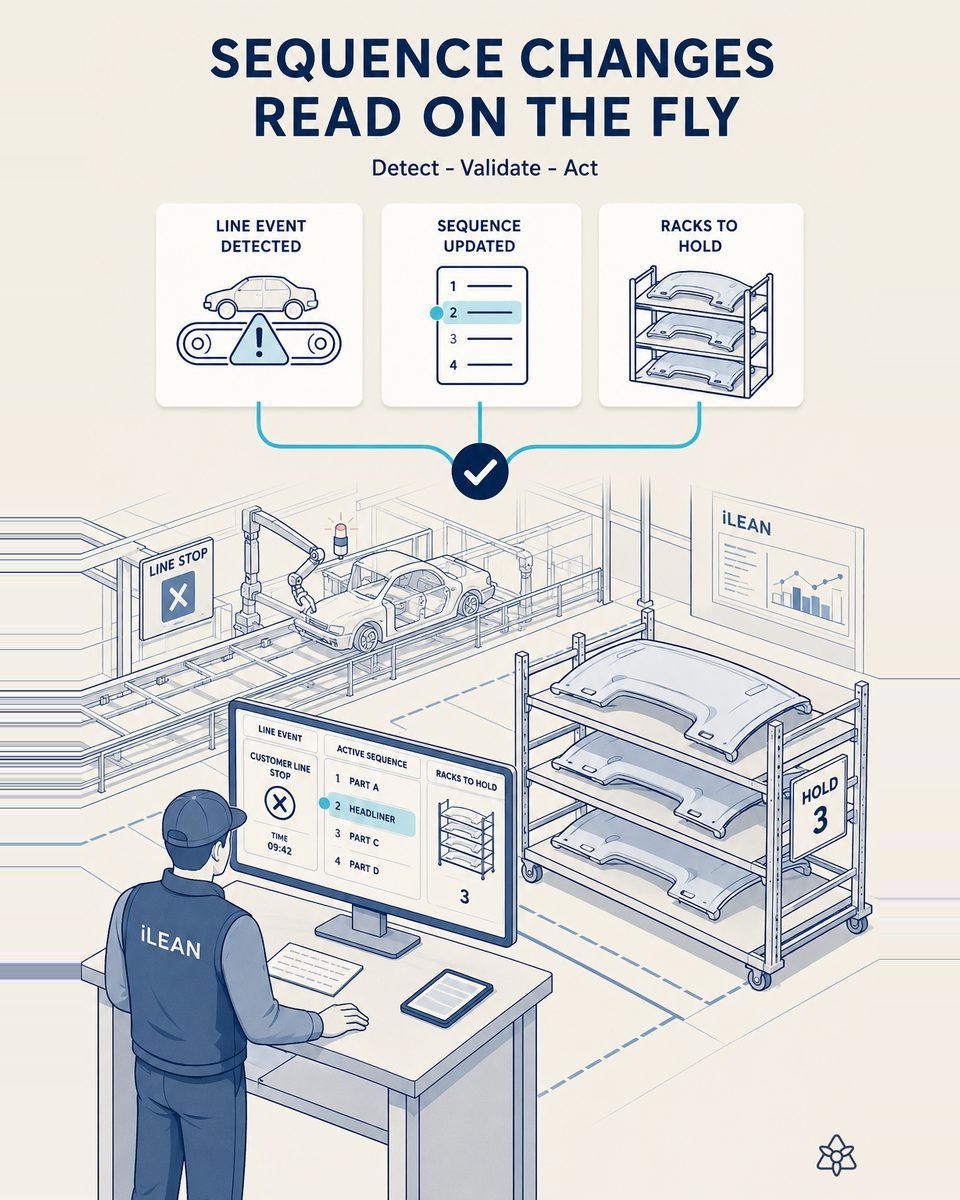
EDI covers the schedule; it does not cover the exceptional, which is what costs money.
EDI covers schedules and firm calls. It does not cover the exceptional, and the exceptional is what costs money. An alert read two hours late means material built in the wrong order, a rack that has to be broken down, or a special transport paid for. The cost of this appears in no budget line: it dissolves into urgent freight, expedition overtime and rack rework. That is precisely why it is never tackled — nobody knows what it adds up to in a year. And it is not solved by putting more people on the mailbox: it is solved by removing the latency between the message arriving and somebody with decision authority knowing what to do.
- An alert read two hours late means material built in the wrong order, a rack to break down, or a special transport paid for.
- The cost appears in no budget line: it dissolves into urgent freight, expedition overtime and rack rework. That is why it is never tackled — nobody knows the annual total.
- It is not solved by putting more people on the mailbox: it is solved by removing the latency between the message arriving and somebody able to decide knowing what to do.
Connect in chaotic-sources mode — it reads a corporate mailbox, not people.
Connect in chaotic-sources mode.
The system returns to the logistics lead which racks to hold, what to reorder and who to warn. A proposed decision, not a notification that an email arrived. The human approves or corrects.
- Dedicated mailbox in silent copy and corporate messaging channel, live twenty-four hours a day.
- The model extracts intent — customer line stop, mix change, supply delay, delivery window change — and entities: schedule, variant, reference, hour.
- Connect cross-references against the active sequence and the planned expedition load.
- It returns the concrete action to the logistics lead: which racks to hold, what to reorder, who to warn. A proposed decision, not a notification.
- The human approves or corrects. Humans in command.
Alert read when somebody can vs. alert processed instantly
| Aspect | Current handling | With iLEAN Connect |
|---|---|---|
| Latency to action | 1-3 h of human latency | Seconds |
| What reaches logistics | The forwarded email | The concrete action, cross-referenced with the sequence |
| Material in the wrong order | Found while preparing the rack | Avoided before building |
| Urgent transports | Absorbed as a diffuse cost | Reduced and measurable |
| Customer and supplier channel | Email and messaging, unchanged | Email and messaging, unchanged |
| Who decides | Whoever reads the email, when they read it | The lead, with the proposal in front of them |
From one to three hours of human latency to seconds. Fewer urgent transports, fewer racks broken down, decisions taken with this minute's picture.
Impact estimate for your plant — to validate against your numbers.
The block below is an estimate to be validated against your plant's actual data. We put it forward so the committee has an order of magnitude; we refine it during the assessment.
- Sequenced delivery with a reaction window measured in minutes and critical alerts arriving outside EDI.
- Pilot on the customer and transport mailbox, which is where what changes the day comes in.
- Indicative payback between 3 and 7 months depending on alert frequency and the average cost of special freight.
- What usually surprises first is the figure: almost no plant knows what it spent last year on unbudgeted urgent transport.
Estimated payback 3 to 7 months depending on the frequency of critical alerts and the average cost of special freight. *Estimate to validate*.
And the fair question from the production manager
“What if it misreads an email and reorders the sequence wrongly?” — it reorders nothing on its own: it proposes to the logistics lead, who decides. The AI task is anchored — extracting schedule, variant, reference and hour from a text — and there the best models drop below 1.5% error [1]. What changes is not who decides, but when they find out.
[1] OpenAI paper "Why Language Models Hallucinate", 2025 — on the reliability of AI in anchored tasks.
What people ask about reading sequence alerts with AI
Does this read our people's email?
No. Connect is copied on a dedicated corporate mailbox and a company messaging channel, not on personal inboxes. It is a channel that already exists and that somebody in logistics checks manually today. People are not observed and private conversations are not read.
Why isn't EDI enough?
EDI covers schedules and firm calls, which is the stable part. What it does not cover is the exceptional: the customer stopping their line for two hours, the carrier missing their window, the component supplier running late. And the exceptional is exactly what costs money in sequenced delivery, because it is what forces a reaction in minutes.
How is this different from an alert or a mail rule?
A rule tells you a message arrived; this tells you what to do about it. The difference is the cross-reference against the active sequence and the planned expedition load: the output is not “supplier delay”, it is “the racks in positions 40 to 60 carry a reference that will not arrive in time, proposal: hold those racks and bring the next block forward”.
Who approves the action?
The logistics lead, always. The system prepares the proposal with the data already cross-referenced and puts it in front of whoever holds the responsibility. Humans in command is not a slogan here: it is what lets logistics adopt the tool instead of defending itself against it.
How long until it runs?
A pilot on one mailbox is set up in weeks, because there is no integration with the customer's system and no development on their side. What takes a little longer is tuning the cross-reference with your sequence and expedition planning, because that does require understanding how you work.
More cases from this series
- The non-conformity does not come from a bad process, it comes from evidence with gapsEvery changeover, first part and validation leaves evidence on the spot. Agents organizes it by…
- In sequence you can stop the customer's line in two waysFour cross-checked verification rings — process, part, order and evidence — so that no rack leaves the…
- The lab measures in a spreadsheet the ERP cannot seeAdhesion, delamination and dimensional tests reach the ERP on their own after validation. Typical saving…
- The truck waits while somebody types twenty linesPhoto of the delivery note and batch labels: reference, quantity and supplier into the ERP after one…
- The most expensive press in the plant is also the most silentA camera and anchored OCR digitize the temperature and pressure curve of an isolated forming press,…
- A perfect rack with the wrong identityThe labeler prints what the sequencing system dictates and the scale verifies the rack. Zero human error…
Tell us what you spent last year on urgent transport and we will send the estimated ROI within 48h.
We work on your plant's real data, not ours. Assessment with no commitment.
Request estimated ROI within 48h ‹ See all cases of automotive headliners See automotive