A perfect rack with the wrong identity
In a plant delivering in sequence, the label is the part: it says which variant the rack carries and in which position it goes. That labeler already has an API, but it is still isolated and somebody selects the template by hand. With Connect, the label is dictated by the sequencing system and the scale checks that what is inside is what should be inside.
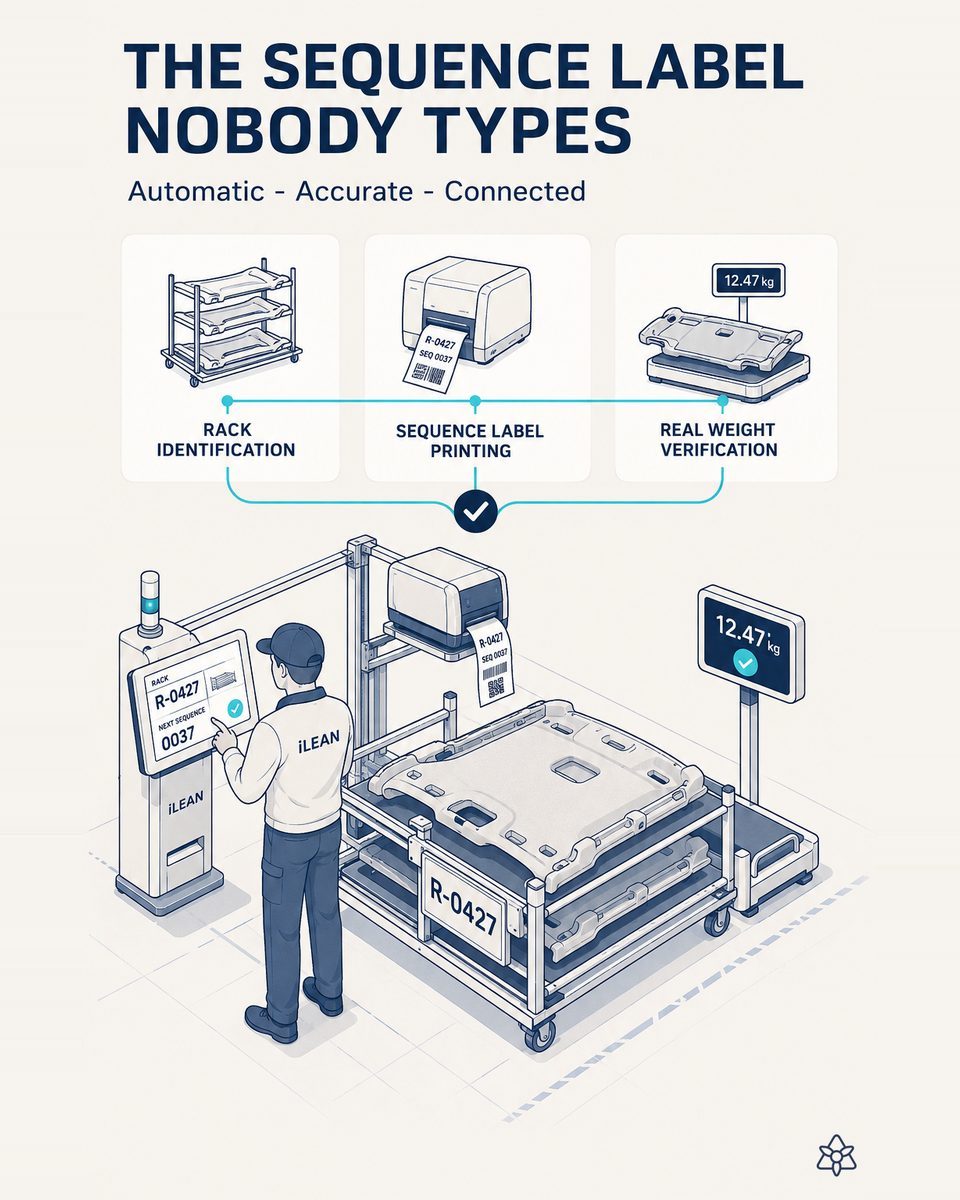
A perfectly built rack with the wrong identity.
The labeler is between five and fifteen years old and comes with an API or a command interface. It is isolated not out of technical impossibility, but because integrating it properly never becomes the priority of the quarter. A selection error there is the worst case in the whole plant: it does not generate a defect, it generates a perfectly built rack with the wrong identity. It passes every internal quality control — because the part is fine — and fails on the customer's assembly line, which is where the error costs the most. The verification scale, where it exists, is not connected either: somebody looks at the number and decides by eye.
- The labeler has an API or command interface, and sits isolated not out of technical impossibility but because integrating it never becomes the priority of the quarter.
- A selection error there is the worst case in the plant: it does not generate a defect, it generates a correct rack with the wrong identity.
- It passes every internal control — because the part is fine — and fails on the customer's assembly line, where the error costs the most.
- The verification scale, where it exists, is not connected either: somebody looks at the number and decides by eye.
Connect stitching two modern systems through the API, replacing neither.
Connect stitching two modern systems through the API, replacing neither.
Changing program becomes a change in the system, not a keystroke on the machine panel. And there are two independent checks on the same fact: what the label says and what is actually inside the rack.
- When the sequencing system fixes a rack's position, it automatically publishes reference, variant, sequence number and destination to the labeler.
- Changing program becomes a change in the system, not a keystroke on the machine panel.
- The scale returns the rack's real weight and Connect checks it against the theoretical weight of its declared contents.
- If it does not match, the rack is not closed and the lead is warned with the specific discrepancy.
- Two independent checks on the same fact: what the label says and what is actually inside.
Label selected by hand vs. label dictated by the system
| Aspect | Current labeling | With iLEAN Connect |
|---|---|---|
| Source of the label | Template selected by hand | Published by the sequencing system |
| Rack identity error | The customer finds it | It never happens |
| Program change | A keystroke on the panel | A change in the system |
| Content verification | By eye, if somebody looks | Real weight checked against theoretical |
| If it does not match | The rack ships anyway | The rack is not closed and a warning is raised |
| Independent checks | One, and human | Two: what the label says and what is inside |
From rack identity errors detected by the customer to zero human-origin labeling errors. From weight verified by eye to systematic verification by cross-check.
Impact estimate for your plant — to validate against your numbers.
The block below is an estimate to be validated against your plant's actual data. We put it forward so the committee has an order of magnitude; we refine it during the assessment.
- Five-to-fifteen-year-old labeler with an API or command interface, and a verification scale at expedition.
- Indicative payback between 3 and 6 months: one of the shortest-return cases in the matrix.
- The reason is that it directly attacks the most expensive event in the sub-sector: the sequence incident.
- It is also a prerequisite for the zero customer line stops case: without reliable identity there is no possible verification in the last meter.
Estimated payback 3 to 6 months. It is one of the shortest-return cases because it directly attacks the most expensive event in the sub-sector: the sequence incident. *Estimate to validate*.
And the fair question from the production manager
“What if the system publishes the wrong label?” — there is no interpretation involved: Connect does not read or compose the reference, it carries it from the sequencing system, which is the source of truth. This is not an AI task with a margin of error, it is an API integration. And on top of that the scale checks the contents independently.
[1] OpenAI paper "Why Language Models Hallucinate", 2025 — on the reliability of AI in anchored tasks.
What people ask about stitching the labeler to the system
Does the labeler have to be replaced?
Almost never. These machines are between five and fifteen years old and usually come with an API or command interface: what is missing is not technical capability, it is the integration project that never reaches the top of the priority list. If yours is from an earlier generation with no interface, that shows up in the assessment, but it is the less frequent case.
Why is it the most expensive error in the plant?
Because it does not generate a defect. A rack with the wrong identity is perfectly built, so it passes every internal quality control — which looks for bad parts, not badly selected labels — and fails on the customer's assembly line. That is exactly where the error costs the most and where there is least margin to correct it.
What does connecting the scale add?
A second independent check on the same fact. The label says what should be inside; the scale says what the contents weigh. If the real weight does not match the theoretical weight of the declared contents, the rack is not closed and the lead sees the specific discrepancy. Two independent signals fail together far less often than one.
Does the line have to stop to integrate it?
No. Publishing is first tested against the machine during an already planned stop or a scheduled changeover, not by asking for a dedicated window. The line PLC and the labeler logic are not touched: it is sent through its own interface what a person selects on it today.
What if the sequencing system changes program mid-production?
That is exactly what this protects. Today a program change requires somebody to remember to change the template on the panel too; if they do not, the following racks ship with the previous identity. When the label is dictated by the system, the change propagates on its own and stops depending on anyone remembering.
More cases from this series
- The non-conformity does not come from a bad process, it comes from evidence with gapsEvery changeover, first part and validation leaves evidence on the spot. Agents organizes it by…
- In sequence you can stop the customer's line in two waysFour cross-checked verification rings — process, part, order and evidence — so that no rack leaves the…
- The lab measures in a spreadsheet the ERP cannot seeAdhesion, delamination and dimensional tests reach the ERP on their own after validation. Typical saving…
- The truck waits while somebody types twenty linesPhoto of the delivery note and batch labels: reference, quantity and supplier into the ERP after one…
- The most expensive press in the plant is also the most silentA camera and anchored OCR digitize the temperature and pressure curve of an isolated forming press,…
- EDI brings the schedule; email brings realityWhat changes the day does not arrive by EDI: it arrives by email. iLEAN reads it instantly,…
Tell us how many machines with an API you have running as islands and we will tell you what it would take.
We work on your plant's real data, not ours. Assessment with no commitment.
Request estimated ROI within 48h ‹ See all cases of automotive headliners See automotive