In sequence you can stop the customer's line in two ways
The capital pain of a headliner plant delivering in sequence is not scrap or cost-down: it is the minute of the customer's assembly line stopped, which gets billed, and everything that comes after. The iLEAN system coordinates the previous eleven pieces into four cross-checked verification rings: if the four do not agree, the rack does not leave the plant.
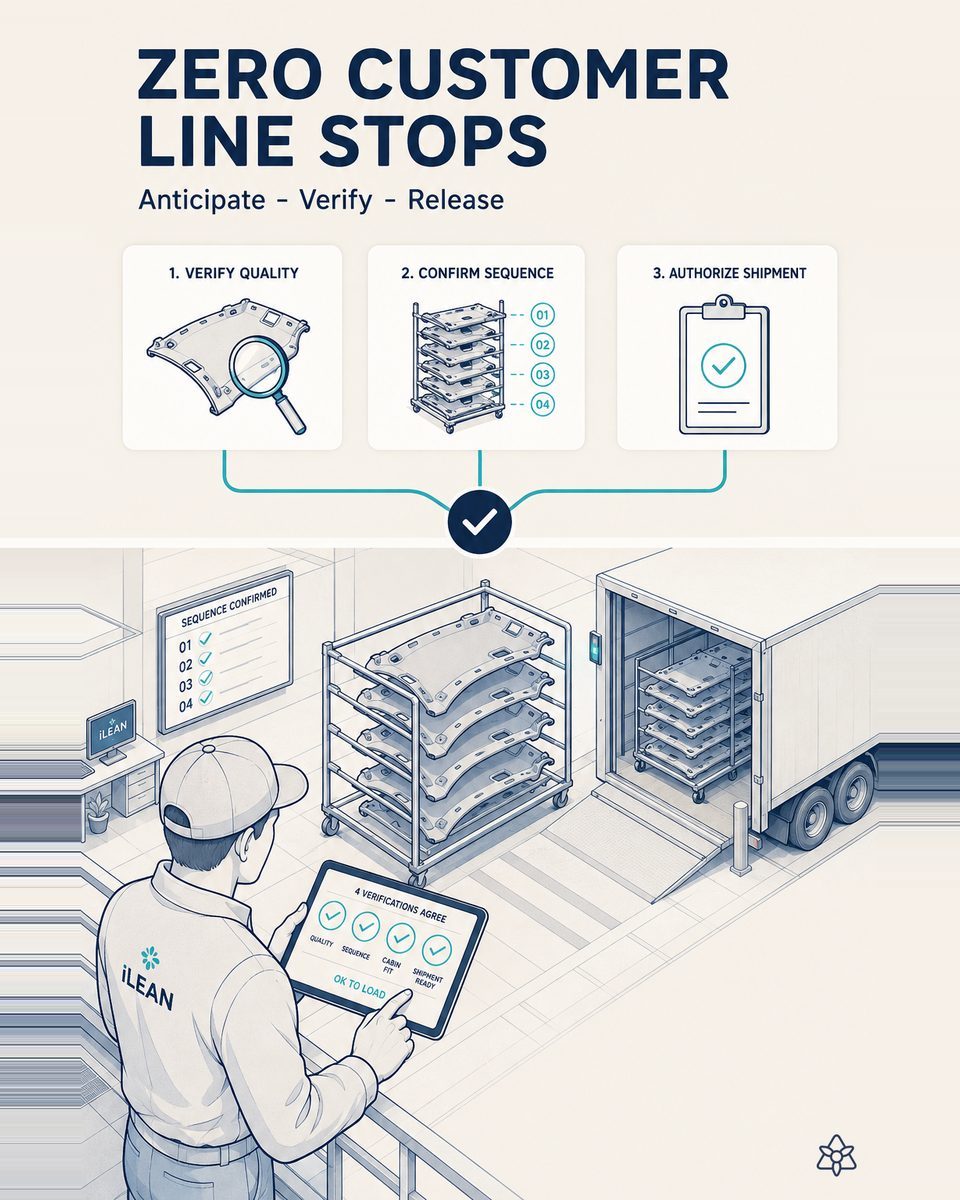
In sequence there are two ways to stop the customer's line, and they cost the same.
An incident that reaches the customer's line costs, between direct charge, containment and commercial consequences, from tens to hundreds of thousands of euros per event. And it drags along controlled shipping, sorting paid to third parties, an extraordinary customer audit, a drop in supplier ranking and, at worst, a program that is not renewed. In sequenced delivery there are two distinct ways to cause it: sending a bad part, or sending a good part in the wrong order. They cost the same on the customer's line but they are different technical problems, and a defense covering only one of them leaves half the risk open. It is the risk the operations director carries every day, and the one that no isolated investment in a machine or a control fully solves.
- An incident reaching the customer's line costs, between direct charge, containment and commercial consequences, from tens to hundreds of thousands of euros per event.
- And it drags along controlled shipping, sorting paid to third parties, an extraordinary customer audit, a drop in supplier ranking and, at worst, a program that is not renewed.
- There are two ways to cause it: sending a bad part, or sending a good part in the wrong order. They cost the same but they are different technical problems.
- A defense covering only one of them leaves half the risk open.
The four coordinated rings — and the last one is at expedition.
Four coordinated rings.
If the four rings do not agree, the rack does not leave the plant. Facing a claim, the answer takes hours and comes with data, not days and consensus.
- Ring 1 · Process: the digitized press curve and the variant changeover validation guarantee the part is born with the right tooling and parameters. JIDOKA AI does not allow startup otherwise.
- Ring 2 · Part: the Edge cameras verify surface, trim and presence of every component of that specific variant before the rack. The bad part leaves the sequence, not the plant.
- Ring 3 · Identity and order: the labeler prints what the sequencing system dictates, the scale checks the rack weight and customer change alerts arrive within seconds. The good part goes in the right position.
- Ring 4 · Evidence: every rack ships with its dossier, cross-referencing the three previous rings with the signed human validations. Facing a claim, the answer takes hours and comes with data.
- SMED AI speeds up the changeover between variants so the four rings are not paid for in productivity, which is the shop floor team's legitimate objection.
Incident found outside vs. discrepancy stopped inside
| Aspect | Without the four rings | With the coordinated system |
|---|---|---|
| Where it is detected | On the customer's line | Inside the plant, before expedition |
| Cost of the event | Tens to hundreds of thousands per incident | Moving one rack |
| Bad part | The customer's operator stops it | It leaves the sequence on the line |
| Good part in the wrong order | Nobody catches it until the customer | Label and scale cross-check it |
| Facing a claim | The charge is argued with no data | Bounded with traceability in hours |
| Supplier ranking | Exposed on every shipment | Protected systematically |
From incidents detected by the customer to discrepancies detected inside the plant, before expedition. From arguing a charge with no data to bounding it with full traceability in hours.
Impact estimate for your plant — to validate against your history.
The block below is an estimate to be validated against your plant's actual data. We put it forward so the committee has an order of magnitude; we refine it during the assessment.
- Plant delivering in sequence to one or several customer plants, with a hundred active variants.
- Indicative payback between 6 and 12 months against the first avoided incident.
- The value of protecting supplier ranking and program renewal is multi-year and far greater than that of the isolated incident.
- To validate against the last three years' history of charged incidents, which is the number that really sizes this case.
Estimated payback 6 to 12 months against the first avoided incident. The value of protecting supplier ranking and program renewal is multi-year and far greater than that of the isolated incident. *Estimate to validate against the last three years' history*.
And the fair question from the production manager
“What if the system holds a rack that was fine and stalls expedition?” — the hold happens when the rings do not agree, and the lead sees the specific discrepancy on their tablet and can resolve it on the spot. Compare it with the alternative scenario, which is not smooth expedition: it is that same rack reaching the customer's line. A hold costs minutes; a sequence incident costs a charge.
[1] OpenAI paper "Why Language Models Hallucinate", 2025 — on the reliability of AI in anchored tasks.
What people ask about the zero line stops system
Do you need the previous eleven pieces?
Not all of them, but yes the ones that hold up each ring. Stitching the labeler is the clearest prerequisite for the identity ring: without it, the last-meter verification compares the system against data that came from a manual selection. The press curve and the changeover validation hold up the process ring, and Edge the part ring. It can be deployed in phases, but the order matters and it is not arbitrary.
Why do you insist there are two ways to stop the customer's line?
Because it is what distinguishes this sub-sector and what makes the usual defenses insufficient. Sending a bad part is a quality problem; sending a good part in the wrong order is an identity and sequence problem. On the customer's line they cost the same, but they are solved with different technologies. An investment covering only the first leaves half the risk open.
Will this stall expedition every other day?
It should not hold anything that was fine. The hold triggers when the rings do not agree — the weight does not match what is declared, the batch is not validated, the changeover was not closed — which are objective conditions, not a system judgment. And when it triggers, the lead sees the specific reason and can resolve it with the rack still in the plant.
What role does SMED AI play?
Making sure the four rings are not paid for in productivity, which is the shop floor team's legitimate objection and has to be taken seriously. SMED AI speeds up the changeover between variants, which is where a plant with a hundred configurations loses most time. Without that piece the system defends itself worse internally even if it works technically.
How does the conversation with the customer change after a claim?
It stops being an argument about who is right. Today a charge is argued with no data and accepted because the opposite cannot be proven. With the four rings, every rack ships with its dossier: raw material batch, press cycle, test result, changeover validation and final control. The answer takes hours and comes with data, and the containment scope gets bounded instead of over-contained.
More cases from this series
- The non-conformity does not come from a bad process, it comes from evidence with gapsEvery changeover, first part and validation leaves evidence on the spot. Agents organizes it by…
- The lab measures in a spreadsheet the ERP cannot seeAdhesion, delamination and dimensional tests reach the ERP on their own after validation. Typical saving…
- The truck waits while somebody types twenty linesPhoto of the delivery note and batch labels: reference, quantity and supplier into the ERP after one…
- The most expensive press in the plant is also the most silentA camera and anchored OCR digitize the temperature and pressure curve of an isolated forming press,…
- EDI brings the schedule; email brings realityWhat changes the day does not arrive by EDI: it arrives by email. iLEAN reads it instantly,…
- A perfect rack with the wrong identityThe labeler prints what the sequencing system dictates and the scale verifies the rack. Zero human error…
Tell us how many charged customer incidents you have had in the last three years.
We work on your plant's real data, not ours. Assessment with no commitment.
Request estimated ROI within 48h ‹ See all cases of automotive headliners See automotive