The lab measures in a spreadsheet the ERP cannot see
Every shift the lab fills in a sheet with the control plan tests: laminate adhesion, delamination resistance, weight per unit area, dimensional, climatic chamber, anchor strength. Those are the data that actually decide whether a batch ships, and they live in a folder the ERP cannot see. Connect absorbs them when the sheet is saved and, after validation, pushes them to the ERP.
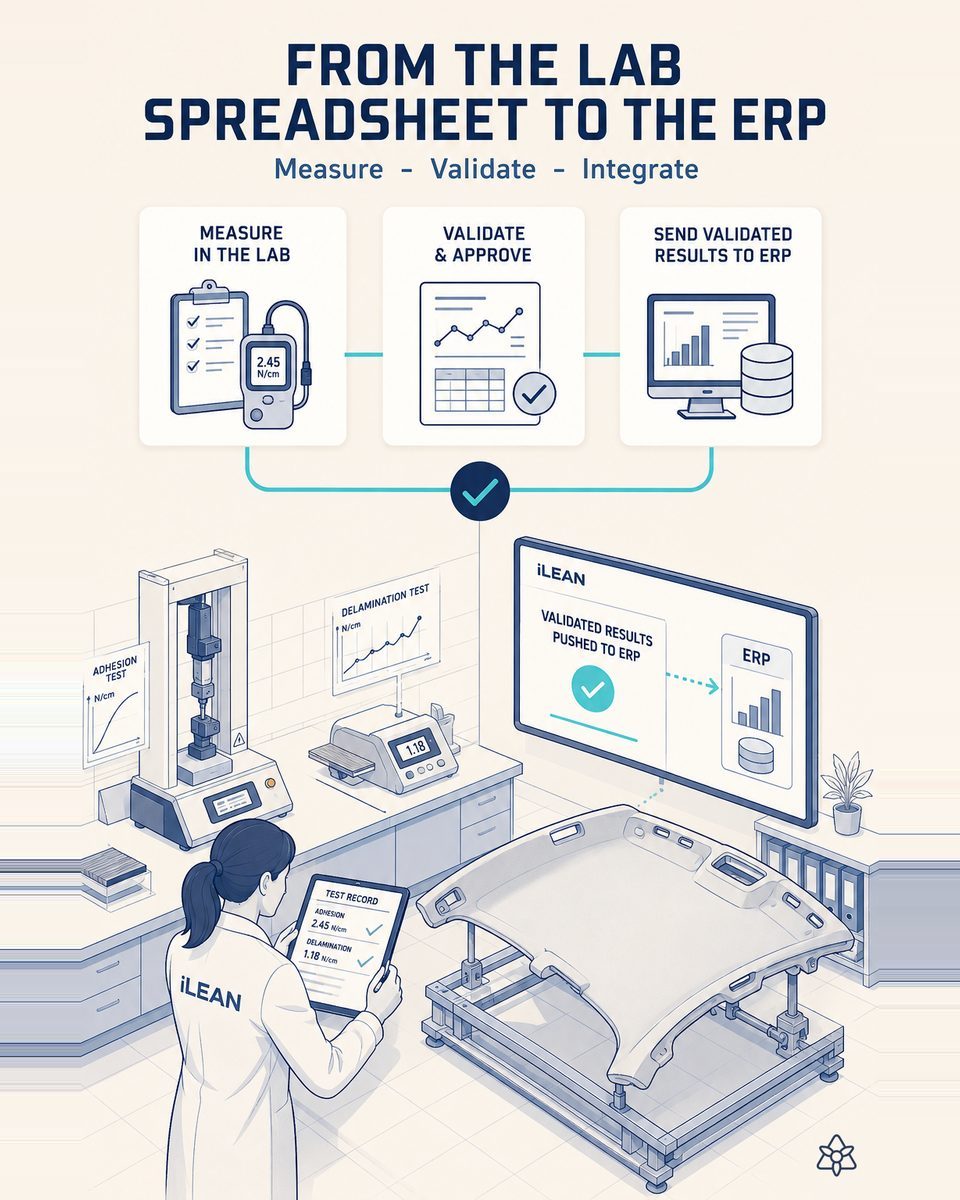
Two parallel worlds: the real spreadsheet and the official ERP.
There are two parallel worlds: the real spreadsheet, where the lab writes what it measures, and the official ERP, which receives a summarized, late, hand-typed version. When the ERP's statistical control shows a parameter drifting, the drift has been happening for weeks. In an audit, the difference between the two worlds is exactly the kind of finding that raises a non-conformity: the auditor asks for the source data, the spreadsheet appears, and the discussion becomes one about record control. And there is a silent cost: half a day a month of a qualified person copying cells from one place to another, plus the errors that introduces.
- The real spreadsheet is where the lab records adhesion, delamination, weight per unit area, dimensional, climatic chamber and anchor strength.
- The official ERP gets a summarized, late, hand-typed version. When its statistical control flags a drift, the drift has been happening for weeks.
- In an audit, the difference between the two is the kind of finding that raises a non-conformity: the auditor asks for the source data, the spreadsheet appears, and the discussion becomes one about record control.
Connect in listen-inward mode — it watches the file, not the person.
Connect in listen-inward mode.
The lab keeps working in its usual sheet. What disappears is the person who was retyping, and with them the ERP licenses that existed only to upload data.
- iLEAN watches the shared folder — the file, not the person — and reads the delta when the sheet is saved.
- An anchored model parses against the known structure of the sheet and normalizes the results.
- The quality lead validates the summary on screen.
- Connect pushes to the ERP through the API, without migrating anything or changing the lab's tool.
- The results stay linked to the batch, the variant and the press cycle, which makes it possible for the first time to correlate forming curve with test result.
Manual retyping vs. push after validation
| Aspect | With manual retyping | With iLEAN Connect |
|---|---|---|
| Lag between measured and system data | Weeks | Second zero |
| Effort | Half a day a month of qualified staff | None |
| Statistical control | Retrospective | Live |
| In an audit | The parallel spreadsheet appears | The source data is already in the system |
| Quality module licenses | One per person who uploads | One, the validating lead |
| Correlation with the press | Impossible | Result linked to cycle and variant |
From weeks of lag between measured data and data in the system to second zero. From half a day a month retyping to zero. From retrospective statistical control to live control.
Impact estimate for your plant — to validate against your ERP invoice.
The block below is an estimate to be validated against your plant's actual data. We put it forward so the committee has an order of magnitude; we refine it during the assessment.
- Lab with a test sheet per shift and per line in a shared folder.
- The ERP charges per active user: if lab and engineering log in only to enter results, each access is a license.
- With Connect only the validating lead needs one. Typical reduction of 50-80% in quality and lab module licenses, recurring every year.
- Indicative payback between 4 and 9 months combining the license saving and the freed time.
CFO angle — the ERP charges per active user. If the lab and engineering team log into the ERP only to enter test results, each access is a license; with Connect only the validating lead needs one. Typical reduction of 50-80% in quality and lab module licenses, recurring every year. Estimated payback 4 to 9 months combining license saving and freed time. *Estimate to validate against the real ERP invoice*.
And the fair question from the production manager
“What if it parses a cell wrongly and uploads a bad result?” — reading a cell against a known schema is an anchored task, where the best models drop below 1.5% error [1]. And the order matters: anything out of specification is flagged and put in front of the lead before anything is uploaded. The doubtful value gets the most human attention.
[1] OpenAI paper "Why Language Models Hallucinate", 2025 — on the reliability of AI in anchored tasks.
What people ask about moving the lab to the ERP
Does the test sheet have to change?
No, and that is a design condition. That sheet has worked for years and is maintained by people who know why each column is where it is. Asking for it to be migrated to a new form is the fastest way to make sure the project never starts. Connect adapts to the sheet's schema; the sheet does not adapt to Connect.
Does this monitor what the lab staff do?
No. The system watches the file in the shared folder and reads the delta when the sheet is saved, exactly as a backup would. It does not monitor people or record individual activity.
How exactly are licenses reduced?
An ERP quality module is normally billed per active user. Today everybody who needs to upload results logs in, even though their real work is in the sheet. With Connect only the lead who validates the push logs in; the rest keep working in their sheet without needing access. And that reduction recurs year after year without renegotiating the framework contract.
What does linking the test to the press cycle add?
It makes it possible for the first time to correlate the forming curve with the test result. Today they are two data points living in different places that nobody cross-references; once linked, a drop in adhesion stops being a mystery and gets a specific parameter and cycle behind it.
And the audit finding about record control?
Its cause disappears. Today the auditor asks for the source data, a spreadsheet appears that is not the official system, and the conversation turns into a record control problem. When the push is immediate and validated, source data and official data are the same thing.
More cases from this series
- The non-conformity does not come from a bad process, it comes from evidence with gapsEvery changeover, first part and validation leaves evidence on the spot. Agents organizes it by…
- In sequence you can stop the customer's line in two waysFour cross-checked verification rings — process, part, order and evidence — so that no rack leaves the…
- The truck waits while somebody types twenty linesPhoto of the delivery note and batch labels: reference, quantity and supplier into the ERP after one…
- The most expensive press in the plant is also the most silentA camera and anchored OCR digitize the temperature and pressure curve of an isolated forming press,…
- EDI brings the schedule; email brings realityWhat changes the day does not arrive by EDI: it arrives by email. iLEAN reads it instantly,…
- A perfect rack with the wrong identityThe labeler prints what the sequencing system dictates and the scale verifies the rack. Zero human error…
Work out how many ERP licenses exist only to enter data that is already in a spreadsheet.
We work on your plant's real data, not ours. Assessment with no commitment.
Request estimated ROI within 48h ‹ See all cases of automotive headliners See automotive