The most expensive part to scrap is the one already finished
A headliner is a large, light, matte part: the defects that matter show up backlit and at an angle, not head-on and at line speed. The human eye performs well in the first hour of the shift and worse from the fourth. iLEAN Edge inspects at the three points where the defect appears and takes the part out of the sequence before the rack.
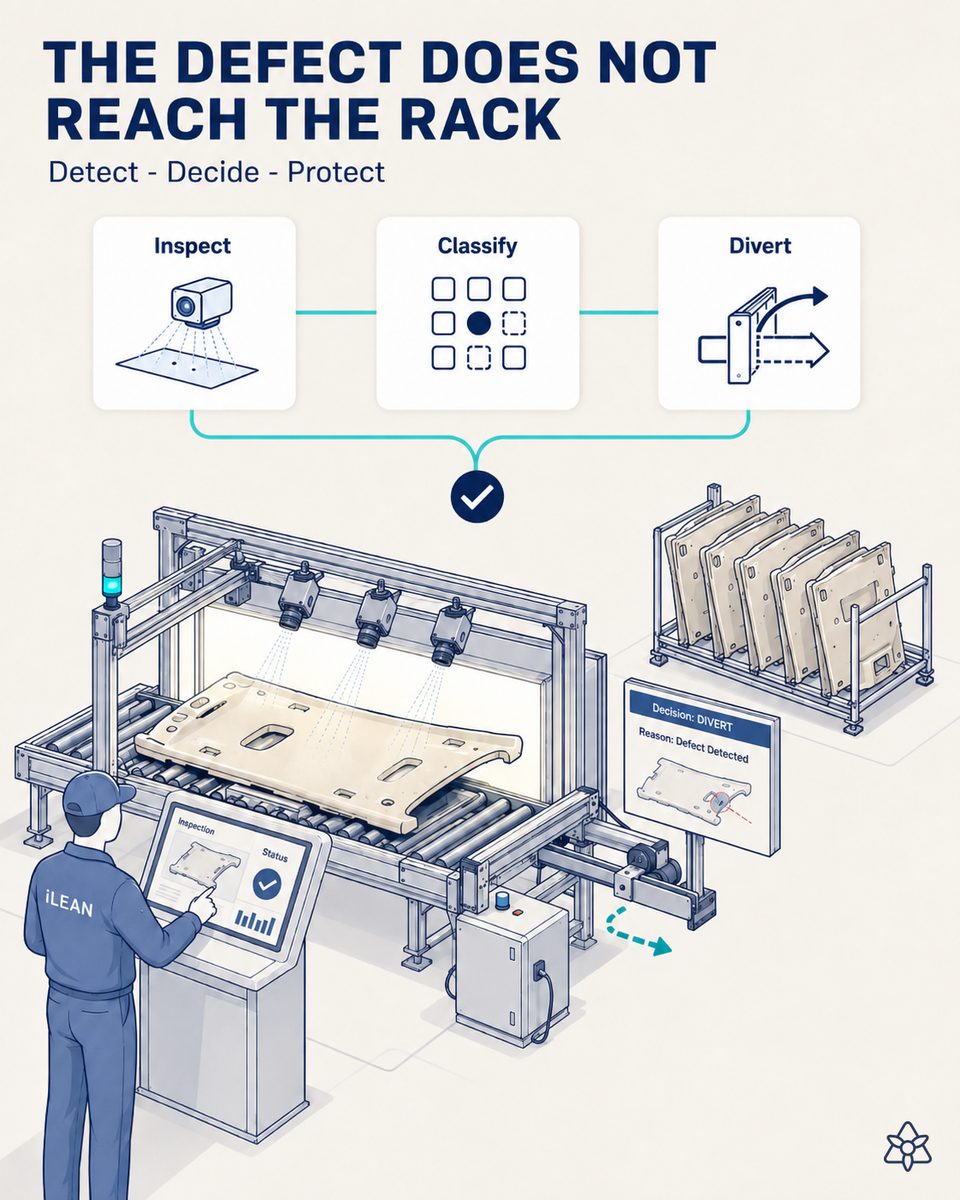
The most expensive part to scrap is the one already finished.
Fabric wrinkle, bubbling, incipient delamination, mold mark, stain, out-of-tolerance trim, badly seated speaker ring, missing sun visor or grab handle, unmated connector. With a hundred active variants, each with its own component combination, one hundred percent human visual control is not sustainable and sampling leaves gaps by definition. Besides, the headliner is the most expensive part to scrap in the whole plant: when it fails, it already carries the formed substrate, the lamination, the trimming and the full assembly. All the added value is inside what gets thrown away. And the one that slips through does not reach an end consumer: it reaches the customer's assembly line, where an operator sees it and stops the line.
- Wrinkle, bubbling, incipient delamination, mold mark, stain, out-of-tolerance trim, badly seated speaker ring, missing visor or handle, unmated connector.
- With a hundred active variants, each with its component combination, one hundred percent human visual control is not sustainable and sampling leaves gaps by definition.
- When it fails, the part already carries the formed substrate, the lamination, the trimming and the full assembly: all the added value is inside what gets thrown away.
- And the one that slips through does not reach a consumer: it reaches the customer's assembly line, where an operator sees it and stops the line.
Edge — vision with local inference, at the three points where the defect appears.
Edge — CNN vision with local inference.
The image does not leave the plant: no cloud latency, no bandwidth cost, no customer product circulating outside the site. The suspect part leaves the sequence and a person decides its final destination.
- Cameras at the lamination outfeed, at the trimming center and at the final assembly station, with lighting designed to reveal surface defects backlit.
- Inference on a local plant GPU, in milliseconds per part.
- One model per defect family, trained with real good and bad parts from your own production, not with generic catalogs.
- The detection is cross-referenced with the active variant to also verify that every component that specific variant must carry is present.
- The suspect part leaves the sequence and is flagged for human review; the person decides its final destination.
- The image does not leave the plant: no cloud latency, no bandwidth cost, no customer product circulating outside the site.
Sampling vs. one hundred percent control at three points
| Aspect | Sampling control | With iLEAN Edge |
|---|---|---|
| Coverage | One or two percent | 100% at three points in the flow |
| Where it is detected | Sometimes, at the customer | Before the rack |
| Control performance | Drops from the fourth hour | Constant all shift |
| Component presence | Depends on the variant and the eye | Verified against the active variant |
| Value of the scrapped part | Finished, with all the value inside | Detected at the first process |
| Where the image goes | There is no image | It stays in the plant |
From sampling one or two percent to controlling one hundred percent of parts at three points in the flow. From a defect found at the customer to a defect found before the rack.
Impact estimate for your plant — to validate against your numbers.
The block below is an estimate to be validated against your plant's actual data. We put it forward so the committee has an order of magnitude; we refine it during the assessment.
- Headliner: a large, light, matte part whose defects show up backlit and at an angle, not head-on.
- Pilot on one point of the flow, with real good and bad parts from your own production as training material.
- Indicative payback between 5 and 12 months depending on the current scrap and rework rate.
- What gets counted is the reduction in PPM to the customer and the risk of paid sorting, which is where the big cost sits.
Estimated payback 5 to 12 months depending on the current scrap and rework rate, with reduced PPM to the customer and reduced risk of paid sorting. *Estimate to validate against the scrap and claims history*.
And the fair question from the production manager
“What if the model pulls good parts out of the sequence?” — the false positive rate is measured from day one of the pilot and is a tunable parameter: it is calibrated with good and bad parts from your own production. A model trained on a generic catalog does tend to over-reject; one trained on your fabric, your lighting and your variants does not. And the suspect part is not scrapped on its own: it is flagged for human review.
[1] OpenAI paper "Why Language Models Hallucinate", 2025 — on the reliability of AI in anchored tasks.
What people ask about AI vision in headliners
Why is inference local rather than in the cloud?
For three reasons that stack up. Latency: the decision has to be made in milliseconds per part. Cost: continuously uploading video from several cameras is an absurd recurring expense. And confidentiality: this is customer product, and many automotive plants are contractually forbidden from letting product images leave the site. With Edge, the image stays inside.
How do you detect a surface defect on a light, matte part?
With lighting designed to reveal it, which is half the work. The defects that matter on a headliner — wrinkle, bubbling, incipient delamination, mold mark — show up backlit and at an angle, not head-on. The camera alone is not enough: the installation includes the lighting that makes the defect visible.
Does it also verify that every component is present?
Yes, and that is where it adds most with a hundred active variants. The detection is cross-referenced with the active variant to check the part carries exactly the components that specific variant must have: visor, grab handle, speaker ring, mated connector. It is an error the human eye makes easily precisely because the variants look alike.
Is it trained on catalogs or on our parts?
On your parts, good and bad, from real production. A model trained on a generic catalog does not know your fabric, your lighting or what your usual defects actually look like. That is why the pilot starts by collecting real material over a few weeks.
Who decides the fate of a detected part?
A person. The suspect part leaves the sequence and is flagged for human review; the system does not scrap it on its own. That matters especially here, because scrapping a finished headliner means throwing away that part's whole value chain.
More cases from this series
- The non-conformity does not come from a bad process, it comes from evidence with gapsEvery changeover, first part and validation leaves evidence on the spot. Agents organizes it by…
- In sequence you can stop the customer's line in two waysFour cross-checked verification rings — process, part, order and evidence — so that no rack leaves the…
- The lab measures in a spreadsheet the ERP cannot seeAdhesion, delamination and dimensional tests reach the ERP on their own after validation. Typical saving…
- The truck waits while somebody types twenty linesPhoto of the delivery note and batch labels: reference, quantity and supplier into the ERP after one…
- The most expensive press in the plant is also the most silentA camera and anchored OCR digitize the temperature and pressure curve of an isolated forming press,…
- EDI brings the schedule; email brings realityWhat changes the day does not arrive by EDI: it arrives by email. iLEAN reads it instantly,…
Tell us how many finished parts you scrap a month for a defect that appeared in the first process.
We work on your plant's real data, not ours. Assessment with no commitment.
Request estimated ROI within 48h ‹ See all cases of automotive headliners See automotive