The AI captures; the person signs
What separates iLEAN from an autonomous AI agent is that nothing captured enters the central system without a human having seen it. In a plant whose sequencing system the customer queries in real time, that is not a design preference: it is the condition for installing anything at all.
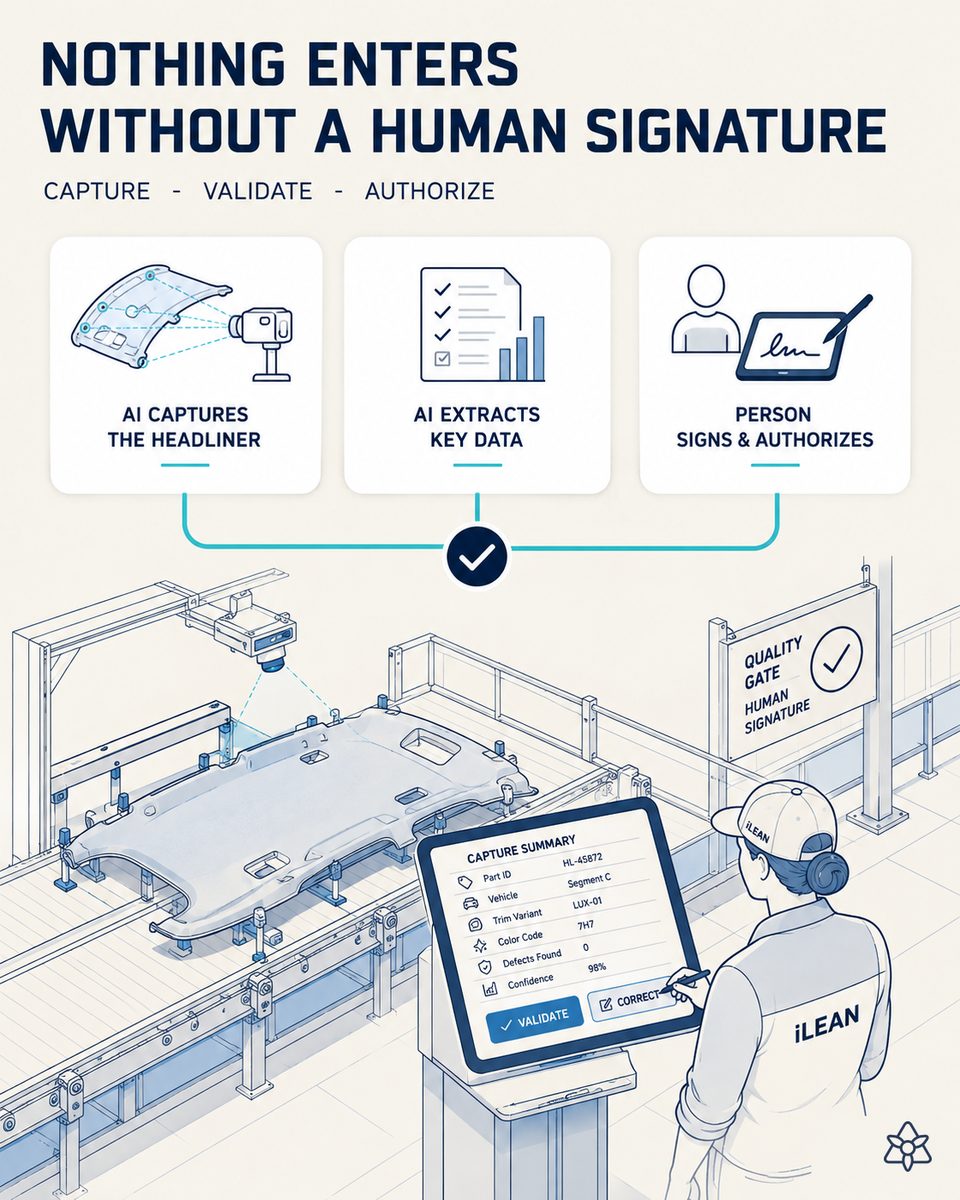
The real brake is not technical, it is accountability.
The real brake on digitization in a Tier 1 is not technical, it is accountability. If wrong data enters the sequencing system, the error goes out by EDI to the customer and becomes a contractual problem, not a database correction. That is why no manager signs off on installing a system that writes into the master on its own. And at the same time the operator does not want to type: every second at the station counts against cycle time, and a system that demands data entry is not used, it is worked around. The contradiction between the two is what leaves many plants capturing on paper in the year their customer demands real-time data.
- If wrong data enters the sequencing system, the error goes out by EDI to the customer and becomes a contractual problem, not a database correction.
- That is why nobody signs off on installing a system that writes into the master on its own.
- And at the same time the operator does not want to type: every second at the station counts against cycle time, and a system that demands data entry is not used, it is worked around.
- That contradiction is what leaves many plants capturing on paper in the year their customer demands real-time data.
A tablet at the line, a two-second summary and two taps.
Connect in early human verification mode.
What separates iLEAN from an autonomous agent is that nothing captured enters the central system without a human having seen it. In a plant whose sequencing system the customer queries in real time, that is the condition for installing anything.
- Industrial tablet at the assembly line and at the expedition station.
- Everything iLEAN captures by any route — photographed startup sheet, press panel curve, parsed customer alert, voice dictation — appears as a two-second visual summary.
- The human confirms with two taps: validate and it enters the central system, or correct before it enters.
- The signature is recorded with the role that validated, and feeds the auditable evidence dossier.
- The interface is designed to validate, not to enter data: no prior training and no habit change.
Autonomous agent vs. early human verification
| Aspect | AI writing to the master on its own | With early human verification |
|---|---|---|
| Who is accountable | Nobody clearly | The person who signed, with their role |
| If the data is wrong | It goes out by EDI to the customer | It is corrected before entering |
| Plant manager sign-off | Not given | Data governance is settled |
| Load on the operator | None, but no control either | Two taps, no typing |
| Cycle time | Compromised if typing is required | Untouched: validating is not entering |
| Audit evidence | Technical log | Signature with role and time, in the dossier |
From the dilemma between unvalidated data polluting the master and data not captured out of distrust, to data captured and validated within seconds with a clean master.
Why this piece is an enabler and does not sell on its own
The block below is an estimate to be validated against your plant's actual data. We put it forward so the committee has an order of magnitude; we refine it during the assessment.
- It has no standalone payback and we are not going to invent one.
- It is the requirement for the other eleven to be signed off in an IATF environment.
- Its value is measured by what it unlocks, not by what it saves.
- It is also what makes the floor adopt it: the operator does not lose control of what enters the system under their role.
Strategic value rather than directly monetizable. It is the enabling piece: without early human verification, the other eleven are not signed off in an IATF environment. *Estimate to validate*.
And the fair question from the production manager
“Isn't this putting manual work back in?” — validating is not typing. The screen shows a visual summary meant to be read in two seconds and resolved with one tap. What is removed is data entry; what is kept is the human decision, which in a Tier 1 is exactly what nobody wants to delegate to a machine.
[1] OpenAI paper "Why Language Models Hallucinate", 2025 — on the reliability of AI in anchored tasks.
What people ask about data governance in a Tier 1
Why not let the AI write straight into the MES?
Because in sequenced delivery the error does not stay inside. If wrong data enters the sequencing system it goes out by EDI to the customer and stops being a database correction to become a contractual problem. Early human verification costs two seconds per capture and turns a diffuse risk into a signature with role and time.
Doesn't it compromise cycle time?
No, and that is the point of the design. The interface is built to validate, not to enter data: a two-second visual summary and two buttons. Compare it with the real alternative, which is not “zero friction” but capturing on paper and keying it later, or not capturing at all.
Where do the tablets go?
At the assembly line and at the expedition station, where the person who can validate is. Not in an office: if validation piles up it stops being early and the system loses its guarantee.
What if nobody validates?
The data does not enter the central system. It stays in the queue, visible, and is not accepted by administrative silence. That is deliberate: a system that validates by timeout ends up being a system with no validation, and the guarantee we give would stop being true.
Does it work as IATF audit evidence?
Yes, and it is better evidence than a manual transcription: every data point that entered carries who validated it, with which role and at what time, plus the original capture it came from. The chain is complete and timestamped, which is exactly what an auditor asks for when questioning record control.
More cases from this series
- The non-conformity does not come from a bad process, it comes from evidence with gapsEvery changeover, first part and validation leaves evidence on the spot. Agents organizes it by…
- In sequence you can stop the customer's line in two waysFour cross-checked verification rings — process, part, order and evidence — so that no rack leaves the…
- The lab measures in a spreadsheet the ERP cannot seeAdhesion, delamination and dimensional tests reach the ERP on their own after validation. Typical saving…
- The truck waits while somebody types twenty linesPhoto of the delivery note and batch labels: reference, quantity and supplier into the ERP after one…
- The most expensive press in the plant is also the most silentA camera and anchored OCR digitize the temperature and pressure curve of an isolated forming press,…
- EDI brings the schedule; email brings realityWhat changes the day does not arrive by EDI: it arrives by email. iLEAN reads it instantly,…
Tell us what it would take for you to sign off on a system writing into your MES.
We work on your plant's real data, not ours. Assessment with no commitment.
Request estimated ROI within 48h ‹ See all cases of automotive headliners See automotive