What the supervisor knows is in no system
The shift supervisor walks the press, the trimming center and the assembly lines with their hands always busy. Nobody asks them anything because they cannot type, and everything they know — which station is running slow and why, which fabric batch marks more, which tooling comes in misaligned — dies at the end of the shift. With Connect in voice mode they dictate while walking and it stays structured, linked and available.
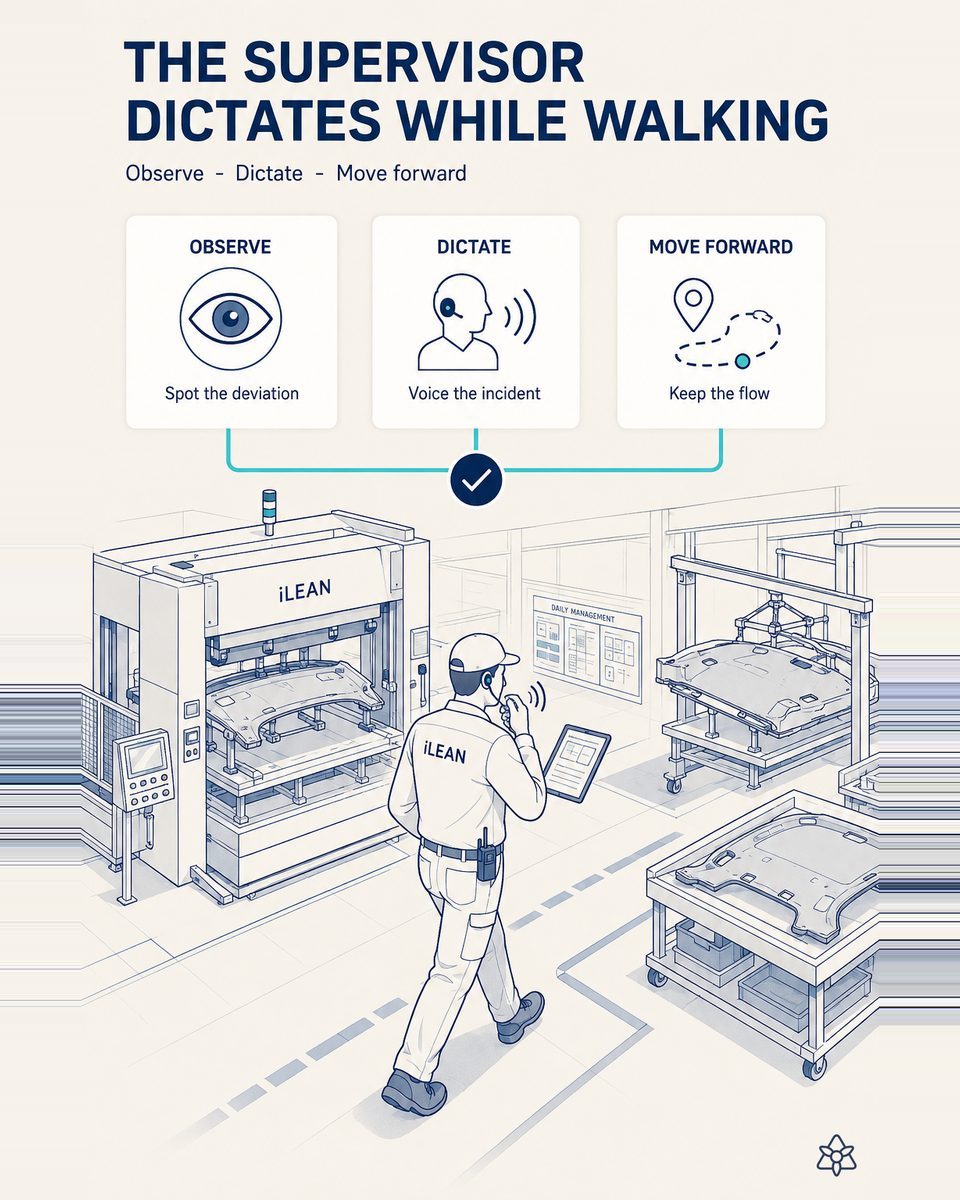
The person with the information is exactly the one who does not sit down all shift.
The knowledge that separates a good shift from a bad one lives in the head of the supervisor and three veteran operators. With the usual turnover, that knowledge is lost and has to be relearned through scrap. There is a second problem, less visible and more expensive for a multi-plant operations director: that knowledge is not transferred between plants of the same perimeter either. Each one rediscovers on its own what another already solved, because it was never written down anywhere. Conventional tools do not capture it because they require sitting down to write. And the person with the information is exactly the one who does not sit down all shift.
- The knowledge that separates a good shift from a bad one lives in the supervisor's head and in three veteran operators. With the usual turnover it is lost and relearned through scrap.
- It is not transferred between plants of the same perimeter either: each one rediscovers what another already solved, because it was never written down.
- Conventional tools do not capture it because they require sitting down to write.
Connect in voice mode — hands busy, voice free.
Connect in voice mode.
The supervisor dictates without stopping. The model structures the dictation and links it to the active line, variant, tooling and shift, and returns within seconds who received it and what is proposed.
- Bluetooth earpiece and custom wake word.
- The supervisor dictates without stopping: a process observation, an incident, a request to quality or maintenance.
- The model structures the dictation and automatically links it to the active line, variant, tooling and shift.
- Response within seconds by voice or push to the tablet: who received it, what they propose, what is needed from them.
- The information stays in central memory, queryable and transferable to other plants in the perimeter.
Knowledge that dies in the shift vs. knowledge that stays
| Aspect | Current situation | With Connect voice mode |
|---|---|---|
| When it is recorded | At the end of the shift, if there is time | While walking, on the spot |
| What it takes | Sitting down to write | Speaking |
| Link to context | None | Active line, variant, tooling and shift |
| Staff turnover | Relearned through scrap | The knowledge stays |
| Across plants in the group | Each one rediscovers the same thing | Shared, queryable repository |
| Response to the supervisor | None | Who received it and what is proposed, in seconds |
From knowledge that dies at the end of the shift to knowledge that enters in real time and is cross-referenced with live data. From every plant rediscovering the same thing to a shared repository.
Why this piece is not measured in payback
The block below is an estimate to be validated against your plant's actual data. We put it forward so the committee has an order of magnitude; we refine it during the assessment.
- Plant on three shifts with supervisors walking press, trimming and assembly with their hands busy.
- A full-shift trial with one supervisor: what gets measured is how many observations are recorded versus before.
- We do not present it as a direct saving because it is not one, and saying otherwise would be selling smoke.
- It is the basis of any continuous improvement plan and of any serious attempt to replicate across plants what works in one.
Not directly monetizable. It is the basis of any continuous improvement plan and of any serious attempt to replicate across plants what works in one. *Estimate to validate with the continuous improvement manager*.
And the fair question from the production manager
“What if it transcribes badly with the press noise?” — the earpiece has industrial noise cancellation and recognition works over plant vocabulary, not general language. And what matters: the transcription triggers no automatic action, it structures an observation a person will read. An error here costs a correction, not a wrong decision.
[1] OpenAI paper "Why Language Models Hallucinate", 2025 — on the reliability of AI in anchored tasks.
What people ask about voice mode on the floor
Does this record the whole shift?
No. It is triggered by a custom wake word and captures the dictation the supervisor chooses to make, exactly as if they pulled out a phone to write a note. It is not continuous listening and it is not a people-monitoring system, and that distinction matters both legally and for adoption: nobody uses something they perceive as an open microphone on them.
Does it work with press and trimming noise?
It is designed for that. The earpiece has industrial noise cancellation and recognition works over plant vocabulary — tooling names, variant names, station names — rather than general language, which is where generic dictation fails in an industrial environment.
What if the supervisor does not want to use it?
That is the right question, because adoption is the real risk of this piece, not the technology. What convinces is not the pitch but what comes back: when you dictate something and within seconds you get the history of that tooling, or a warning that this fabric batch already caused problems in another plant, it stops being a reporting duty and becomes a tool that gives you something.
How is knowledge transferred between plants?
Because the observation is structured and linked to variant and tooling, not left as loose text. That lets another plant in the perimeter building the same variant find what was already solved here. Today that jump never happens, because the knowledge was never written anywhere queryable.
How do you measure whether it works?
With a simple comparison: how many observations were recorded in a shift with the system versus before. It is a number you see in the first week. What we will not do is present a payback in months for this piece, because on its own it does not have one.
More cases from this series
- The non-conformity does not come from a bad process, it comes from evidence with gapsEvery changeover, first part and validation leaves evidence on the spot. Agents organizes it by…
- In sequence you can stop the customer's line in two waysFour cross-checked verification rings — process, part, order and evidence — so that no rack leaves the…
- The lab measures in a spreadsheet the ERP cannot seeAdhesion, delamination and dimensional tests reach the ERP on their own after validation. Typical saving…
- The truck waits while somebody types twenty linesPhoto of the delivery note and batch labels: reference, quantity and supplier into the ERP after one…
- The most expensive press in the plant is also the most silentA camera and anchored OCR digitize the temperature and pressure curve of an isolated forming press,…
- EDI brings the schedule; email brings realityWhat changes the day does not arrive by EDI: it arrives by email. iLEAN reads it instantly,…
Try voice mode for a full shift with your supervisor and measure how many observations end up on record.
We work on your plant's real data, not ours. Assessment with no commitment.
Request estimated ROI within 48h ‹ See all cases of automotive headliners See automotive