The shift starts on a sheet of paper and stays there for eight hours
In a headliner plant the shift does not start in the system: it starts on a handwritten sheet where the line lead notes which variant is coming in, which tooling has been fitted, what parameters the press starts with and what was left open from the previous shift. That sheet defines the whole shift, and today it is retyped late, partially or never. With iLEAN Connect, two photos at startup and the shift exists in the central system at second zero.
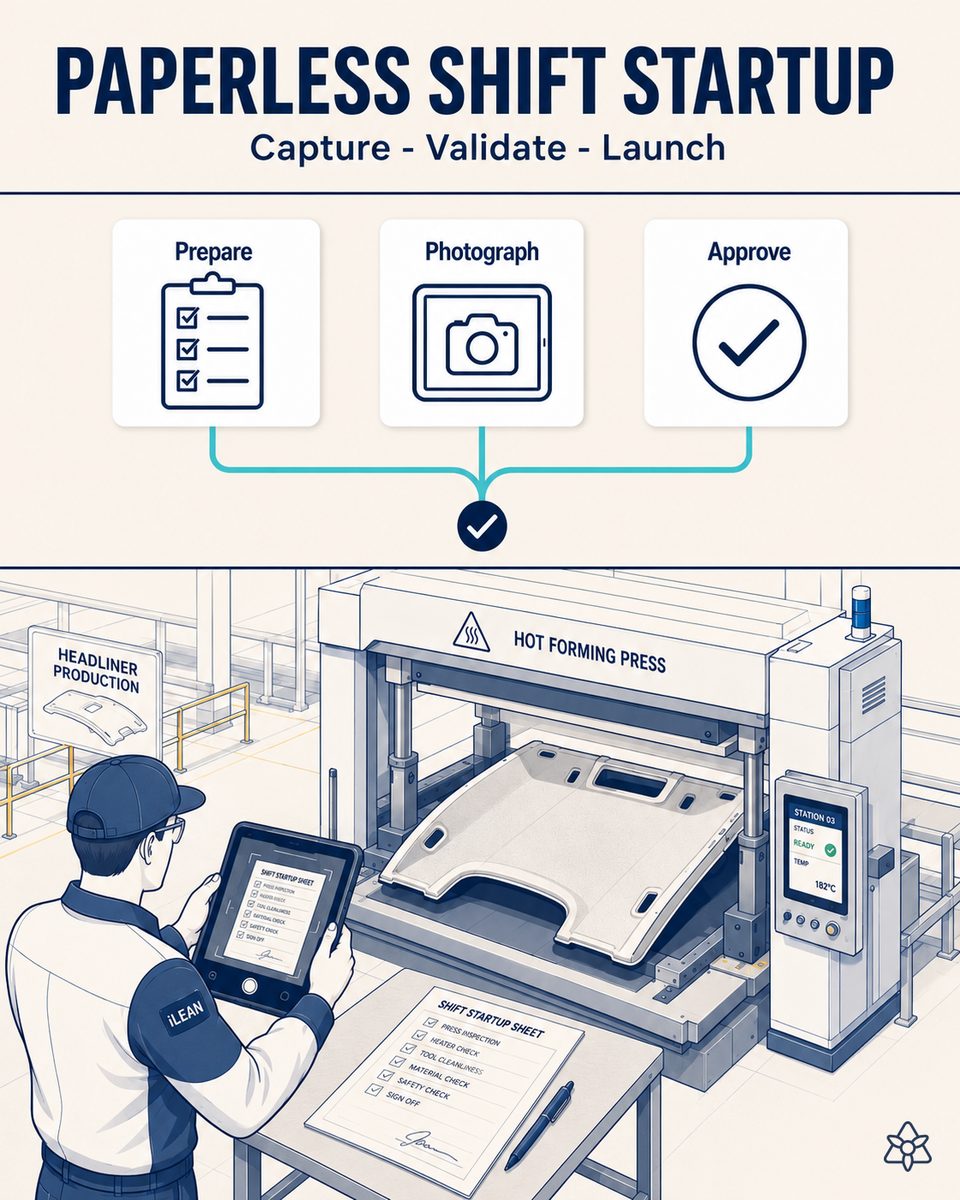
The sheet that defines the whole shift ends up in an office folder.
With around a hundred active variants, shift startup and intermediate changes generate several handwritten sheets a day per line: startup sheet, variant changeover checklist, first-part record required by the control plan. All of it travels to a folder in the office. The consequence is not administrative. When the customer opens a claim about a specific part three days later, the plant needs to prove which tooling and which parameters it was made with. If the paper is not digitized and linked to the order, there is no possible proof: the charge is accepted without being able to argue it technically. The classic attempt to fix it — asking the line lead to also key it into a terminal — always fails for the same reason: it competes with cycle time and with the attention the line demands at startup, the busiest moment of the shift.
- Startup sheet — which variant is coming in, which tooling has been fitted and what parameters the press starts with.
- Variant changeover checklist — the proof that what had to be checked was checked before releasing the line.
- First-part record — required by the control plan, and the evidence asked for months later in a claim.
Connect in photo-the-analog mode — the line lead's phone digitizes the paper without touching the line.
Connect in photo-the-analog mode.
Two photos at startup. Connect extracts variant, tooling, parameters and incidents, and links them to the active shift and order. The line lead keeps filling in the paper exactly as always.
- The line lead photographs the startup sheet and the variant changeover checklist with a phone or an industrial tablet. They keep filling them in by hand exactly as always.
- An anchored language model extracts the structured fields: variant, fitted tooling, press parameters, station operators, open incidents and first-part result.
- Connect links that record to the shift, the order and the variant active in the production system.
- The summary appears on the line tablet for human validation in two taps before crossing into the central system.
- From there, any query by shift, by variant or by tooling is instant.
Startup retyped after the fact vs. startup captured at second zero
| Aspect | Startup on a paper sheet | With iLEAN Connect |
|---|---|---|
| Data latency | 4-8 h, or never digitized | Second zero |
| Link to the order | None: the sheet goes to a folder | Anchored to shift, order and variant |
| Facing a claim | “I think we started with tooling B” | Queryable, signed record |
| Press parameters | Handwritten, uncorrelated | Linked to that shift's parts |
| Load on the line lead | Fill in the paper and also key it in | Fill in the paper and take a photo |
| Query by tooling or variant | Search the office folder | Instant |
From four to eight hours of latency — or never being digitized — to second zero. From "I think we started with tooling B" to a queryable, signed record. From a claim accepted for lack of evidence to a claim bounded with process data.
Impact estimate for your plant — to validate against your numbers.
The block below is an estimate to be validated against your plant's actual data. We put it forward so the committee has an order of magnitude; we refine it during the assessment.
- Plant with around a hundred active variants and several changes per shift and per line.
- Connect pilot on one line, with the phone or tablet the line lead already carries. No construction work and no downtime.
- Indicative payback between 4 and 9 months, depending on variant changes per shift.
- The hard lever is not the retyping time: it is being able to argue a claim technically instead of accepting the charge for lack of evidence.
Estimated payback 4 to 9 months depending on the number of variant changes per shift, combining recovered retyping time and the ability to defend a claim technically. *Estimate to validate*.
And the fair question from the production manager
“What if the model misreads a parameter on the handwritten sheet?” — hallucination is a problem of free generation, not of anchored tasks. Here the AI moves a specific data point from one medium to another, and in that kind of task the best models dropped below 1.5% error [1]. And nothing enters the system without the supervisor validating it on the line tablet.
[1] OpenAI paper "Why Language Models Hallucinate", 2025 — on the reliability of AI in anchored tasks.
What people ask about digitizing shift startup
Do we have to stop filling in the sheet by hand?
No, and that is deliberate. The sheet keeps being filled in exactly as always, in the same format and by the same person. The only thing added is a photo. The classic attempt to fix this — asking the line lead to also key it into a terminal — always fails for the same reason: it competes with cycle time and with the attention the line demands right at startup, the busiest moment of the shift.
What about sheets that differ between lines or plants?
They coexist without a problem. The model recognizes the structure of the document rather than relying on a fixed coordinate template, so there is no need to standardize forms before starting. Standardizing forms across lines or plants is a project in itself, and we do not want it to be the prerequisite for this one.
Does it help defend a customer claim?
That is its main value. When the customer opens a claim about a specific part three days later, the plant needs to prove which tooling and which parameters it was made with. If the paper is not digitized and linked to the order, there is no proof and the charge ends up accepted without any technical discussion. With the record anchored to the shift and the variant, that conversation changes in nature.
Do you touch the press or the production system?
The press is not touched at all: Connect photographs paper, not signals. With the production system there is a connection, but read-only: it checks which shift, order and variant are active in order to anchor the record. Nothing is written without prior human validation.
How long until it runs on a line?
A pilot on a single line starts in weeks, because there is no machine integration, no construction work and no downtime. What takes a little longer is tuning the extraction to your specific sheet formats, and that is done with the real sheets from the first few weeks.
More cases from this series
- The non-conformity does not come from a bad process, it comes from evidence with gapsEvery changeover, first part and validation leaves evidence on the spot. Agents organizes it by…
- In sequence you can stop the customer's line in two waysFour cross-checked verification rings — process, part, order and evidence — so that no rack leaves the…
- The lab measures in a spreadsheet the ERP cannot seeAdhesion, delamination and dimensional tests reach the ERP on their own after validation. Typical saving…
- The truck waits while somebody types twenty linesPhoto of the delivery note and batch labels: reference, quantity and supplier into the ERP after one…
- The most expensive press in the plant is also the most silentA camera and anchored OCR digitize the temperature and pressure curve of an isolated forming press,…
- EDI brings the schedule; email brings realityWhat changes the day does not arrive by EDI: it arrives by email. iLEAN reads it instantly,…
Tell us how many startup sheets go undigitized each week and we will send the estimated ROI within 48h.
We work on your plant's real data, not ours. Assessment with no commitment.
Request estimated ROI within 48h ‹ See all cases of automotive headliners See automotive