Model changeover, released with evidence
A windshield line changes model several times per shift. Each changeover involves the print screen, the bending mold, the PVB type (acoustic, shade band, head-up display) and bonded components: mirror bracket, rain sensor or camera bracket. If a single one does not match the model, the first parts, or the whole batch, come out wrong, and sometimes the error is not seen until the OEM. With iLEAN Edge, cameras at each critical point compare what is mounted with the model reference, and the line does not start until they all match and the quality lead signs off with evidence.
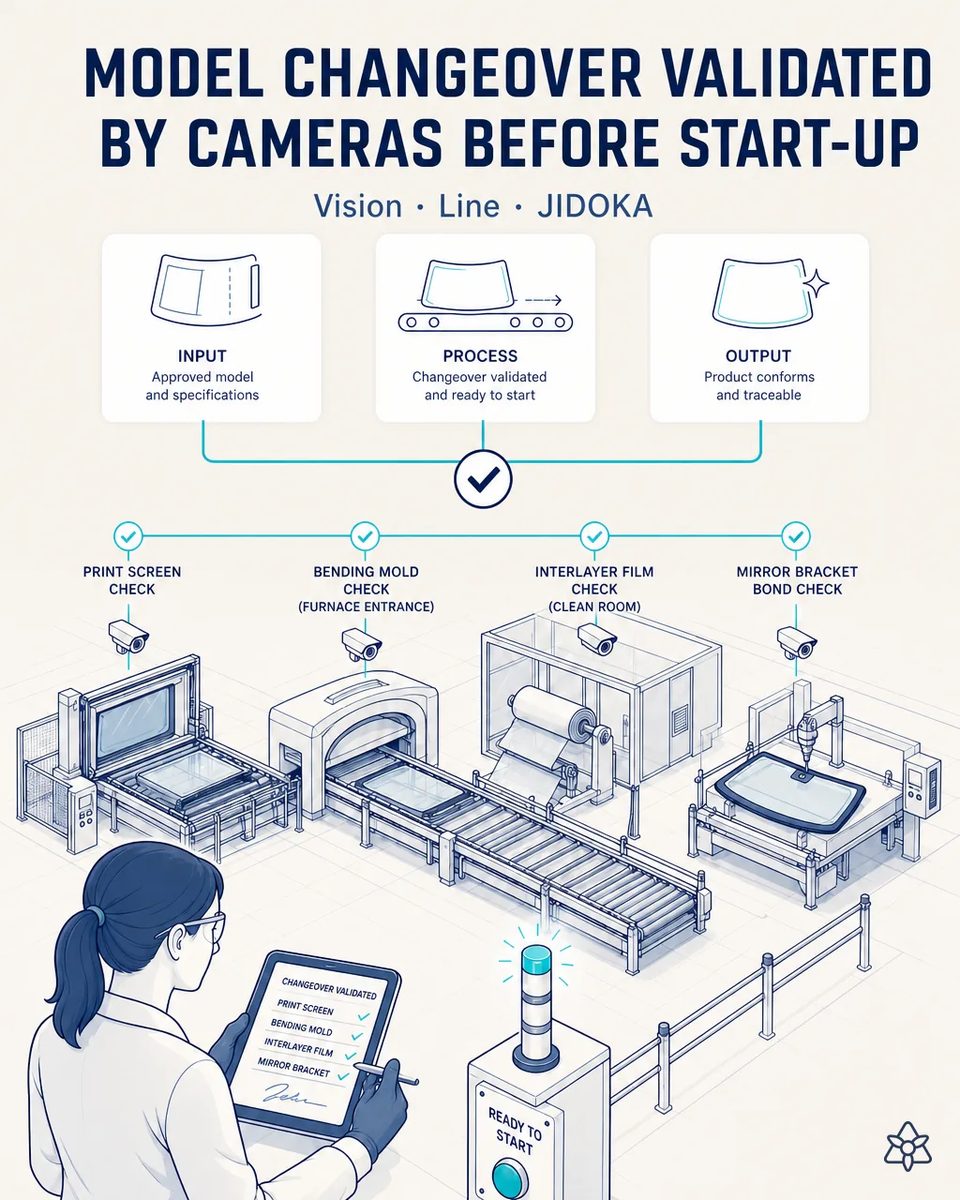
Windshield variants look alike, and the changeover is released on a signature.
Model changeover is released today with a checklist signed by one person. With variants that look more and more alike, the same windshield with or without a sensor, with acoustic or standard PVB, the risk of a mix-up grows, and the signature is given without objective evidence. Purchased components (brackets, sensors, moldings) add another layer: a box with the wrong part number at the bonding station produces windshields that are perfect in glass and wrong in configuration. It is the kind of defect an OEM dislikes most, because it stops their line.
- A windshield line changes model several times per shift, and each changeover involves the print screen, the bending mold, the PVB type and the bonded components. Four points, any of which can be wrong while the others are right.
- The same windshield exists with or without a rain sensor, with acoustic, shade band or head-up display PVB: variants that look more and more alike. The difference between two part numbers can be a single bracket or the tint of the PVB.
- The changeover is released with a checklist signed by one person, without objective evidence behind each box. Under time pressure, the box gets ticked because the line is waiting.
- A box with the wrong bracket part number at the bonding station produces windshields that are perfect in glass and wrong in configuration — the defect an OEM dislikes most, because it stops their line.
Edge with JIDOKA AI — the line gets start permission only when every point matches.
Edge with JIDOKA AI. Fixed cameras read the identification of the print screen and the mold, the type of PVB roll and the label of the components at the bonding station, and compare them with the reference of the model scheduled in the MES. On the first part they also verify the presence and position of each component. If anything does not match, the line does not receive start permission and the person in charge sees exactly which point fails. When everything matches, they sign on the tablet. Quality sets the criteria; the system applies them the same way on every shift.
Quality sets the criteria and the cameras apply them the same way on every shift. When something does not match, the person in charge sees exactly which point fails; when everything matches, they sign on the tablet. The decision stays human, but now it rests on evidence. And the same criteria apply at three in the morning as at ten. The signature still belongs to the quality lead, as IATF expects.
Windshield changeover on a checklist versus with camera evidence
| Aspect | Today | With iLEAN Edge |
|---|---|---|
| Print screen identification | Checked by eye | Read and matched to the model |
| Bending mold | A tick on the checklist | Verified at the furnace entrance |
| Acoustic or standard PVB roll | Easy to swap | Roll type checked in the clean room |
| Bracket or sensor at bonding | Box part number assumed | Label and position verified |
| Variant mix-up | Found at the OEM | Found before the first part |
| Changeover release | Signed without evidence | Signed on visual evidence |
From changeover release by signed checklist to release with visual evidence at each critical point. From variant mix-ups found at the customer to mix-ups found before the first part.
Impact estimate per model changeover — to be validated with your numbers.
The block below is an estimate to be validated against your plant's actual data. We put it forward so the committee has an order of magnitude; we refine it during the assessment.
- Estimated payback 6-12 months, depending on changeover frequency and mix-up history. A single configuration incident at the OEM can justify the whole case.
- Less start-up scrap from a screen, mold or PVB roll that did not match the model.
- Lower risk of a configuration incident at the OEM, the kind that stops their line. Those incidents weigh on the scorecard far more than ordinary scrap.
- And every changeover leaves its evidence, ready for the audit pack.
Estimated payback of 6 to 12 months depending on changeover frequency and mix-up history; less start-up scrap and lower risk of a configuration incident at the OEM. Estimate to be validated.
And the fair question from the production manager
"What if the cameras hold the line for nothing at every changeover?" — reading a screen identifier, a mold tag or a component label and matching it to the scheduled model is an anchored task, where the best models drop below 1.5% error [1]. The line is held on a verifiable mismatch against the MES reference, not on model doubt; when in doubt, the point is escalated to the person in charge. Every hold shows the reference image next to what the camera saw. The person in charge sees in seconds whether it is a real mix-up. A false hold is cleared with a reason, and that reason is stored.
[1] OpenAI paper "Why Language Models Hallucinate", 2025 — on the reliability of AI in anchored tasks.
What people ask about camera-verified windshield model changeovers
Which points does it verify at a windshield changeover?
Print screen, bending mold, PVB roll type and the labels of components at the bonding station. On the first part it also checks presence and position of each component. The list is defined with quality at commissioning, model by model.
Where does the model reference come from?
From the model scheduled in the MES. The cameras compare what is mounted with that reference, so a schedule change is picked up automatically. Nobody has to load references by hand at each changeover.
Does it catch an acoustic PVB roll swapped for a standard one?
Yes: the roll type is read in the clean room before lay-up. It is one of the mix-ups that looks fine in glass and is wrong in configuration. Head-up display and shade band rolls are checked the same way.
Can quality authorize a start-up despite a mismatch?
An exception can be signed and is recorded as such, with who decided and why. What cannot happen is a start-up with no trace. The exception appears later in the evidence pack, so it is never invisible.
Does it make changeovers slower?
The check takes seconds. Combined with SMED AI in the full system, the aim is that control does not cost productivity. Several changeovers per shift is precisely where evidence is most needed.
More cases from this series
- Always audit-readyiLEAN gathers and sorts by requirement the quality evidence for every windshield: IATF and customer…
- Zero escaped defects: from receiving to the shipping rackFour iLEAN verification rings, from receiving to shipment, so that no defective windshield reaches the…
- The autoclave is the same machine, but now it talksA camera reads the autoclave panel and links the pressure and temperature curve to each windshield load,…
- First-piece release, digital from second zeroHow a photo of the first-piece sheet puts the model release into the central system instantly in…
- Raw material receiving, traced with one photoA photo of the supplier's packing slip, labels and certificate: iLEAN records lot and expiry in the ERP…
- What the supervisor sees on the floor, recorded while walkingThe quality supervisor dictates findings by voice while walking the plant; iLEAN structures them and…
Tell us how many model changeovers your windshield line runs per shift.
We work on your plant's real data, not ours. Assessment with no commitment.
Request estimated ROI within 48h ‹ See all cases of automotive glass See automotive