The autoclave is the same machine, but now it talks
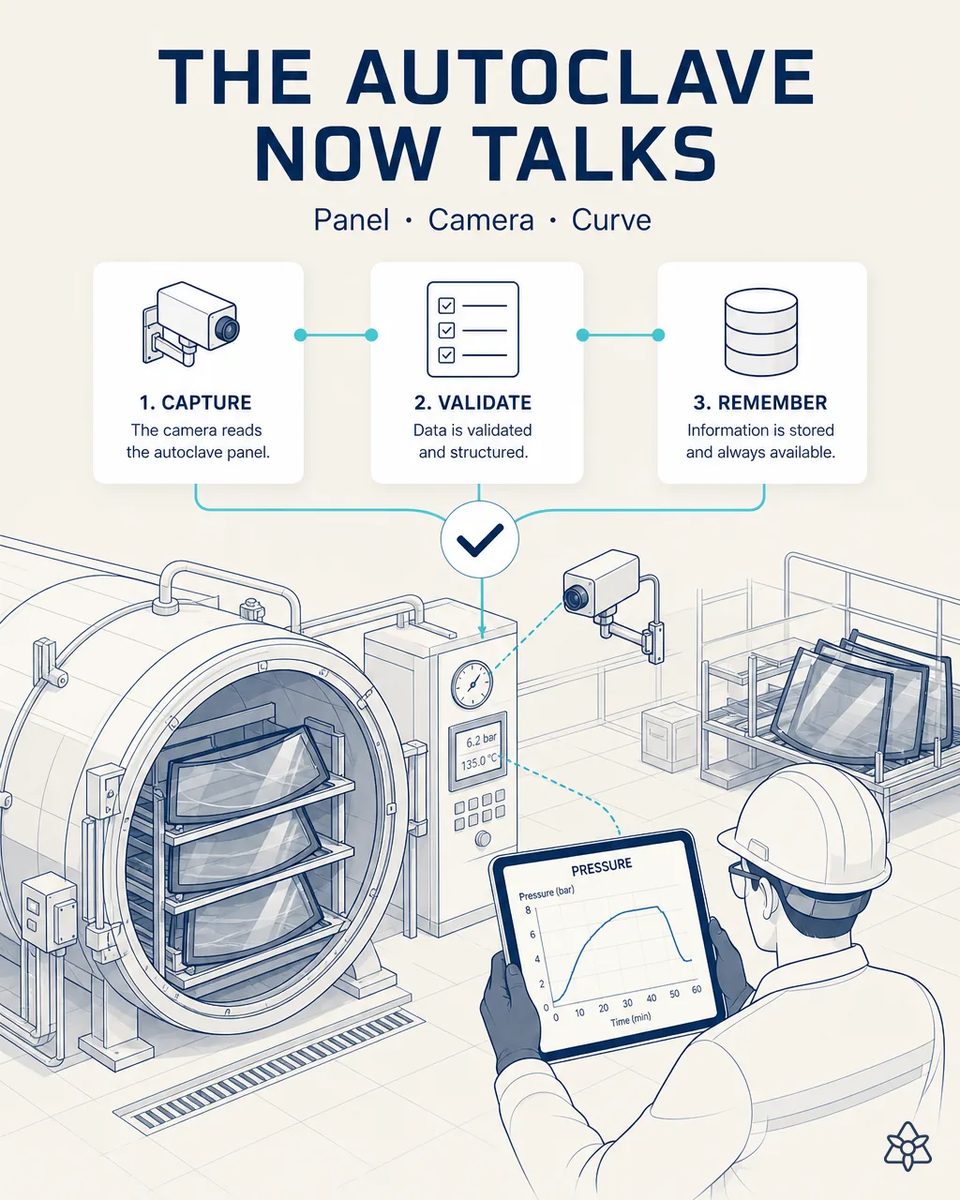
The autoclave is where a laminated windshield becomes final: pressure and temperature over a long cycle bond the PVB and remove residual air. In many plants it is a robust machine with years of service and a proprietary panel that sends no data to the network. Replacing the control means a shutdown nobody wants. With iLEAN Connect, an external camera pointed at the panel is enough: the autoclave stays as it is, but the real curve of every cycle is digitized and linked to the racks that were inside.
The real autoclave curve dies when the laminating cycle ends.
When a bubble or delamination shows up at final inspection, or weeks later at the OEM, the first question is always the same: what happened in the autoclave cycle for that load? The answer is usually a paper log or a screen that has already moved on. The real pressure and temperature curve dies when the cycle ends. Without that curve tied to each load, root cause analysis between process and raw material (was it the cycle, PVB moisture, de-airing?) remains a matter of opinion. For supplier quality this is especially uncomfortable: you cannot sustain a claim against the PVB supplier without first ruling out your own process with data.
- The autoclave is where the windshield becomes final: pressure and temperature over a long cycle bond the PVB and remove residual air. It is the step with the most added value already locked in.
- Many are robust machines with years of service and a proprietary panel that sends nothing to the network. Replacing the control means a shutdown nobody wants to schedule.
- When a bubble or delamination appears at final inspection, or weeks later at the OEM, the question is always which cycle that load went through — and the answer is a paper log or a screen that has moved on.
- Without the curve per load, the root cause between cycle, PVB moisture and de-airing stays a matter of opinion, and a claim against the PVB supplier cannot stand without first ruling out your own process.
Connect in photo mode on the autoclave panel — read from outside, untouched inside.
Connect in photo mode on a panel. A fixed industrial camera reads the autoclave screen every few seconds; OCR with an anchored LLM interprets pressure, temperature, phase and alarms, and builds the time curve of each cycle. iLEAN crosses it with the load (which racks, which models, which PVB lots went in) taken from the traveler or the MES. The autoclave control and its validation are untouched: the machine is still itself, but now it talks.
The autoclave keeps its control, its validation and its recipes. A camera reads the screen every few seconds and rebuilds the curve of each cycle, which is then crossed with the racks, models and PVB lots that went in. The machine is the same; the difference is that every cycle now leaves evidence. And that evidence is what supplier quality needs before opening a PVB claim it can actually win.
The silent autoclave versus the autoclave being read
| Aspect | Today | With iLEAN Connect |
|---|---|---|
| Pressure and temperature curve | Lost when the cycle ends | Full curve per load |
| Which racks were inside | Written on the traveler | Linked to the cycle automatically |
| Bubble or delamination root cause | Opinion between process and supplier | Cycle, defect and PVB lot correlated |
| Alarms during the cycle | Seen if somebody was in front | Recorded with phase and time |
| Claim against the PVB supplier | Weak without process data | Backed by the cycle record |
| Autoclave control replacement | In the capex plan | Avoided or deferred |
From a cycle with no usable record to a full curve per load, searchable by rack. From opinion-based root cause to cycle, bubble and PVB lot correlated in minutes.
Impact estimate per autoclave — to be validated with your numbers.
The block below is an estimate to be validated against your plant's actual data. We put it forward so the committee has an order of magnitude; we refine it during the assessment.
- Estimated payback 5-10 months.
- The investment of replacing the autoclave control is avoided or deferred, together with the shutdown it would require. That shutdown is usually what kept the project parked in the first place.
- Bubble and delamination scrap falls once cycle and defect can be correlated load by load.
- And the supplier quality conversation about PVB moves from opinion to a curve, a rack and a lot.
Estimated payback of 5 to 10 months; the investment of replacing the autoclave control is avoided or deferred, and bubble and delamination scrap falls once cycle and defect can be correlated. Estimate to be validated.
And the fair question from the production manager
"Can a camera on a screen give a curve I would show to the OEM?" — reading pressure, temperature and phase from a fixed panel with known positions and physical ranges is an anchored task, where the best models drop below 1.5% error [1]. And any reading outside the physically possible range for that cycle phase is discarded instead of plotted, so the curve never carries an invented point. Gaps are shown as gaps, which is exactly how an engineer wants to see them.
[1] OpenAI paper "Why Language Models Hallucinate", 2025 — on the reliability of AI in anchored tasks.
What people ask about reading the laminating autoclave panel
Does the autoclave control or its validation change?
No. Nothing is installed on the machine and no port is opened. The camera reads the panel from outside, so the recipes and the validated state of the autoclave are untouched. Maintenance and the machine builder do not have to sign anything new.
How does it know which windshields were in each cycle?
The load is taken from the rack traveler or the MES: which racks, which models and which PVB lots went in. The cycle curve is then attached to each of them. From then on, asking for the cycle of a windshield is asking for its rack.
Does it capture the alarms and the cycle phases?
Yes. Phase, alarms and their time are read along with pressure and temperature, so a hold or a deviation during de-airing remains visible after the cycle. It is often the hold nobody saw, at three in the morning, that explains a run of bubbles.
Can it help separate a PVB moisture problem from a cycle problem?
That is its main use: with the curve per load and the PVB lot, a bubble pattern can be checked against both before anyone points at the supplier. If the cycle was clean and the bubbles follow one PVB lot, the claim is supported; if not, the fix is at home.
Does it work if we have several autoclaves of different makes?
Yes. Each panel is learned once with its layout, and all curves end up in the same format, comparable between machines. That comparison alone often explains why one autoclave produces more delamination than its twin.
More cases from this series
- Always audit-readyiLEAN gathers and sorts by requirement the quality evidence for every windshield: IATF and customer…
- Zero escaped defects: from receiving to the shipping rackFour iLEAN verification rings, from receiving to shipment, so that no defective windshield reaches the…
- First-piece release, digital from second zeroHow a photo of the first-piece sheet puts the model release into the central system instantly in…
- Raw material receiving, traced with one photoA photo of the supplier's packing slip, labels and certificate: iLEAN records lot and expiry in the ERP…
- What the supervisor sees on the floor, recorded while walkingThe quality supervisor dictates findings by voice while walking the plant; iLEAN structures them and…
- Lab tests in the ERP, with no retypingiLEAN reads lab and incoming-inspection spreadsheets and, after human validation, posts them to the ERP.…
Tell us how you trace a bubble back to its autoclave cycle today.
We work on your plant's real data, not ours. Assessment with no commitment.
Request estimated ROI within 48h ‹ See all cases of automotive glass See automotive